Aluminium profiles sit at the heart of modern fabrication. From building facades and solar farms to industrial machinery and EV chassis, almost every advanced manufacturing line runs on extruded Aluminium somewhere. For procurement teams and fabrication shops, the challenge isn’t finding profiles. It’s finding the right alloy, the right tolerance, and the right supplier who can hold both consistently across a long project.
Here’s what experienced buyers look at before locking in an Aluminium profile order.
What Are Aluminium Profiles?
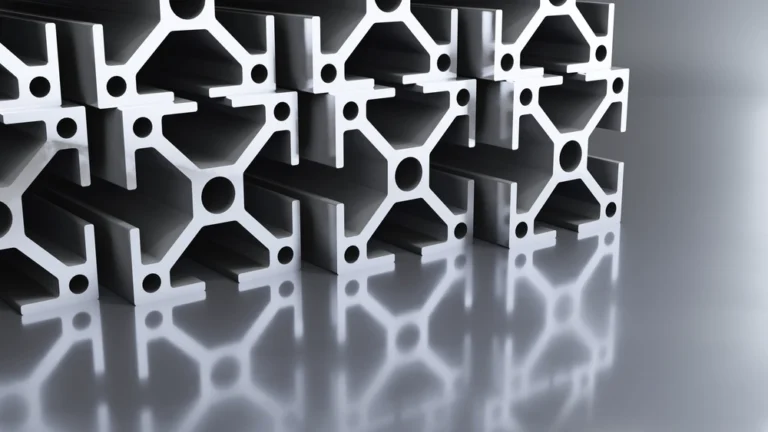
Aluminium profiles are extruded shapes produced by forcing a heated Aluminium billet through a precision die. The die determines the cross-section, and the result is a continuous length of metal with that exact shape running end to end. Standard profiles include angles, channels, T-slots, hollows, tubes, bars, and U sections, while custom profiles are engineered to a specific application.
Because the shape is formed in a single pass through the die rather than welded or assembled, extruded profiles hold tighter tolerances and stronger structural integrity than fabricated alternatives.
Why Aluminium Profiles Dominate Modern Fabrication
Three properties keep Aluminium profiles on every serious fabrication shop’s preferred list:
- Strength-to-weight ratio. Aluminium delivers structural performance at about a third of the weight of steel, lowering shipping cost, install labor, and dead load on the structure.
- Corrosion resistance. A self-healing oxide layer protects Aluminium in humid, marine, and chemical environments where carbon steel would rust without coatings.
- Design freedom. Extrusion lets engineers integrate features like screw bosses, locator slots, snap fits, and heat sink fins directly into a single profile, reducing part count and assembly time downstream.
Add full recyclability and stable long-term pricing, and the case for Aluminium profiles makes itself.
Common Aluminium Profile Categories
Most fabrication orders fall into a handful of profile families:
- Angles and channels for framing, trim, and edge work
- Tubes and hollows for structural runs, railings, and fluid lines
- Bars and flats for backing plates, bus bars, and machined components
- T-slot profiles for modular framing, jigs, and assembly lines
- Heat sink profiles for electronics, LEDs, and power systems
- Architectural profiles for windows, doors, curtain walls, and facades
- Custom profiles engineered to a specific drawing or application
Standard profiles cover most general work, but custom extrusions are where projects gain real efficiency, eliminating secondary machining and reducing assembly steps.
Choosing the Right Alloy and Temper
Most fabrication-grade Aluminium profiles fall into the 6000 series, with two grades doing the heavy lifting.
6063 is the architectural and decorative workhorse. It extrudes cleanly, finishes beautifully, and is the alloy of choice for window frames, curtain walls, and any profile that will be anodized or powder coated.
6061 is the structural pick, with higher mechanical strength and better load-bearing capacity. The right call for industrial framing, transport components, and engineered structural assemblies.
Tempers matter just as much. T5 delivers solid strength with excellent surface quality straight off the press. T6 offers maximum hardness and is the standard for engineered structural work where loads, vibration, or fatigue are in play.
What to Look for in an Aluminium Profile Supplier
Three factors separate a supplier that will protect your project from one that will quietly cost you money:
- Vertical integration. A manufacturer that controls billet, extrusion, and finishing in one facility holds tighter quality control than a broker who pulls from multiple sources.
- Tolerance consistency. Profiles that drift in width, wall thickness, or straightness across batches inflate scrap and slow assembly. Consistent dimensional output is the real test.
- Finishing capability. In-house anodizing and powder coating shorten lead times and eliminate the risk of finish damage during third-party transit.
Sourcing Aluminium Profiles for Your Fabrication Needs
Profile quality lives or dies on alloy purity, extrusion precision, and finishing control. The cleanest way to protect your project timelines and margins is to work with a manufacturer who owns the entire chain, from raw billet to finished, packed, and shipped profile.
Whether you need standard profiles or custom cross-sections designed for your specific fabrication requirements, Exalum Metal has the capacity and expertise to deliver.
Ready to place an order or discuss your requirements? Get in touch with the Exalum Metal team directly:
Email: [email protected] WhatsApp: +62 811 9429 970 Website: www.exalummetal.com
Your next fabrication project deserves material you can count on. Make Aluminium profiles from Exalum Metal your standard.