
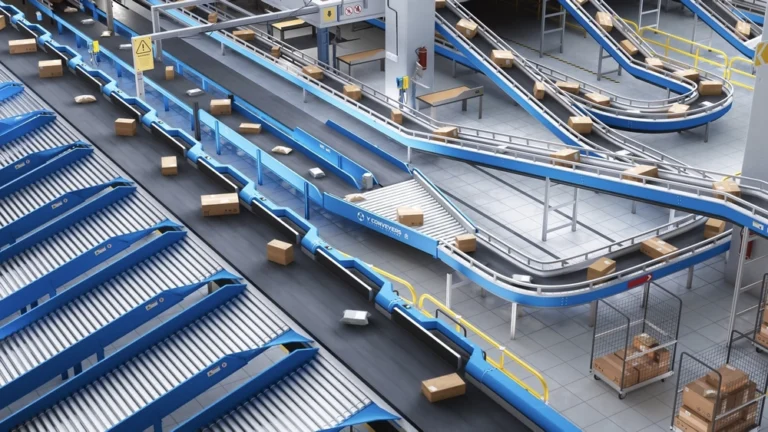
Conveyors are among the most common causes of serious workplace injuries in manufacturing. Pinch points, entanglement zones, and unexpected start-ups account for thousands of incidents annually across food processing, logistics, automotive, and packaging operations. The good news is that almost every one of these incidents is preventable. The combination of well-placed sensors, properly specified safety interlocks, and robust guarding enclosures keeps workers out of harm’s way while keeping production running.
For mechanical engineers, automation integrators, and procurement teams designing or upgrading conveyor systems, this article covers the sensor and safety interlock architecture that makes a conveyor compliant, productive, and protected from costly downtime.
Why Sensor and Safety Systems Are Non-Negotiable on Modern Conveyors
Three forces have made comprehensive sensor and safety system integration mandatory rather than optional:
- Regulatory compliance. Standards like ISO 13849-1, IEC 62061, ANSI B11.19, and OSHA 1910.212 require risk-assessed safeguarding on industrial machinery, with documented performance levels for safety-related controls.
- Insurance and liability. Workplace injury claims, equipment damage from collisions, and product losses from misaligned material flow all show up on the operations budget. Sensor-equipped systems reduce these costs measurably.
- Production efficiency. Beyond safety, sensors enable accumulation control, automated sortation, throughput monitoring, and predictive maintenance — all of which improve operational performance.
Skimping on the sensor and safety layer is a false economy. The cost of one serious incident or one regulatory shutdown dwarfs the cost of doing it right at the design stage.
Operational Insight: “Earn the Right to Automate”
In industrial automation, process stability precedes high-level machine control. Line stoppages often stem from poor physical discipline—such as unmonitored jams, belt slipping, or loose guard doors—rather than bad control code. Integrating robust sensors and interlocks converts physical line events into deterministic signals. This establishes the baseline process repeatability required before deploying advanced robotics or automated sorting algorithms.
The Main Sensor Types Used in Conveyor Systems
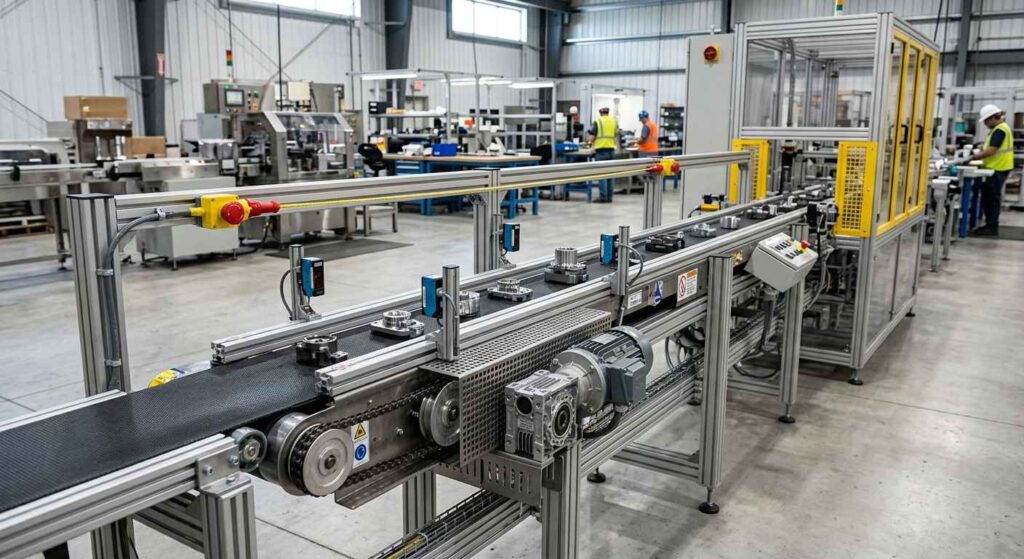
Conveyor systems use several sensor categories, each with a specific role:
Photoelectric sensors detect product presence using light beams (through-beam, retro-reflective, or diffuse). The most common sensor type in conveyor work, used for product counting, position detection, jam detection, and zone control.
Inductive proximity sensors detect ferrous and non-ferrous metal objects without physical contact. Used for metal product tracking, drive component position feedback, and detecting metal contamination.
Capacitive proximity sensors detect non-metallic materials including plastic, glass, liquid, and wood. Used in food, beverage, and packaging applications where the product isn’t metallic.
Ultrasonic sensors measure distance and detect objects using sound waves. Useful for detecting transparent, reflective, or irregularly shaped products that confuse optical sensors.
Encoders measure rotational position and speed on drive shafts and idler pulleys. Critical for synchronized multi-conveyor systems, accumulation control, and motion-based product tracking.
Load cells and weigh sensors measure product weight in motion, used for quality control, checkweighing, and bulk material flow measurement.
Temperature sensors monitor motor windings, gearbox oil, and bearing temperatures to enable predictive maintenance and prevent thermal damage.
Vibration sensors detect bearing wear, belt misalignment, and structural issues before they cause failures.
Safety Interlocks: How They Actually Work
A safety interlock is a system that automatically stops a conveyor when a guard is opened, an emergency stop is pressed, or a person enters a protected zone. The architecture varies depending on the application and the required safety integrity level.
Safety door switches monitor guard doors and access panels around conveyor drives and pinch points. When a door opens, the switch breaks the safety circuit, immediately stopping the conveyor. Mechanical, magnetic, and RFID-coded variants are available.
Safety light curtains project an array of infrared beams across an opening. When any beam is broken, the safety circuit stops the conveyor. Standard for protecting access points where physical guarding isn’t practical.
Safety mats and edges detect pressure from someone stepping on or against them, triggering an immediate stop. Used at floor-level conveyor exits and around overhead conveyor zones.
Emergency stop devices include push buttons, pull cords, and pull wires positioned along the conveyor for immediate operator-triggered shutdown. Pull cord systems are particularly common on long conveyor runs where reaching a push button isn’t practical.
Safety PLCs and safety relays are the controllers that monitor all safety inputs and execute the stop logic. They must meet the safety performance level required by the risk assessment, typically PLd or PLe under ISO 13849-1.
Lockout/tagout (LOTO) provisions ensure that conveyors can be physically isolated for maintenance, preventing unexpected start-up while workers are inside the system.
Technical Specifications for Industrial Safety Interlocks
When selecting hardware for high-risk access doors or heavy machine enclosures, physical interlocks must meet strict mechanical load thresholds:
High Retaining & Locking Forces: Interlocks specified for heavy conveyor doors feature solenoid-locking forces ranging from 2000 N (e.g., compact ZM series) up to 2500 N (e.g., heavy-duty ZS/ZD series) to keep guard doors securely locked until dangerous machine movement stops completely.
Ingress Protection (IP67): Heavy-duty interlocks utilize die-cast aluminium heads rated to IP67, making them resistant to heavy dust, washdown environments, and abrasive industrial conditions.
Flexible Actuator Alignment: To fit tight conveyor profiles, actuator heads rotate in 90° increments and accommodate straight, angled, or hinged actuators (with optional rubber bushings or insertion funnels) for smooth alignment on hinged or sliding doors.
Electrical Modes: Units support both closed-circuit and open-circuit operating current principles to integrate with standard safety relays or safety PLCs.
Where Sensors and Interlocks Are Placed on a Conveyor
A comprehensive safety design covers multiple zones:
- Drive zones around motors, gearboxes, and drive pulleys where rotating components create entanglement hazards
- Transfer points where products move between conveyors or onto downstream equipment
- Pinch points at idler pulleys, belt returns, and chain return runs
- Operator interface points at loading, unloading, and inspection stations
- Access doors and removable guards on enclosures around safety hazards
- Emergency stop reach zones along the full length of the conveyor with no more than 75 metres between devices
The risk assessment should drive the placement, not the catalog. Generic safety packages rarely cover every hazard on a specific layout.
How Conveyor Sensors and Safety Systems Integrate with the Frame
Sensors and safety devices don’t float in space. They’re mounted to the conveyor frame, sit inside guarding enclosures, and run their cabling through structural members. The frame design directly determines how well the safety system performs in real operation.
Three frame-related factors influence safety system reliability:
Sensor mounting stability. Sensors mounted to a frame that flexes, twists, or vibrates produce false triggers and missed detections. A dimensionally stable aluminum frame keeps sensors aligned and reliable over years of operation.
Guard enclosure integration. Safety guards, access doors, and electrical enclosures are built from extruded profiles attached directly to the main frame. The frame and the guarding need to be dimensionally compatible, with consistent slot patterns and bolt spacing.
Cable management and conduit routing. Sensor cables, safety bus wiring, and pneumatic lines need protected pathways along the frame. Frames built from extruded profiles with integrated channels handle this far more cleanly than welded steel structures.
Dual T-Slot Advantage for Dense Automation
On high-density automation lines, space on the rail face is limited. Dual T-slot profiles carry two parallel slots on their wider faces. This layout allows a guard panel or interlock switch to be mounted alongside a parallel row of proximity sensors and cable conduits on the exact same rail, doubling fixing density without altering the frame geometry.
The Aluminum Profiles That Build the Safety Framework
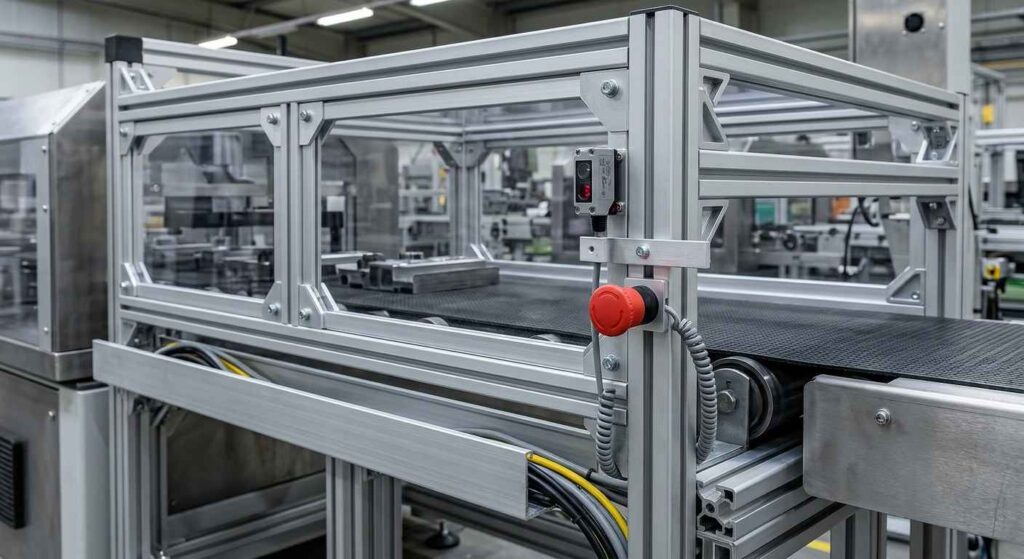
The structural and safety framework of a modern conveyor is built almost entirely from extruded aluminum profiles, each playing a role in housing, protecting, and integrating the sensor and safety system:
Partition profiles form the framework for safety guarding around drive zones, pinch points, and machine perimeters. They mount panels of polycarbonate, mesh, or sheet metal to create the physical barrier that interlocks monitor.
Louvers integrate ventilation into electrical enclosures and motor compartments, dissipating heat from drives and sensors while maintaining the protective barrier required by guarding standards.
Square Hollow and Rectangular Hollow profiles form the primary conveyor chassis, providing the dimensional stability that keeps sensors aligned and guards mounted square. Frame flex translates directly into sensor failures.
Equal Angle and Unequal Angle sections create cross-bracing and mounting brackets for sensors, safety devices, and emergency stop stations along the conveyor length.
Unequal Channel profiles function as cable trays, sensor mounting rails, and side-guide reinforcement, creating organized pathways for sensor wiring and safety bus cabling.
Flat Bars serve as precision mounting plates for safety door switches, photoelectric sensor brackets, and emergency stop pull cord anchors.
Heat Sinks integrate into drive controller and safety PLC enclosures, managing the heat generated by variable frequency drives, sensor power supplies, and safety controllers operating continuously.
Diffusers and Doors complete the architectural integration where conveyors interact with facility infrastructure, ensuring guarding extends seamlessly from conveyor frames into surrounding building elements.
The advantage of sourcing all these profiles from one extruder is dimensional compatibility. Sensor brackets, guard panels, and access doors all need to fit together with bolt patterns that align, slot dimensions that match, and surface finishes that survive the same washdown or industrial conditions.
Verified Product Data: Exalum Conveyor Profile Range
For direct engineering layout and procurement planning, Exalum Metal manufactures standard single and double (dual-slot) conveyor extrusions:
Single Conveyor Profiles:
Profile 70330: Wall Thickness T = 1.20 mm, Linear Weight W = 0.647 kg/m
Profile 70440: Wall Thickness T = 1.35 mm, Linear Weight W = 1.184 kg/m
Profile 70010: Wall Thickness T = 2.15 mm, Linear Weight W = 1.589 kg/m
Double Conveyor Profiles (Dual T-Slot):
Profile 70360: Wall Thickness T = 1.20 mm, Linear Weight W = 1.095 kg/m
Profile 70480: Wall Thickness T = 1.35 mm, Linear Weight W = 2.014 kg/m
Profile 70015: Wall Thickness T = 2.50 mm, Linear Weight W = 1.764 kg/m
Alloy Selection Guidelines
Alloy 6061 (High Strength): High yield strength for heavily loaded conveyor bases, structural chassis spans, and robotic bases subject to heavy dynamic vibration.
Alloy 6063 (Medium Strength / Excellent Finish): Excellent surface quality and anodizing finish, standard for T-slot framing, guard enclosures, partition profiles, and lightweight side guides.
Sourcing Aluminum Profiles for Your Conveyor Safety System
For conveyor manufacturers, safety system integrators, and automation engineers building sensor-equipped conveyor systems, the aluminum supplier upstream determines how cleanly the entire safety architecture comes together. Profiles that vary in dimension or finish across batches force the integration team to fight the hardware, instead of focusing on the actual sensor and control programming.
The cleanest protection is a manufacturer who controls billet quality, extrusion precision, and finishing in one facility. Exalum Metal Indo operates a 20,000 m² vertically integrated facility producing the complete profile range required for conveyor frames, guards, and safety enclosures, from Square Hollow chassis members through to Partition, Louvers, and Heat Sinks for the safety and control framework, with in-house anodizing and powder coating to finish every component to specification.
Whether you need standard profiles or custom cross-sections designed for your specific fabrication requirements, Exalum Metal has the capacity and expertise to deliver.
Ready to place an order or discuss your requirements? Get in touch with the Exalum Metal team directly by clicking the “Contact Us” button below.