
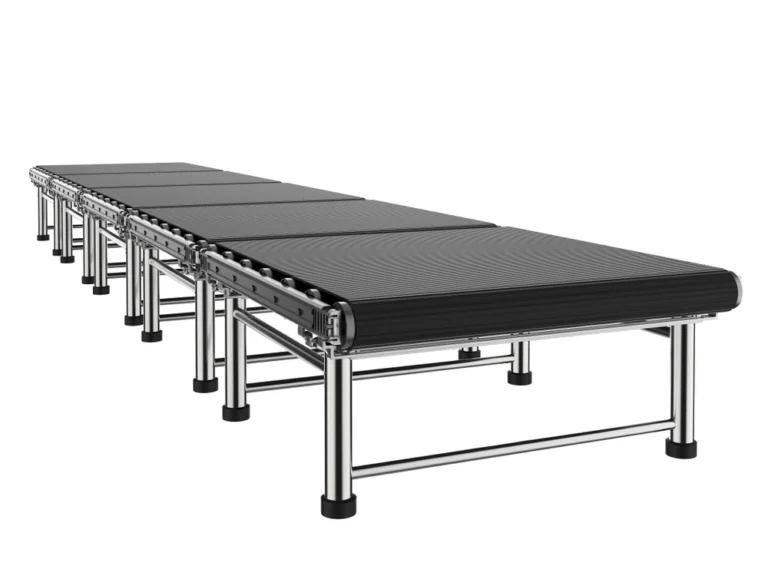
Few pieces of industrial equipment carry as much economic weight as the humble conveyor belt. Every packaged item on a supermarket shelf, every parcel from an e-commerce warehouse, and most of the food and beverages consumed globally have moved across a conveyor belt at some point in their journey. For manufacturers, fabricators, and production engineers, choosing the right belt and the right frame to support it determines whether a production line runs profitably for two years or twenty.
This article covers what a conveyor belt is, the major belt materials and types in industrial use, how to match a belt to its application, and why the aluminum frame underneath the belt matters as much as the belt itself.
What Is a Conveyor Belt?
A conveyor belt is a continuous loop of flexible material that runs between two or more pulleys, carrying products or bulk material from one point to another. The belt is driven by a motorized pulley that creates tension and friction, pulling the loop around its path while the carrying side supports the load.
A complete belt conveyor system consists of the belt itself, the frame that supports the belt, drive and idler pulleys, motor and gearbox, side guides, support rollers, tensioning mechanisms, and safety guards. Each component contributes to performance, but the belt is the wear part that defines what the conveyor can do.
How a Conveyor Belt Works
The belt loops around two pulleys spaced apart at the required conveyor length. One pulley is powered by a motor and acts as the drive pulley. The other acts as the idler or tension pulley. As the drive pulley rotates, friction between the pulley surface and the belt pulls the belt around the loop.
Tension is maintained by either gravity take-up systems, screw take-up adjusters, or pneumatic tensioners. Support rollers or a flat sliding bed underneath the carrying side prevent the belt from sagging under load. Side guides or skirt plates keep products on track and prevent belt drift.
The simplicity of the mechanism is what makes belt conveyors so reliable. With proper material selection and maintenance, a conveyor belt system runs for years with minimal intervention.
Conveyor Belt Materials and What They’re Used For
Belt material choice drives almost every performance characteristic of the system. The major categories used in industrial conveyor work include:
- PVC (polyvinyl chloride) belts are the most common general-purpose belt material. Cost-effective, durable, and available in a wide range of surface finishes and thicknesses. Used in packaging, light manufacturing, and general material handling.
- Polyurethane (PU) belts are the food-grade standard. Highly resistant to oils, fats, and washdown chemicals, with smooth surfaces that don’t trap food particles. The default choice for food, beverage, and pharmaceutical lines.
- Rubber belts carry heavy loads and abrasive materials. Used in mining, aggregate handling, cement production, and bulk material conveying.
- Silicone belts tolerate high temperatures and chemical exposure. Common in baking, food processing, and rubber molding lines.
- Modular plastic belts are made of interlocking plastic modules linked by rods. They allow for direct washdown, curve conveying, and easy replacement of damaged sections. The growing standard for hygiene-sensitive industries.
- Steel mesh belts carry heavy or hot loads where polymer belts would fail. Used in baking, heat treatment, and freezing applications.
- Fabric-reinforced belts combine textile carcasses with rubber or PVC covers for high tensile strength applications.
The right material is the one matched to the product being moved, the temperature range, washdown frequency, and load profile. Specifying a cheaper belt that fails in 18 months costs more than specifying the right belt that lasts a decade.
Types of Conveyor Belt Systems
Beyond material, conveyor belt systems differ by configuration:
- Flat belt conveyors are the standard horizontal layout for moving packaged goods, cartons, and unit loads.
- Inclined belt conveyors transport products up or down grades, typically using cleated or rough-top belts to prevent sliding.
- Curved belt conveyors turn around horizontal corners, allowing layout flexibility without manual transfers between straight runs.
- Modular belt conveyors use plastic module belts for hygiene, washability, and easy maintenance.
- Sanitary belt conveyors are designed for food, pharma, and clean rooms with stainless or aluminum frames, washdown-rated motors, and food-grade belts.
- Cleated belts have molded ridges across the belt surface to carry loose product up steep inclines.
- Magnetic belt conveyors combine belt motion with embedded magnets to control ferrous parts in stamping and machining operations.
Industries That Run on Conveyor Belts
The applications span almost every manufacturing and logistics vertical:
- Food and beverage packaging, processing, baking, and bottling lines
- Pharmaceutical filling, capping, and packaging operations
- E-commerce and warehousing for parcel sortation and order fulfillment
- Automotive assembly and parts handling
- Mining and aggregate for bulk material movement
- Cement, sand, and gravel processing
- Recycling and waste sorting facilities
- Airport baggage handling systems
- Agriculture for harvest sorting, grading, and packing
- Plastic and rubber manufacturing
- Cosmetics and personal care production
Each industry has its own combination of belt material, frame specification, and accessory requirements. Matching all three correctly at the design stage is what separates a system that runs reliably from one that fights its operators every shift.
How to Choose the Right Conveyor Belt
The selection process comes down to five questions:
- What is the product? Size, weight, shape, fragility, and surface texture all affect belt choice.
- What is the operating environment? Temperature range, washdown frequency, chemical exposure, and hygiene requirements.
- What is the throughput? Line speed and load per meter determine belt strength and width.
- What is the layout? Straight, curved, inclined, or elevation change? Each requires different belt characteristics.
- What is the service expectation? Continuous operation, multiple shifts, and uptime targets affect material durability requirements.
Working through these questions with a qualified integrator or material supplier prevents the expensive mismatches that show up six months into operation.
Why the Frame Underneath the Belt Matters Just as Much
A conveyor belt is only as good as the frame supporting it. A poorly built frame causes belt tracking problems, premature wear, alignment failures, and the kind of recurring downtime that quietly destroys production schedules.
The frame controls three critical performance factors: belt straightness over distance, pulley alignment, and support flatness under load. Any deviation in these areas accelerates belt wear and creates tracking issues that no amount of belt quality can compensate for.
Modern conveyor belt frames are built almost universally from aluminum profiles, for the same reasons that aluminum has displaced steel across automation generally:
- Lightweight for easier installation and lower freight cost
- Corrosion-resistant for washdown and humid environments
- Modular for assembly without welding and reconfiguration as needs change
- Clean finish that meets hygiene requirements out of the box
The Aluminum Profiles That Frame Belt Conveyors
A complete belt conveyor frame is built from a coordinated set of extruded aluminum profiles, each handling a specific role:
- Square Hollow and Rectangular Hollow profiles form the main longitudinal frame members, providing the torsional rigidity needed to keep the belt running straight across the full conveyor length.
- Equal Angle and Unequal Angle sections create cross-bracing, motor mount platforms, and the structural supports that carry drive pulleys and idlers.
- Unequal Channel profiles handle side-guide mounting, edge reinforcement, and accessory rails along the belt run.
- Flat Bars function as precision shim plates, mounting brackets, and adjustment plates for pulley alignment.
- Round Bars are machined into shaft stock for drive pulleys, idler pulleys, and support roller assemblies.
- Heat Sinks integrate into motor and drive controller enclosures, dissipating heat from variable frequency drives and PLC components.
- Partition and Louvers form the framework for safety guarding and ventilated electrical enclosures around the drive end.
Sourcing all these profiles from a single extruder gives the consistency that conveyor manufacturers need: profiles that hold tight dimensional tolerance across batches, allowing frames to assemble cleanly with minimal field adjustment.
Sourcing Aluminum Profiles for Your Conveyor Belt Manufacturing
For conveyor manufacturers, system integrators, and fabricators building belt conveyor systems, the upstream aluminum supplier sets the ceiling on your build quality. Profiles that vary in alloy temper, wall thickness, or straightness quietly destroy assembly efficiency, regardless of how well the conveyor is designed on paper.
The cleanest protection is a manufacturer who controls billet quality, extrusion precision, and finishing in one facility. Exalum Metal Indo operates a 20,000 m² vertically integrated facility producing the complete profile range required for belt conveyor frames, from Square Hollow chassis members through to Heat Sinks for drive electronics, with in-house anodizing and powder coating to finish every component to specification.
Whether you need standard profiles or custom cross-sections designed for your specific fabrication requirements, Exalum Metal has the capacity and expertise to deliver.
Ready to place an order or discuss your requirements? Get in touch with the Exalum Metal team directly:
Email: [email protected] WhatsApp: +62 811 9429 970 Website: www.exalummetal.com
Your next fabrication project deserves material you can count on. Make aluminum profiles from Exalum Metal your standard.