
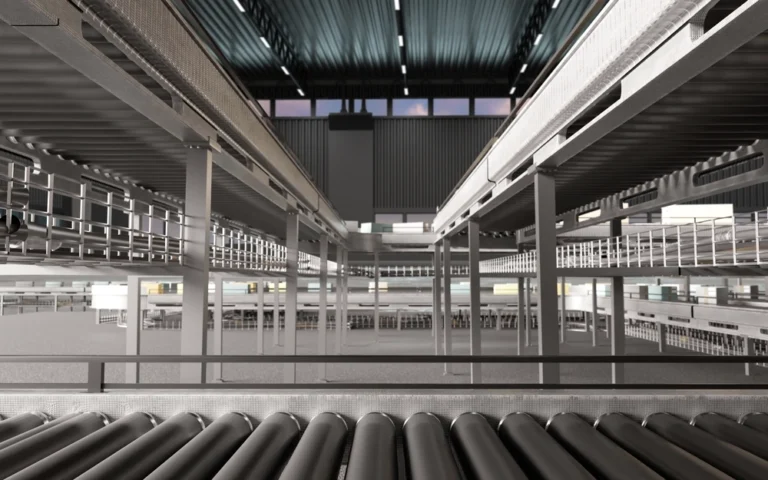
If you’ve ever watched a warehouse loading dock, a parcel sortation center, or an airport baggage system in operation, you’ve watched roller conveyors do the kind of work that would otherwise need a small army of material handlers. They’re the workhorse of logistics, packaging, and assembly operations precisely because they’re simple: a frame, a set of rollers, and gravity or a motor doing the rest.
For operations managers, fabricators, and procurement teams, the challenge isn’t understanding what a roller conveyor is. It’s choosing the right type, sizing the rollers correctly, and partnering with a frame supplier who delivers consistent dimensional quality. This article walks through all three.
What Is a Roller Conveyor?
A roller conveyor is a material handling system that uses a series of parallel rollers mounted between two side frames to move flat-bottomed items along a defined path. Unlike a belt conveyor where the carrying surface moves with the product, the rollers themselves stay in fixed positions and rotate on their axes, allowing items to roll across them.
The simplicity is the point. With no belt to wear out, fewer drive components, and minimal maintenance requirements, a properly built roller conveyor runs reliably for decades. It’s also the easiest conveyor type to manually load, unload, and divert, which is why it dominates warehousing and distribution operations.
How Roller Conveyors Work
The mechanism depends on the conveyor type. There are two fundamental categories:
Gravity roller conveyors use the natural downward slope of the conveyor (typically 3 to 7 degrees) to move products by gravity alone. Items placed at the high end roll under their own weight toward the low end. No motor, no electricity, no controls. Ideal for areas where products move briefly between workstations or onto loading docks.
Powered roller conveyors drive the rollers using motors, chains, belts, or line shafts. The rollers actively push products along, allowing horizontal transport, controlled speed, and zone-by-zone accumulation. The standard for high-throughput operations where gravity flow isn’t practical.
Both types share the same structural foundation: a rigid frame, precision-aligned rollers, and end-mounted axles or bearings. The frame is what controls roller alignment over distance, which directly determines how reliably the conveyor performs.
Types of Roller Conveyors
Within the gravity and powered categories, several configurations cover the major applications:
- Gravity roller conveyors are the simplest setup, used for short transfers, loading docks, and pick-pack stations.
- Skate wheel conveyors use small rotating wheels instead of full-width rollers. Lighter, cheaper, and suited to small or light items, but with lower load capacity than rollers.
- Line shaft driven roller conveyors use a single rotating shaft under the rollers, with O-ring belts connecting the shaft to each roller. Quiet, reliable, and cost-effective for medium-duty operations.
- Chain-driven live roller (CDLR) conveyors drive each roller with a chain looped around sprockets on the roller ends. Heavy-duty, suited to high-load applications like pallet handling and automotive parts.
- Belt-driven live roller conveyors use a flat belt running underneath the rollers, pressing against the roller bottoms to drive them. Cleaner and quieter than chain-driven systems.
- Zero-pressure accumulation conveyors use sensors and zoned control to allow products to accumulate without touching each other, preventing crushing damage on packaged goods.
- Powered curve conveyors turn around horizontal corners using tapered rollers that match the curve radius, allowing flexible layout designs.
- Pallet handling conveyors are heavy-duty roller systems with reinforced frames and large-diameter rollers designed for moving loaded pallets.
Roller Conveyor Sizing and Specification
Three primary variables drive roller conveyor specification:
Roller diameter determines load capacity and product size compatibility. Common diameters range from 38mm for light parcels, 50mm for medium loads, 60mm to 76mm for heavy cartons, and 89mm or larger for pallets and industrial loads. Larger rollers carry more load but require larger products to bridge across them properly.
Roller pitch (spacing between roller centers) must be close enough that at least three rollers support the product at any time. A general rule is pitch no greater than one-third of the shortest product dimension.
Frame width is sized to product width plus clearance, typically the widest product plus 50mm to 100mm on each side for guides and tolerance.
Roller material is matched to load and environment: steel rollers for heavy industrial loads, aluminum rollers for medium loads and lower weight requirements, stainless steel for food and washdown applications, and PVC or polymer rollers for light loads and quiet operation.
Get the sizing right at the design stage and the system performs reliably for decades. Get it wrong and you spend years field-modifying around the original mistakes.
Industries That Run on Roller Conveyors
Roller conveyors dominate operations where products have rigid, flat bottoms and need to move continuously through a facility:
- E-commerce and warehouse fulfillment for parcel and tote handling
- Manufacturing assembly for work-in-progress movement between stations
- Packaging operations for carton handling on filling and sealing lines
- Airport baggage handling for check-in, sorting, and reclaim
- Parcel delivery and courier hubs for sortation and loading
- Automotive manufacturing for parts and sub-assembly movement
- Pharmaceutical and cosmetics for tote and crate handling
- Food and beverage distribution for case and tray transport
- Cold storage operations for pallet and tote movement
- Document and mail handling systems
Each industry has its own combination of load capacity, hygiene requirement, and throughput target. The conveyor specification should follow from the operation, not the other way around.
Why Aluminum Has Become the Standard for Roller Conveyor Frames
The frame underneath a roller conveyor handles three critical jobs: holding rollers in precise parallel alignment, supporting the load transferred from rollers to the floor, and resisting deflection over long spans. A poorly built frame causes roller misalignment, which leads to products tracking off-center, accelerated bearing wear, and the kind of recurring maintenance that quietly destroys uptime.
Aluminum has displaced welded steel as the frame material of choice for most roller conveyor applications:
- Lightweight at roughly one-third the weight of steel, lowering shipping costs and simplifying installation
- Corrosion-resistant for food, beverage, cold storage, and washdown environments where steel rusts
- Modular for clean assembly without welding, plus easy reconfiguration as operations change
- Clean finishing with anodizing and powder coating that meets hygiene requirements out of the box
- Dimensional stability that holds roller alignment over decades, unlike welded steel frames that develop heat-affected zone distortion
For all but the heaviest industrial pallet handling, aluminum has become the default specification.
The Aluminum Profiles That Build Roller Conveyor Frames
A complete roller conveyor frame is assembled from a coordinated set of extruded aluminum profiles, each handling a specific structural role:
Square Hollow and Rectangular Hollow profiles form the side frames that carry the rollers and resist bending across long spans. The dimensional stability of these profiles directly determines how well roller alignment holds across the conveyor length.
Equal Angle and Unequal Angle sections create cross-members, leg connections, motor mount platforms, and side-guide brackets. Angles handle most of the right-angle structural work on the conveyor.
Unequal Channel profiles function as roller mounting tracks, side-guide rails, and edge reinforcement where standard hollow sections don’t fit the geometry.
Tubing Pipes serve as vertical legs and structural support columns, providing the height adjustment and load transfer between conveyor and floor.
Flat Bars are used as precision shims, mounting plates, and adjustment plates for fine-tuning roller alignment during commissioning.
Round Bars are machined into roller shafts and idler axles where standard catalog rollers don’t fit the spec, particularly for custom-width or extra-heavy load applications.
Heat Sinks integrate into the motor and drive controller enclosures on powered roller conveyors, dissipating heat from variable frequency drives and PLC components.
Partition and Louvers form the framework for safety guarding around drive ends, motor enclosures, and pinch-point hazards required by workplace safety regulations.
Sourcing all these profiles from a single extruder is what makes the difference between a frame that goes together cleanly and one that fights the assembly crew. Tight dimensional tolerance across batches means roller alignment falls into place during assembly rather than requiring field adjustment on every section.
Sourcing Aluminum Profiles for Your Roller Conveyor Manufacturing
For roller conveyor manufacturers, integrators, and fabricators, the upstream aluminum supplier sets the ceiling on build quality. Profiles that drift in alloy temper, wall thickness, or straightness across deliveries quietly destroy assembly efficiency and roller alignment, regardless of how well the conveyor is designed.
The cleanest protection is a manufacturer who controls billet quality, extrusion precision, and finishing in one facility. Exalum Metal Indo operates a 20,000 m² vertically integrated facility producing the complete profile range required for roller conveyor frames, from Square Hollow side frames through to Round Bars for custom roller shafts, with in-house anodizing and powder coating to finish every component to specification.
Whether you need standard profiles or custom cross-sections designed for your specific fabrication requirements, Exalum Metal has the capacity and expertise to deliver. Ready to place an order or discuss your requirements? Get in touch with the Exalum Metal team directly:
Email: [email protected] WhatsApp: +62 811 9429 970 Website: www.exalummetal.com
Your next fabrication project deserves material you can count on. Make aluminum profiles from Exalum Metal your standard.