
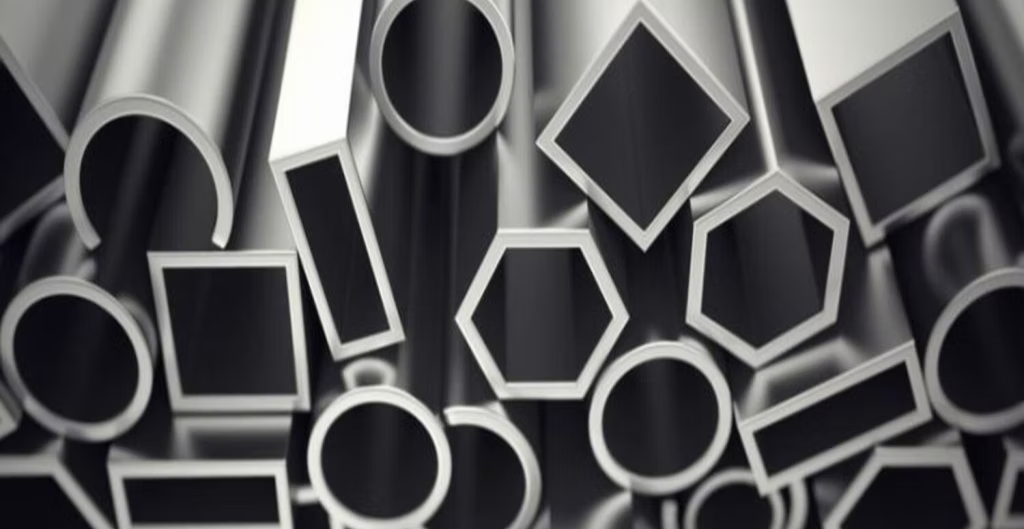
Welcome to the world of aluminium bars, a versatile and essential material used in numerous applications across various industries. From aerospace and construction to automotive and electronics, aluminium bars play a pivotal role in modern manufacturing.
Aluminium bars are solid, rectangular pieces of aluminium metal, prized for their strength, lightweight nature, and impressive corrosion resistance. These bars are produced through a precisely controlled manufacturing process to ensure consistent quality and performance. With their numerous advantages, aluminium bars are indispensable in a wide range of industries.
Aluminium bars possess a unique combination of properties that make them stand out from other materials. These properties include:
Aluminium bars are renowned for their exceptional strength-to-weight ratio, making them ideal for applications where weight reduction is crucial without compromising structural integrity.
A key benefit of aluminium bars is their resistance to corrosion, ensuring durability and longevity even in harsh environments.
As a recyclable material, aluminium bars promote sustainability and eco-friendliness, aligning with the growing demand for environmentally conscious solutions.
Aluminium is an excellent conductor of electricity and heat, making it invaluable in electrical and thermal applications.
Aluminium bars can be easily formed into various shapes and machined to precise dimensions, enhancing their versatility in manufacturing processes.
The manufacturing of high-quality aluminium bars involves several steps, each crucial to ensuring the desired properties and characteristics are achieved:
The process starts with the extraction of aluminium ore, which is then refined to obtain pure aluminium. This pure aluminium is melted and cast into ingots, the primary raw material for aluminium bars.
The aluminium ingots are heated to a specific temperature and forced through a shaped die to create the desired cross-sectional shape of the bar. This extrusion process ensures the bars achieve uniformity and strength.
After extrusion, the bars undergo heat treatment to enhance their strength, hardness, and other mechanical properties.
Surface treatment techniques such as anodizing or coating are applied to improve corrosion resistance and the overall appearance of the aluminium bars.
Aluminium is an excellent conductor of electricity and heat, making it invaluable in electrical and thermal applications.
Aluminium bars can be easily formed into various shapes and machined to precise dimensions, enhancing their versatility in manufacturing processes.
The versatility of aluminium bars makes them indispensable in numerous industries. Let’s explore some of the key applications:
Aluminium bars are widely used in the aerospace sector for aircraft frames, wings, and fuselage components due to their lightweight and high strength.
The excellent electrical conductivity of aluminium bars makes them indispensable for electrical wiring, power transmission lines, and busbars.
In construction, aluminium flat bars are essential for building structures, window frames, doors, and various architectural elements, offering durability and aesthetic appeal.
Their corrosion resistance makes aluminium bars ideal for marine environments, including shipbuilding, boat fittings, and offshore structures.
Aluminium bars contribute to weight reduction and fuel efficiency in vehicles, serving as key materials for chassis components, engine parts, and body panels.
Aluminium bars are utilized in consumer electronics for crafting smartphone frames, laptop casings, and electronic enclosures, providing strength and a sleek design.
Using aluminium bars provides several advantages, making them a preferred choice in various industries:
The excellent electrical conductivity of aluminium bars makes them indispensable for electrical wiring, power transmission lines, and busbars.
In construction, aluminium flat bars are essential for building structures, window frames, doors, and various architectural elements, offering durability and aesthetic appeal.
Their corrosion resistance makes aluminium bars ideal for marine environments, including shipbuilding, boat fittings, and offshore structures.
Aluminium bars contribute to weight reduction and fuel efficiency in vehicles, serving as key materials for chassis components, engine parts, and body panels.
Aluminium bars are utilized in consumer electronics for crafting smartphone frames, laptop casings, and electronic enclosures, providing strength and a sleek design.

Aluminium bars have transformed modern manufacturing, offering unmatched versatility and performance. Spanning industries from aerospace to construction, automotive, and electronics, their lightweight, corrosion-resistant, and recyclable qualities make them an eco-friendly and dependable choice. Incorporating aluminium flat bars into diverse applications boosts efficiency, improves performance, and supports sustainable practices, contributing to a greener and more innovative future.