
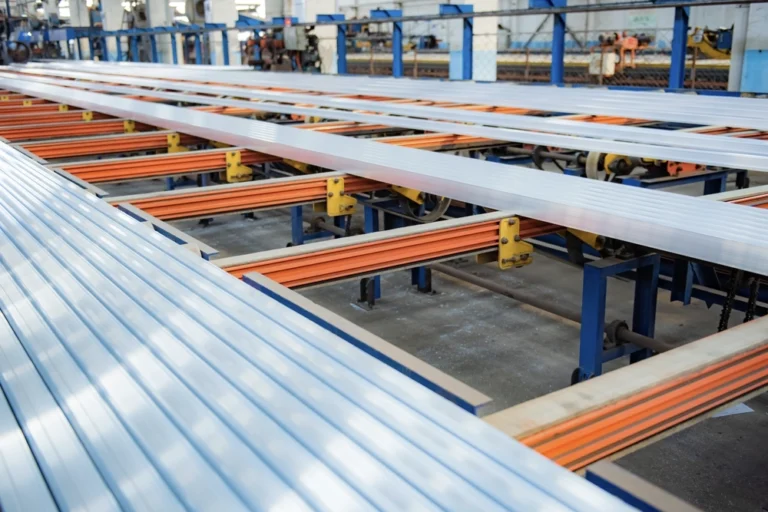
Mill finish aluminium is the most ordered surface condition in industrial extrusion, yet it’s the most misunderstood. Some procurement teams treat it as the “raw” or “unfinished” option to avoid. Others spec it without realising what they’re actually getting. Used correctly, mill finish saves real money on the right projects. Used wrongly, it shows up on site looking blotchy, scratched, and not what the architect approved.
Here’s the practical view on mill finish aluminium for fabricators, contractors, and procurement teams.
What Is Mill Finish Aluminium?
Mill finish aluminium is the natural surface condition of an aluminium extrusion as it exits the press, with no secondary finishing applied. It’s not raw or untreated. The surface has the dull silver-grey appearance characteristic of aluminium, with light tool marks from the die and a thin, naturally formed oxide layer that develops within seconds of exposure to air.
The finish varies slightly from batch to batch and even from start to end of a single press run. Some sections may show faint die lines, minor pickup marks, or subtle colour variation. These are inherent to the extrusion process, not defects.
When Mill Finish Is the Right Spec
Mill finish makes sense in several common scenarios:
- Hidden structural applications where the profile is buried inside walls, ceilings, or assemblies and surface appearance doesn’t matter
- Industrial machinery and jigs where function matters more than appearance
- Profiles that will be painted, powder coated, or anodised by a downstream supplier rather than at the original extruder
- Welded structural assemblies where finishing happens after fabrication
- Cost-sensitive projects where the budget doesn’t support a finished surface and the aesthetic doesn’t require one
The savings versus anodised or powder-coated material are meaningful, often 15 to 30% depending on the finish specification being replaced.
When Mill Finish Will Disappoint You
Mill finish is the wrong choice when:
- The profile will be visible in the finished build — facade trim, balustrades, shopfront sections, or interior decorative work
- The application is exposed to coastal, industrial, or chemically aggressive environments without further protection, where surface oxidation accelerates
- The job requires colour matching across multiple deliveries, since mill finish colour drifts subtly between batches
- The end user expects a uniform, finished look straight out of the wrapping
A common procurement mistake is ordering mill finish to save cost, then realising on site that the profile is visible and now needs to be field-finished, eating any savings several times over.
How to Protect Mill Finish in Storage and Transit
Mill finish aluminium is more vulnerable to handling damage than finished material because there’s no protective coating to absorb minor abrasion. Three habits prevent most of the problems:
Store indoors and off the ground. Direct moisture contact, especially in humid conditions, accelerates surface oxidation and water staining. Pallets in a dry, ventilated store stay clean for months.
Keep original wrapping intact until install day. Most extruders wrap mill finish bundles in paper or plastic for transit protection. Pulling the wrap early invites scratches and handling marks.
Handle with clean gloves. Bare hands deposit oils and salts that show up as fingerprints once the metal oxidises further. On visible work, this matters.
Mill Finish vs Anodised vs Powder Coated
A quick decision framework for the most common alternatives:
Mill finish is the right call for hidden, structural, or downstream-finished applications. Lowest cost, fastest lead time.
Anodised aluminium thickens the natural oxide layer into a hard, scratch-resistant, colour-stable surface. The right call for visible architectural work expected to last decades outdoors. Available in natural, bronze, black, and other colours.
Powder coated aluminium applies an electrostatic polymer finish in any RAL colour, with high impact resistance and excellent UV stability. The right call for decorative or branded work where colour matching is critical.
Specify by application, not by habit. Each finish has a place where it wins on cost, performance, or both.
What to Spec When Ordering Mill Finish Aluminium
Three details to lock down on the purchase order:
- Alloy and temper matched to the structural requirement, typically 6063-T5 for architectural extrusions or 6061-T6 for structural work
- Acceptable surface variation noted clearly, especially if the material will be visible or further finished by another party
- Packaging specification including interleaving, end caps, and bundle wrapping to protect the surface in transit
Sourcing Mill Finish Aluminium for Your Fabrication Needs
Mill finish quality depends entirely on the extruder’s press conditions, die maintenance, and handling discipline. A manufacturer with strict in-house standards will deliver consistent mill finish material that holds up through transit, storage, and downstream processing.
Whether you need standard profiles or custom cross-sections designed for your specific fabrication requirements, Exalum Metal has the capacity and expertise to deliver.
Ready to place an order or discuss your requirements? Get in touch with the Exalum Metal team directly:
Email: [email protected] WhatsApp: +62 811 9429 970 Website: www.exalummetal.com
Your next fabrication project deserves material you can count on. Make mill finish aluminium from Exalum Metal your standard.