
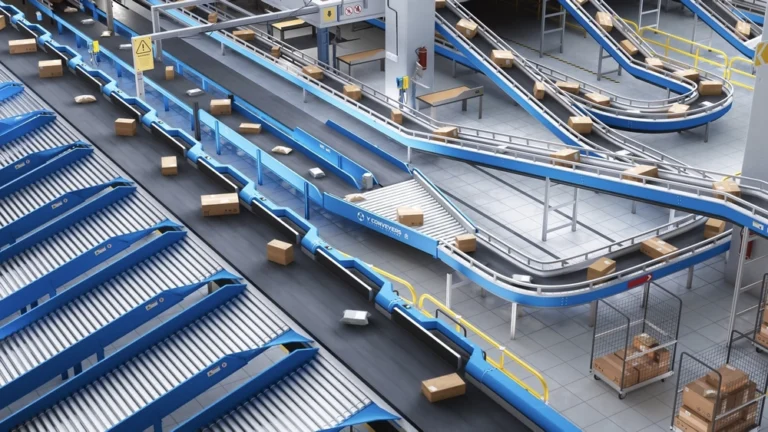
Industrial conveyor systems quietly run the global economy. From food and beverage packaging lines to airport baggage handling, e-commerce fulfillment centers, automotive assembly, and pharmaceutical production, almost every product you touch has spent time on a conveyor at some point. For manufacturers, fabricators, and procurement teams, understanding how conveyor systems work and what materials they should be built from is no longer optional. It’s a competitive advantage.
This article walks through what a conveyor system is, the main types in use today, where each one performs best, and why aluminum profiles have become the default material specification for modern conveyor manufacturing.
What Is a Conveyor System?
A conveyor system is a mechanical assembly designed to move materials, products, or components from one point to another continuously and automatically. The system typically consists of a structural frame, a moving surface (belt, rollers, chain, or modular plastic), drive components (motors, gearboxes, sprockets), and control electronics.
Beyond simple transport, modern conveyors integrate quality inspection, weighing, metal detection, sorting, packaging, and loading or unloading operations. This flexibility is why conveyors anchor almost every serious production line in operation today.
Why Conveyor Systems Matter for Industrial Productivity
The case for conveyor automation comes down to four measurable outcomes:
- Labor cost reduction. A single conveyor replaces the equivalent of five to ten manual material handlers per shift, with no fatigue, breaks, or shift premium costs.
- Throughput increase. Conveyors maintain a constant, adjustable speed that human handling cannot match, multiplying line output without expanding headcount.
- Product damage reduction. Manual handling produces drop, crush, and contamination losses that disappear with proper conveyor integration.
- Hygiene and safety improvement. Especially in food, pharmaceutical, and electronics environments, automated material movement eliminates contamination paths that manual handling can’t fully control.
The investment math typically pays back within 12 to 24 months on production lines running two or more shifts.
The Main Types of Industrial Conveyors
There’s no universal conveyor. The right type depends on the product being moved, the production environment, and the throughput required. Here are the conveyor types that handle the vast majority of industrial applications:
Belt conveyors use a continuous belt running between two pulleys. The most versatile and widely used conveyor type, suitable for packaged goods, bulk material, and food applications when specified with food-grade belts and stainless or aluminum frames.
Roller conveyors use parallel rollers to move flat-bottomed items. Ideal for cartons, totes, and packages in warehousing, logistics, and packaging operations. Available as gravity-driven or powered.
Modular plastic belt conveyors use interlocking plastic modules to form a flexible, washable belt. The standard for food, beverage, pharmaceutical, and cosmetic lines where hygiene and easy maintenance are critical.
Table top chain conveyors use plastic or stainless chain belts under 300mm wide, designed for handling small items like bottles, cans, and jars at high speed.
- Chain conveyors use heavy-duty chains to move pallets, large containers, and heavy assemblies, common in automotive and heavy industry.
- Screw conveyors use a rotating helical screw inside a tube or trough to move bulk powders, grains, and granular materials.
- Slat conveyors use linked metal or plastic slats to handle hot, oily, or oversized products that would damage a belt.
- Bucket conveyors use buckets attached to belts or chains to move bulk material vertically, common in agriculture and mining.
- Pneumatic and vacuum conveyors use air pressure differentials to move powders, granules, and small parts through enclosed tubes.
- Spiral and vertical conveyors lift products between floors or levels without occupying horizontal floor space.
- Magnetic conveyors use magnetic fields to move ferrous components, common in metal stamping and machining shops.
- Vibrating conveyors use controlled vibration to move bulk granular material, often in food processing and recycling.
How to Choose the Right Conveyor Type
The selection comes down to four factors:
- Product characteristics: size, weight, shape, fragility, and surface
- Production environment: wash-down requirements, temperature, dust, hygiene rating
- Throughput targets: units per hour and continuous vs batch operation
- Layout constraints: floor space, elevation changes, and integration with other equipment
Getting these right at the design stage prevents the expensive retrofits that happen when a conveyor specification doesn’t match real operating conditions.
Conveyor Frame Materials: Why Aluminum Has Become the Standard
Conveyor frames historically came in three material options: welded steel, stainless steel, and aluminum. The market has shifted decisively toward aluminum for most non-extreme applications, and the reasons are practical.
- Welded mild steel is cheap upfront but corrodes, requires repainting, and adds substantial weight that increases shipping and installation cost. It still has a place in dry, abrasive environments like mining.
- Stainless steel offers excellent corrosion resistance and is required for direct food contact and aggressive chemical environments. It’s also heavy and expensive, so it’s reserved for applications where its specific properties are non-negotiable.
- Aluminum has become the default for most modern conveyor builds. It weighs about a third of steel, doesn’t rust, takes anodizing and powder coating cleanly, and allows modular construction that can be reconfigured as production needs change. The cost premium over mild steel is recovered through faster installation, lower maintenance, and longer service life.
The Aluminum Profiles That Build Conveyor Systems
A complete conveyor frame is built from a coordinated set of aluminum profiles, each handling a specific structural role:
Square Hollow and Rectangular Hollow form the primary load-bearing chassis, providing torsional stiffness across long spans while keeping the overall structure light. These profiles handle the bending and twisting forces that come from continuous belt or chain tension.
Tubing Pipes function as vertical legs, support columns, and cross-bracing where round geometry offers cleaner aesthetics or specific mounting advantages for guards and accessories.
Equal Angle and Unequal Angle profiles create motor mount platforms, cross-members, and side-guide supports. Angles are the workhorse for any application requiring corner reinforcement or right-angle bracing.
Unequal Channel sections handle edge-stiffening and reinforcement where asymmetric loading requires it, such as motor end frames carrying drive components offset to one side.
Flat Bars serve as precision mounting plates, spacers, and bracket stock. Their flatness and dimensional consistency are critical for aligning rollers, sensors, and guides across long frame sections.
Round Bars are machined into shaft stock for rollers, idlers, and drive components requiring concentric rotation and tight bearing fits.
Heat Sinks integrate into motor and electronic controller mounts, dissipating heat from variable frequency drives and PLC enclosures on high-duty cycle systems.
Partition and Louvers form the framework for machine guarding, perimeter enclosures, and ventilated access panels that meet workplace safety requirements.
The advantage of sourcing all these profiles from a single extruder is dimensional consistency. Profiles that hold tight tolerance across batches mean frames that align cleanly during assembly, with less field adjustment and lower scrap rates.
Industries That Run on Aluminum-Framed Conveyors
Aluminum-framed conveyor systems dominate in:
- Food and beverage processing, bottling, and packaging
- Pharmaceutical and clean room manufacturing
- Cosmetics and personal care production
- Electronics and semiconductor assembly
- Automotive parts and sub-assembly lines
- E-commerce fulfillment and parcel sortation
- Cold storage, refrigerated logistics, and frozen food
- Airport baggage handling
- Light assembly and packaging operations
Heavy mining, bulk aggregate, and direct-fire foundry environments still favor steel, but for everything else, aluminum has earned its place as the modern standard.
Sourcing Aluminum Profiles for Your Conveyor Manufacturing
For conveyor manufacturers, integrators, and fabricators, the supplier behind the aluminum is what ultimately determines build quality. Profiles that vary in alloy temper, wall thickness, or straightness across deliveries quietly destroy assembly efficiency, regardless of how well the conveyor is designed.
The cleanest protection is a manufacturer who controls billet quality, extrusion precision, and finishing under one roof. Exalum Metal Indo operates a 20,000 m² vertically integrated facility producing the complete profile range required for conveyor manufacturing, from Square Hollow and Rectangular Hollow chassis members through to Heat Sinks, Flat Bars, and machine guarding profiles, with in-house anodizing and powder coating to finish every component to specification.
Whether you need standard profiles or custom cross-sections designed for your specific fabrication requirements, Exalum Metal has the capacity and expertise to deliver.
Ready to place an order or discuss your requirements? Get in touch with the Exalum Metal team directly:
Email: [email protected] WhatsApp: +62 811 9429 970 Website: www.exalummetal.com
Your next fabrication project deserves material you can count on. Make aluminum profiles from Exalum Metal your standard.