
Aluminum is one of the most versatile metals in the modern world. From window frames and vehicle bodies to electronic enclosures, this lightweight metal is present in almost every aspect of industrial life. Two of the most widely used manufacturing technologies for shaping aluminum are extrusion and die casting.
While both processes aim to form aluminum into functional components, their working principles, final results, and applications differ significantly. To select the right process, it is essential to understand how these fundamental manufacturing differences affect product strength, appearance, and cost.
Overview of Aluminium Extrusion
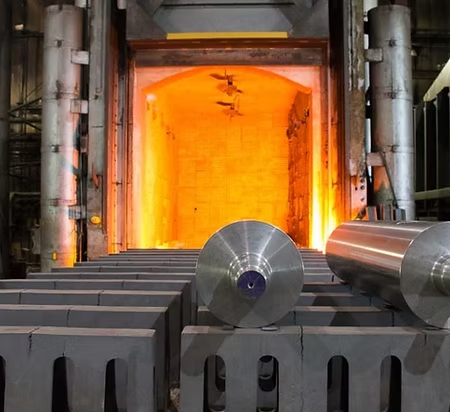
The extrusion process can be compared to making noodles or pasta. A solid aluminium billet (commonly alloys such as 6061, 6063, or 6005) is heated to near its melting point, approximately 450–500°C, and then forced through a die under high pressure. The aluminium exiting the die forms a long, continuous profile that matches the die’s cross-sectional design.
Typical examples include:
T-slot profiles for machine frames
Aluminium sliding door tracks
Electronic heat sinks
Solar panel frames and building façade systems
After leaving the die, the aluminium profile is still hot and relatively soft. It is then cooled, cut to length, and subjected to aging (heat treatment) to strengthen its microstructure.
Key characteristics of extruded aluminium products:
Long, continuous shapes with consistent cross-sections
Uniform wall thickness
Elongated grain structure aligned with the extrusion direction, providing high mechanical strength in that direction
Generally smooth surface, suitable for direct anodizing or powder coating
Main advantages:
Ability to produce complex yet lightweight profiles
Lower die tooling cost compared to die casting
Suitable for medium to large production volumes, especially for long components
Minimal material waste due to high process efficiency
Understanding Aluminum Die Casting
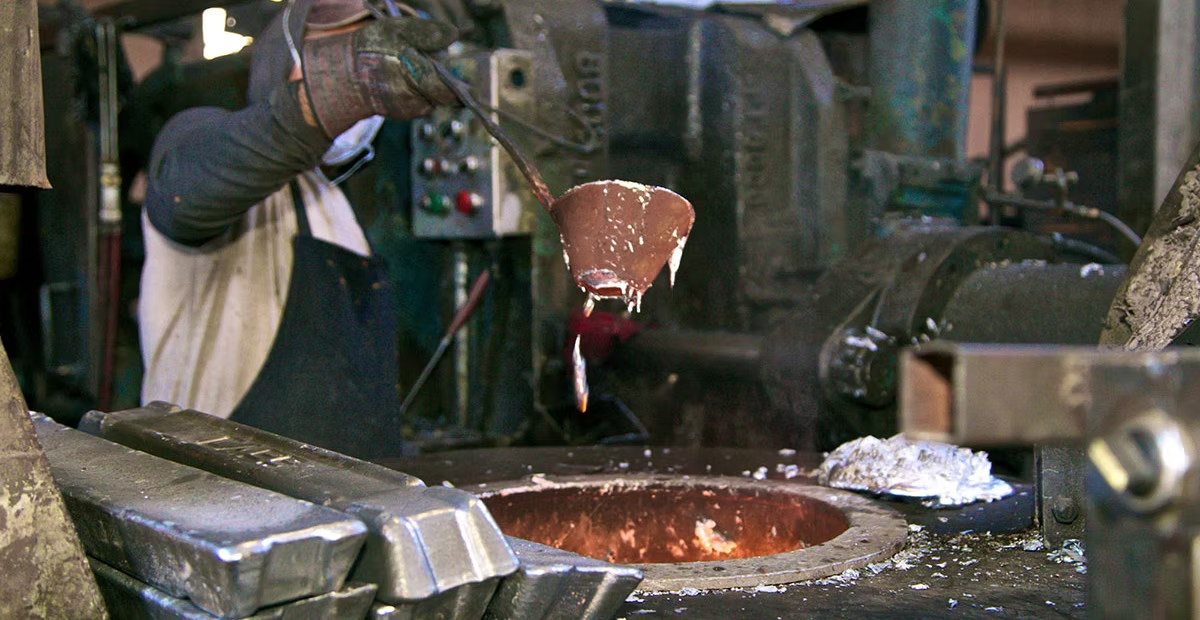
Unlike extrusion, which uses solid aluminium, die casting starts with molten aluminium. In this process, aluminium alloys (commonly ADC12 or A380) are melted at around 660°C and then injected into a closed steel mold under high pressure.
Once the metal cools and solidifies, the mold opens and the aluminium component is ejected. The entire cycle takes only a few seconds and can produce highly complex three-dimensional shapes with fine details such as holes, reinforcing ribs, and textured surfaces.
Key characteristics of die-cast aluminium products:
Complex, solid shapes (e.g., motor housings, lamp casings, pump bodies)
Smoother surface compared to conventional casting methods such as sand casting
High dimensional accuracy, suitable for mechanical parts
Often requires secondary finishing processes (deburring, shot blasting, or light machining)
Main advantages:
High precision, ideal for mass production with tight tolerances
High production speed, with cycle times measured in seconds
Consistent quality due to closed, rigid molds
However, die tooling costs are significantly higher than those for extrusion, making die casting more economical for large production volumes.
Impact of Manufacturing Process on Structure and Quality
One of the most significant differences between extrusion and die casting lies in the resulting metal microstructure.
a. Grain Structure
In extrusion, solid aluminium is plastically deformed, causing the metal grains to elongate along the extrusion direction. This results in high tensile and bending strength along that axis.
In die casting, molten aluminium solidifies inside the mold. Rapid cooling produces fine grains, but with random orientation. As a result, tensile strength is generally lower than that of extruded aluminium, although it remains sufficient for many static components.
b. Porosity and Density
Die casting often contains microscopic porosity caused by trapped air during high-speed injection. For this reason, die-cast components are generally not ideal for anodizing, as surface defects or spots may appear.
Extruded aluminum, which does not involve molten metal flow, produces dense, pore-free material, making it highly suitable for surface finishing processes such as anodizing and powder coating.
Industrial Applications
Applications of Aluminium Extrusion
Because it produces long profiles with consistent cross-sections, extrusion is widely used in:
Construction: door and window frames, building façades, railings, stair rails
Transportation: roof rails, light truck components, trailer frame structures
Electronics: heat sinks due to excellent heat dissipation
Renewable Energy: solar panel frames and mounting structures
Its strong mechanical properties and excellent anodizing capability make extrusion ideal for both structural and decorative components.
Applications of Aluminium Die Casting
Die casting dominates sectors where complex shapes and high precision are required:
Automotive industry: gearbox housings, electric motor bodies, engine brackets
Electronics: LED lamp housings, camera bodies, industrial electronic enclosures
Home appliances: blender bodies, metal door handles, water pump components
Aerospace & defense: small, lightweight parts with intricate geometries
With rapid production cycles, die casting serves as the backbone of mass manufacturing for precision metal components.
Key Considerations When Choosing the Right Process
Deciding between extrusion and die casting depends on three main factors: product design, production volume, and finishing requirements.
1. Product Design
Long, uniform profiles → Extrusion
Complex 3D shapes → Die Casting
2. Production Volume
Small to medium volumes → Extrusion is more economical
Large volumes (>10,000 units) → Die Casting is more efficient
3. Finishing Requirements
Metallic color or textured finish → Extrusion (easy anodizing)
Highly detailed geometry → Die Casting, with some finishing limitations
In many cases, manufacturers combine both methods: extrusion for structural components and die casting for housings or highly detailed parts.
Conclusion
Both aluminum extrusion and die casting offer distinct advantages and limitations.
Extrusion excels in directional strength, material efficiency, and surface finishing.
Die casting excels in producing complex shapes with high-speed mass production.
The best manufacturing process depends on component function, production volume, and aesthetic and mechanical requirements.
By understanding the characteristics of both methods, engineers and manufacturers can design more efficient solutions for construction, automotive, and electronic applications.
Looking for a Reliable Aluminum Manufacturing Partner?
If you are seeking a trusted partner for high-quality aluminum extrusion, visit Exalum Metal. We offer advanced extrusion technology, an experienced engineering team, and end-to-end services from profile design and production to premium finishing.
With extensive expertise in aluminum processing, Exalum Metal is ready to help you determine the most effective solution between extrusion and die casting, tailored to your specific requirements.