
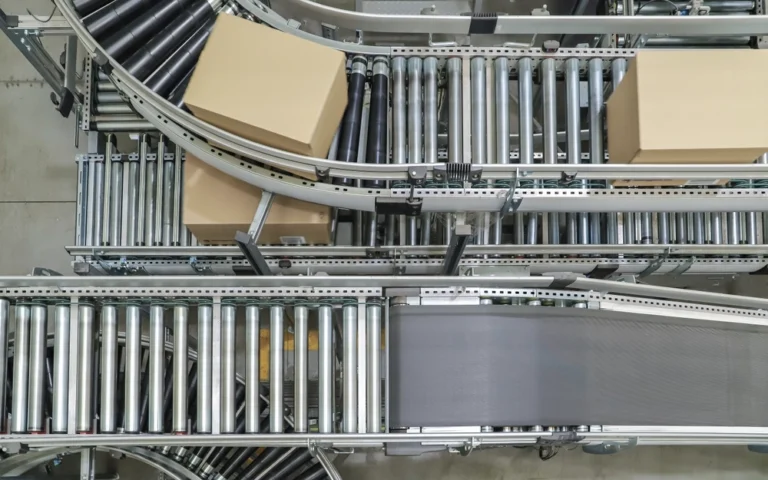
Conveyor system manufacturing has undergone a quiet but decisive transformation over the past two decades. The welded steel chassis that once dominated factory floors is steadily being replaced by lightweight, modular aluminum structures, and the engineering case is hard to argue with. Aluminum frames cut assembly time by half or more, resist corrosion across nearly every plant environment, and present a clean, professional finish that aligns with modern Lean Manufacturing standards.
For OEMs and integrators serving food and beverage, pharmaceutical, automotive, and logistics clients, aluminum has become the default material specification. Exalum Metal Indo supports this shift with a comprehensive range of extruded aluminum profiles purpose-built for industrial manufacturing applications, backed by vertically integrated production from billet to anodized finish.
Core Structural Components: The Foundation
The Frame
The conveyor chassis sets the performance ceiling for the entire system. Square Hollow and Rectangular Hollow profiles deliver the torsional rigidity required for long-span belt and chain conveyors, while remaining light enough to ship, install, and reconfigure without heavy lifting equipment. Tubing Pipes complement these as vertical supports, cross-bracing, and overhead gantry members where round geometry offers cleaner aesthetics or specific mounting advantages.
The weight savings are not cosmetic. An aluminum conveyor frame typically weighs about one-third of an equivalent welded steel structure, which reduces shipping costs, simplifies on-site rigging, and lowers the dead load placed on facility floors and mezzanines.
Support & Stability
Beyond the primary frame, modular assembly depends on robust secondary members. Equal Angle and Unequal Angle profiles form the cross-bracing, motor mount platforms, and side-guide supports that keep the system aligned under continuous load. Unequal Channel sections handle reinforcement and edge-stiffening roles where asymmetric loading requires it. Together, these profiles allow engineers to design frames that are both structurally sound and serviceable, with the option to disassemble and reconfigure without grinding welds or cutting steel.
Mechanical Integration & Precision: The Details
Moving Parts
Conveyor performance ultimately depends on the precision of its moving components. Round Bars in appropriate alloys and tempers serve as shaft stock for rollers, idlers, and drive components, machined to tight tolerances for bearing fits and concentric rotation. Flat Bars function as precision spacers, mounting plates, and bracket stock where flatness and dimensional consistency are critical to alignment.
For OEMs producing dozens or hundreds of identical conveyors, sourcing this stock from a single extruder with consistent dimensional output eliminates the cumulative tolerance creep that derails assembly lines.
Thermal Management
High-duty cycle conveyors generate meaningful heat at drive motors, variable frequency drives, and PLC enclosures. Heat Sinks extruded in fin profiles dissipate this heat efficiently, extending motor life, protecting electronic controls, and preventing the thermal cycling that accelerates component failure. In automated and high-throughput systems, integrated thermal management is no longer optional. It’s a baseline requirement for reliability.
Safety, Enclosure & Finishing: The Full Ecosystem
Worker Safety
Machine guarding and ventilation are regulated requirements in most jurisdictions. Partition profiles form the framework for guarding panels, perimeter enclosures, and access control structures around moving conveyor components. Louvers integrate ventilation into these enclosures without compromising safety isolation, allowing heat and fumes to escape while keeping operators clear of hazards.
Facility Integration
Forward-thinking conveyor manufacturers extend their offering beyond the conveyor itself. Complementary profiles for Rolling Doors, Shop Fronts, and Handrails and Ladders allow a single supplier to deliver a turnkey installation, covering not just the conveyor but the surrounding facility infrastructure. For procurement teams managing complex industrial fit-outs, consolidating these specifications under one material supplier dramatically simplifies vendor management.
Why Exalum Metal?
Exalum Metal Indo’s competitive advantage rests on two pillars: breadth of range and precision of extrusion. The product portfolio spans every category required for conveyor manufacturing, from structural hollows and angles through to heat sinks, flat bars, and decorative finishing profiles. This eliminates the need to source from multiple suppliers and the dimensional variation that follows.
The precision of the extrusion process directly impacts manufacturing efficiency. Profiles that hold tight dimensional tolerance reduce material waste during cutting, ensure perfect alignment during modular assembly, and minimize the field adjustments that erode shop margins. Combined with in-house Anodized Finish and powder coating capability, this means a single source for the complete material specification of a conveyor build.
Scaling conveyor production and improving conveyor durability both come back to the same starting point: a material partner who can deliver consistent, high-precision aluminum profiles across the full structural and finishing range. The right partnership turns material sourcing from a recurring procurement challenge into a stable foundation for engineering and production planning.
Build an Efficient Conveyor System with Aluminum Material You Can Trust
The success of your automation system starts with precision material selection. Exalum Metal stands as a strategic partner for conveyor manufacturers, supplying a complete range of high-quality aluminum profiles, from Square Hollow for primary frames through to Heat Sinks for maximum motor performance.
Consult our team about your project material requirements today:
- Email: [email protected]
- WhatsApp: +62 811 9429 970
- Website: www.exalummetal.com