
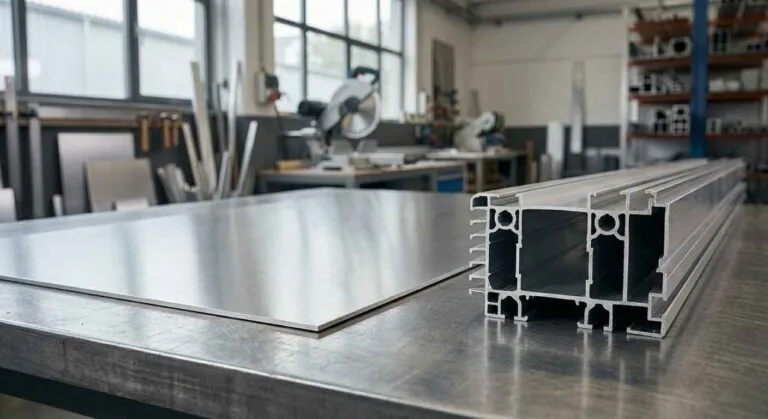
A fabricator lays a flat aluminum panel across a workbench, then sets a long extruded frame section beside it. Both are aluminum, cut from the same family of alloys, yet neither could easily replace the other in the finished assembly. The two pieces will likely end up joined together in the same product.
That difference comes down to how each form is made. Aluminum sheet starts as a flat rolled product, while aluminum extrusion is pushed through a die to create a specific cross-section. Sheet suits large flat or gently curved surfaces, while extrusion suits long parts that need the same shape repeated along their length.
Many finished products actually combine both forms in a single assembly. Knowing which form to specify for which part avoids unnecessary fabrication steps later. This article compares both forms and covers when each one is the right choice.
What Is Aluminum Sheet, and What Is Extrusion?
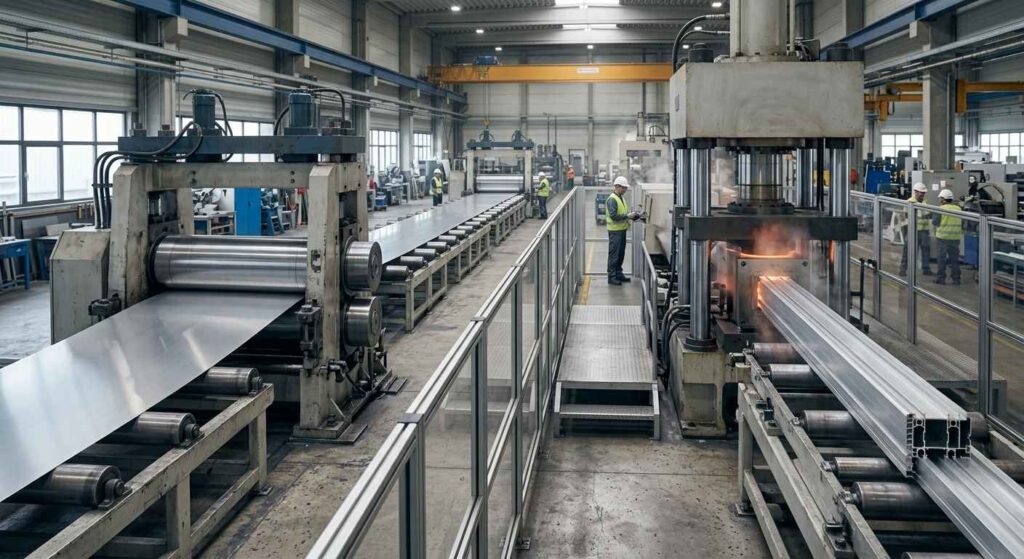
Aluminum sheet is produced by rolling a cast slab between large rollers until it reaches a thin, flat, consistent thickness. The result is a flat panel that can be cut, bent, or stamped into shape by the fabricator. Thickness is usually the only dimension that varies between grades.
Extrusion works differently, pushing a heated aluminum billet through a shaped die to create a continuous profile with a fixed cross-section. That process is how a Door Jamb or window frame gets its exact, repeatable shape from end to end, ready to cut and install. The die, not the rolling mill, defines the final geometry, and that geometry stays identical from the first meter to the last.
Strengths and Limitations of Aluminum Extrusion
What Extrusion Does Well
Extrusion produces complex cross-sections in a single pass, including internal chambers for stiffness or hidden fastening points. A Sliding Doors track relies entirely on this kind of built-in geometry, formed directly by the die. No secondary forming step is needed to achieve it.
Extrusion also holds tight dimensional tolerances along very long lengths. That consistency matters when the same profile needs to repeat across an entire structure without visible variation from one piece to the next. Fabricators rely on that repeatability when ordering thousands of meters at once.
Where Extrusion Has Limitations
Extrusion cannot produce a wide, flat, unbroken surface the way sheet can. A building’s cladding panel or a large flat enclosure wall needs sheet, not extrusion, regardless of how the die is designed. This is a hard geometric limit, not a cost issue.
Extrusion is also limited to a constant cross-section. Any shape that needs to taper, curve across its width, or vary along its length usually needs sheet instead, formed or stamped to the required shape.
Aluminum Sheet vs Aluminum Extrusion
Choosing between sheet and extrusion, including extruded shapes such as Square Hollow sections, comes down to the geometry the project actually needs.
| Form | Best For | Less Suitable For |
| Aluminum sheet | Large flat panels, formed or stamped parts | Long structural profiles, complex cross-sections |
| Aluminum extrusion | Long constant profiles, structural framing | Wide flat panels, deep-drawn shapes |
For structural framing and repeated architectural sections, extrusion’s dimensional consistency usually makes it the better fit. Large flat cladding remains sheet’s clear advantage, and neither form fully replaces the other.
Where Sheet and Extrusion Show Up in Real Projects
Structural Framing Members
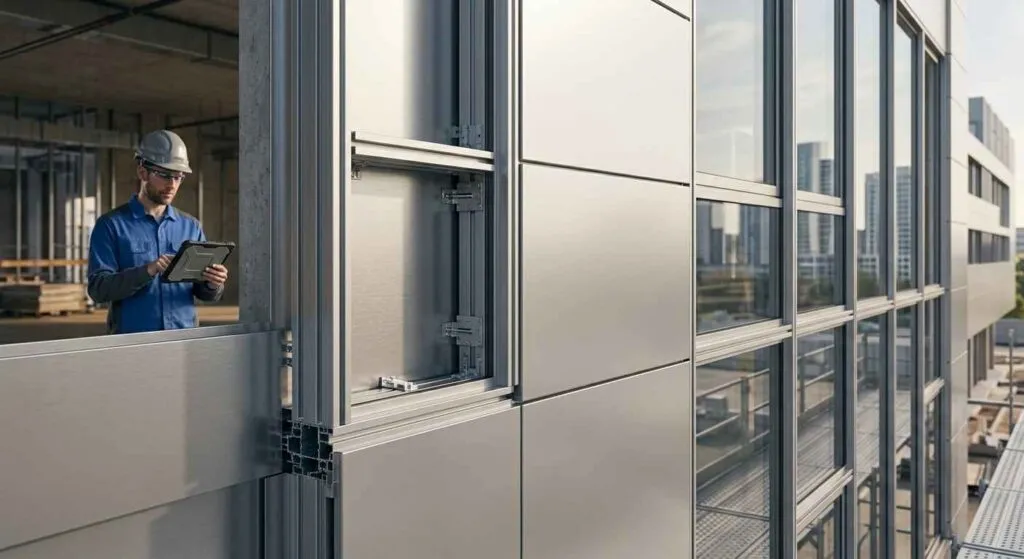
Buildings rely on extrusion for framing that repeats along a wall or ceiling line. A Rectangular Hollow section is a common structural choice here.
Vehicle Body Panels
Vehicle manufacturers stamp aluminum sheet into body panels and hoods, and extrude structural parts such as Automotive Motor Accessories brackets.
Window and Door Systems
Window and door frames rely on extrusion almost exclusively. A Casement Windows frame needs the same shape repeated around the opening.
Interior Wall Cladding
Interior fit-outs often use flat sheet for wall cladding. Extruded trim such as Partition framing then holds the panels in place.
What to Consider Before Choosing Sheet or Extrusion
A few practical factors usually settle the decision between sheet and extrusion. Reviewing them early prevents a costly mid-project redesign, especially once tooling or stamping dies are already ordered.
- Part geometry: flat or curved surfaces need sheet, while constant cross-sections need extrusion.
- Structural role: framing and load-bearing members generally favor extrusion’s built-in stiffness.
- Production method: sheet suits stamping and forming, while extrusion suits continuous profile runs.
- Tooling cost: extrusion dies are often cheaper than stamping tools for large sheet parts.
- Surface area: large flat coverage areas are more efficient in sheet than in multiple extruded pieces.
- Profile shape: parts needing an Equal Channel or similar custom cross-section require extrusion, not sheet.
- Assembly plan: projects combining both forms need matched finishes so the transition is not visible.
- Lead time: extrusion dies typically take less time to produce than large stamping tools.
Aluminum Extrusion from Exalum Metal
Exalum Metal specializes in aluminum extrusion, producing structural and architectural profiles with consistent cross-sections for demanding applications. Every profile holds the same tolerance across the full production run, whether the order is a single shape or several profiles at once.
Custom extrusion is available for project-specific dimensions and shapes. Finishing services include mill finish, anodizing, and powder coating. Volume order support extends to manufacturers and contractors ordering profiles such as Furniture framing at production scale.
If your project needs a specific extruded profile, bring us your drawings or an estimated volume. Get in touch with our team directly through our contact inquiry or click the “Contact Us” button below.