
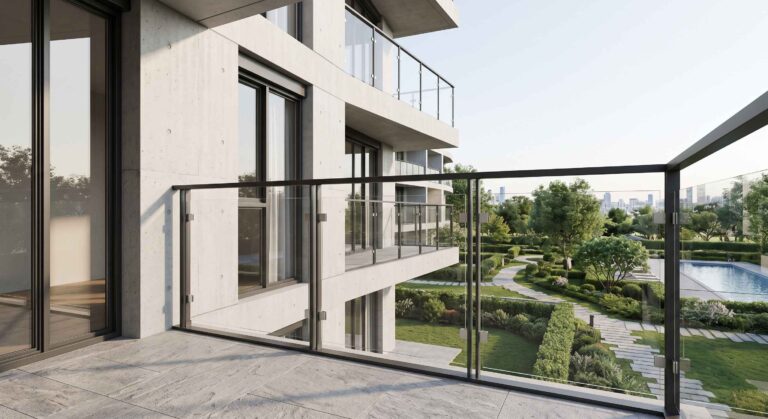
Have you ever leaned on a balcony rail or climbed a modern staircase and noticed how slim, seamless, and solid the metalwork felt? That balance of thin sightlines and real strength is what aluminum railing does best.
Across high-end residential and commercial builds in North America, Europe, Australia, and Asia, architects now reach for aluminum railing because it frames a view without blocking it and lasts far longer than timber or iron. This article breaks down the main railing profiles by function, the metallurgy and finishes that make them last, the engineering that suits real sites, and how Exalum Metal supplies railing systems at volume.
Why Aluminum Leads Modern Railing Design
Modern architecture rewards clean lines, so designers favor ultra-slim extrusions, hidden fasteners, and streamlined channels that maximize sightlines on balconies, decks, and staircases. Aluminum delivers that look because extrusion shapes precise, minimal profiles that steel and timber cannot match as easily. Moreover, modular aluminum systems pair readily with infill panels of tempered glass, wood-grain composite, or stainless-steel cable, which gives one railing line the flexibility to suit many designs. Underneath the style, the material earns its place too. Aluminum forms a self-protecting oxide layer, so it resists moisture, rust, termites, and rot where steel corrodes and wood decays.
Aluminum Railing Profiles by Function
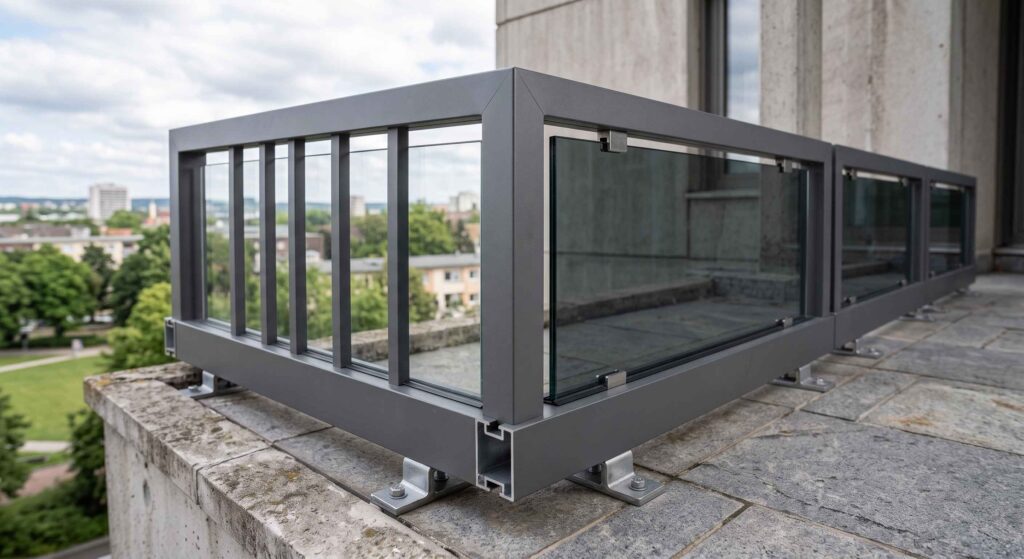
A railing is really a kit of profiles, each doing one job, so buyers specify them by function rather than by looks alone. The four groups below cover most architectural systems, and each maps to specific Exalum profiles.
Base and Shoe Channels
Every glass or post railing starts at the bottom track. Continuous shoe and base channels anchor heavy glass panels or structural posts and transfer their load into the floor. For this role, an Equal Channel or Unequal Channel forms the structural receiver that grips the panel edge.
Top Rails and Handrails
The top rail sets the grip and ties the perimeter together. Oval, rectangular, round, and flat-top profiles each give a different feel in the hand, so the choice balances ergonomics with the design language. Here Pipes form round handrails, while Rectangular Hollow and Square Hollow sections make flat-top and squared rails, and Decorative Tubing Pipes add finished detail.
Balusters and Privacy Slats
Between the rails sit the balusters or slats that fill the panel. Square, rectangular, and tubular pickets suit open guardrails, while closer slats create privacy and control airflow. For these infills, Round Bars and Square Hollow form pickets, and Louvers provide privacy and blade slats.
Posts, Spigots, and Brackets
Finally, the hardware holds everything upright and fixed. Posts carry the structural load, while spigots and mounting brackets connect glass and rails to the structure. Exalum machines these from solid stock and pairs them with Equal Angle, Unequal Angle, and Flat Bars for brackets and base plates.
| Railing Component | Exalum Profile |
| Base and shoe channels | Equal Channel, Unequal Channel |
| Top rails and handrails | Pipes, Rectangular Hollow, Square Hollow |
| Balusters and pickets | Round Bars, Square Hollow |
| Privacy and airflow slats | Louvers, Decorative Tubing Pipes |
| Posts, brackets, base plates | Equal Angle, Unequal Angle, Flat Bars |
Each component links to its Exalum product page in the sections above, and most railings combine several of these profiles in one run.
The Metallurgy and Finishes Behind a Lasting Railing
Strength and looks both come down to alloy and surface. Exalum extrudes railing profiles in the 6000 series, using 6063-T5 or T6 for a smooth finish and intricate geometry, and 6061-T6 for heavy-duty posts and spigot bodies that carry load. Just as important, multi-chamber hollow profiles and targeted wall thickness give a railing steel-equal stiffness at nearly a third of the weight, which drops both freight and on-site handling cost. On the surface, the finish sets the character. Architectural powder coating delivers textured mattes and metallic tones in regional colors such as RAL 7016 Anthracite, clear or black anodizing adds crisp wear resistance, and wood-grain heat transfer gives the warmth of timber with none of the rot or annual sealing.
Engineering for Real Sites
A railing has to fit the ground and the metals around it, so good systems plan for both. Rackable extrusion panels, for example, articulate across up to fifteen degrees of grade change, so a stair or slope keeps parallel rails with no raw cut edges or on-site welding. Just as important, combining aluminum with stainless fasteners calls for care, because dissimilar metals can drive galvanic corrosion. Isolation gaskets, non-conductive washers, and proper coating barriers keep the metals apart and protect the joint for the long term.
The Business Case for Importing from Exalum Metal
For distributors and developers, aluminum railing also makes commercial sense, and Exalum Metal builds to that case as a vertically integrated OEM and ODM manufacturer. Low-maintenance aluminum needs only a rinse, which avoids the sanding and staining of timber or the rust treatment and repainting of steel, so its total cost of ownership stays low. On top of that, non-welded profiles flat-pack into knock-down kits that load densely into containers and cut per-unit freight to ports worldwide. Aluminum is also fully recyclable and reproduces from scrap with about 95% less energy than primary metal, which supports LEED, BREEAM, and corporate sustainability targets. The table below shows how Exalum turns each of these into an importer advantage.
| Content Pillar | Typical Competitor | Exalum Metal OEM Position | Strategic Importer Benefit |
| Material quality | Basic rust resistance and lightness | Multi-chamber extrusions and structural alloy compliance (6063/6061) | Prevents wind-load sagging and passes stringent local building codes |
| Customization | Standard colors and stock sizes | Custom die development, CNC precision machining, and CAD assistance | Lets foreign distributors build proprietary, branded systems |
| Surface coating | General powder coating | Marine-grade anodizing at 60 microns or more and Qualicoat-level finishes | Guarantees weatherability against coastal salt spray and high UV |
| Export logistics | Local distribution only | Flat-packed knock-down kits and consolidated container loading | Lowers per-unit freight and steadies supply to global ports |
Standards and colors vary by market, such as RAL tones in Europe or Qualicoat finishing, so confirm the target requirements before production.
What to Specify When Ordering Aluminum Railing
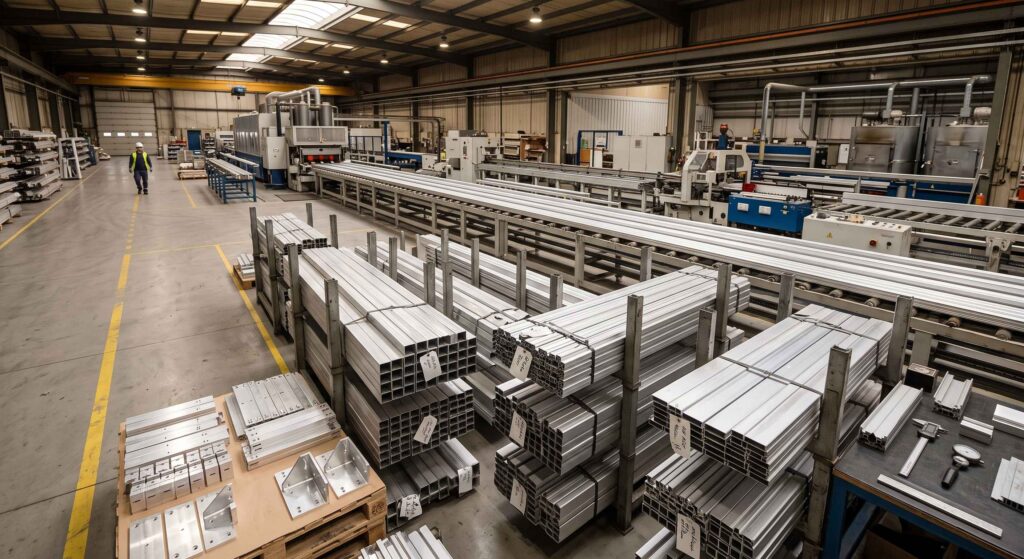
A clear specification keeps a railing order safe, compliant, and on budget, so confirm these points up front:
- Profile set: base channel, top rail shape, baluster or slat type, and post or spigot style.
- Alloy grade: 6063-T5 or T6 for finish and geometry, and 6061-T6 for load-bearing posts and spigots.
- Infill: glass, aluminum pickets, privacy slats, or cable, since the base channel and spacing depend on it.
- Finish: architectural powder coat, clear or black anodizing, or wood-grain heat transfer, with the target RAL or regional color.
- Site and safety: rackable panels for slopes, plus isolation gaskets where aluminum meets stainless steel.
- Format and volume: knock-down kits, container quantity, and the delivery timeline for your market.
Aluminum Railing Solutions from Exalum Metal
At Exalum Metal, we design, extrude, machine, finish, and ship aluminum, which lets us run custom OEM and ODM railing production end to end. We develop custom dies, machine spigots and brackets to precision, and finish in marine-grade anodizing or Qualicoat-level powder coat to match your market. On top of that, we flat-pack knock-down kits for maximum container density and back large orders with consistent dimensional quality and reliable timelines.
Whether you distribute railing systems nationally or supply a single tower, our team can help you specify and source the right aluminum at volume. Get in touch with our team directly by clicking the “Contact Us” button below.