
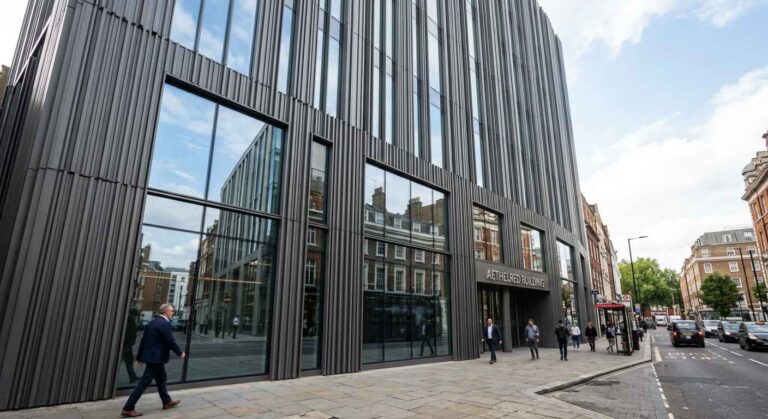
Walk past a glass office tower at noon and the cladding tells a story in its reflections. Some walls ripple faintly, while others read as perfectly straight lines. That difference usually starts with how the aluminum wall panels were made.
Aluminum wall panels form a building’s visible skin, fixed to a frame behind them. They come as flat sheets, composite panels, or solid extruded profiles. That choice shapes installation, upkeep, and aging. This guide compares the options, then covers alloys, applications, finishes, and ordering.
Solid Extruded Profiles Versus Composite Panels
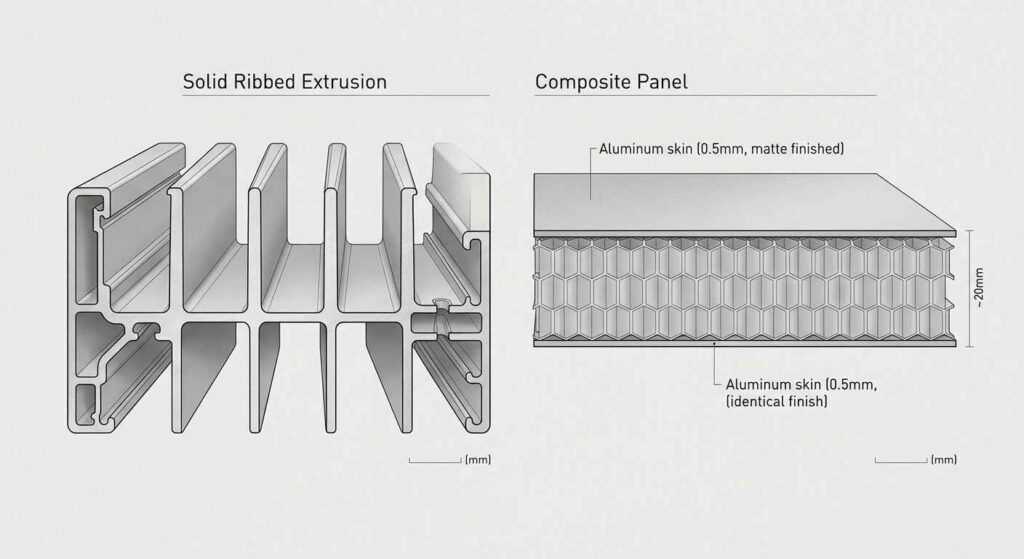
Composite panels sandwich a plastic or mineral core between two thin aluminum skins. Solid extruded profiles skip the core, and that changes how the wall behaves.
One Piece, No Core
An extrusion is aluminum pushed through a shaped steel die, much like dough through a cookie press. The result is one continuous piece with no glue line. Nothing can delaminate when the facade bakes in sun or takes driving rain.
No Oil Canning
Oil canning is the waviness that appears when thin, flat metal buckles slightly. It rarely affects strength, yet it makes a new facade look cheap. Ribbed, interlocking profiles resist that buckling, so reflections stay crisp.
Lighter Than Steel
Aluminum’s density is about 2.70 g/cm³, roughly a third of steel’s. A sub-frame of Square Hollow sections therefore adds far less dead weight. Lighter members also mean easier lifting and faster fixing at height.
When Composite Wins
The press and die limit how wide an extruded profile can be. For large, flat, seamless panels on a tight budget, a composite or flat sheet system often costs less. Solid profiles earn their price where flatness and durability matter most.
Which Alloy Belongs Where in the Wall
Each profile in a wall does a different job, so the alloy should follow that job. T5 and T6 are heat treatments applied after extrusion, and T6 gives the higher strength. Load-bearing backing such as Rectangular Hollow rails therefore needs a stronger grade than the visible face.
| Alloy | Best For | Less Suitable For |
| 6063-T5 | Visible faces, trims, anodized parts | Heavy load-bearing frames |
| 6061-T6 | Structural sub-frames and brackets | Showpiece decorative finishes |
| 6005 | Rails and mounting systems | Intricate decorative shapes |
Exalum extrudes all three grades; the right mix depends on load, exposure, and finish.
Where Extruded Wall Profiles Go to Work
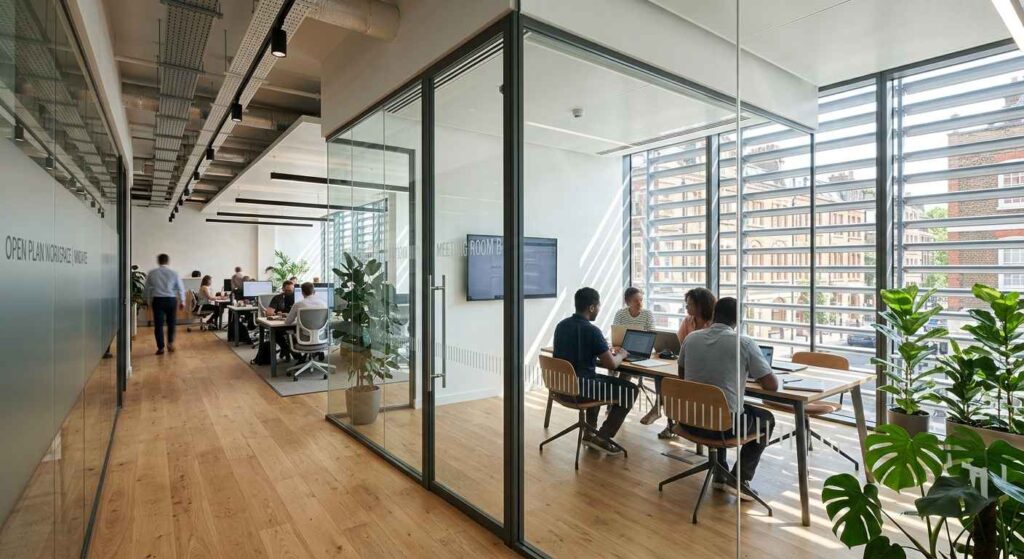
The same extrusion logic serves very different wall systems. Each one uses profile shape to solve a specific problem.
Spandrel Cladding
Spandrel profiles are narrow strips that interlock into a continuous surface for cladding and soffit ceilings. Each strip is rigid on its own, so the face stays straight without heavy backing. They suit walkways, canopies, and feature walls.
Partitions and Glass Walls
Inside, modular Partition frames hold glass or solid infill to divide open floors. The frames assemble like a kit, so tenants can move rooms later. Glass infill also keeps daylight moving through the space.
Curtain and Window Walls
Curtain Wall mullions (vertical members) and transoms (horizontal members) form the grid that carries facade glass. Window walls use the same idea but sit between floor slabs. Both depend on precise profiles, since small errors add up across a tall elevation.
Louvers and Sunscreens
Architectural Louvers use angled blades that shade glass while letting air through. On sun-facing walls, they cut heat gain and cooling loads. They also screen rooftop equipment and parking decks from view.
Finishes That Decide How the Wall Ages
The finish is the part of the wall people see every day. It also sets how the surface copes with UV, rain, and salt.
- Anodizing: thickens the natural oxide layer, so protection is part of the metal and cannot peel. It suits humid and coastal sites.
- Powder coating: bakes on a colored polymer layer for custom colors and UV resistance. It helps when a Shop Front must match the facade.
- Mill finish: leaves the raw extruded surface with no added treatment. It keeps costs down on sub-frames hidden behind cladding.
What a Cladding Order Needs Before Cutting
Most cladding delays trace back to details left open at the drawing stage. Confirm these points before production starts.
- Profile shape: a custom die turns your drawing into a repeatable section. Share the cross-section early, since die work sets lead time.
- Wall thickness: thicker walls resist wind load and impact. Thinner walls save weight where loads are light.
- Finish and exposure: state whether the site is indoor, urban, or coastal. The finish can then suit real conditions.
- Thermal movement: a 6 m profile grows about 5.5 mm over a 40°C swing. Slotted fixings let it move without buckling.
- Fixings: Equal Angle brackets and trims tie cladding to the structure. Order them with the panels so sizes match.
Fire, Upkeep, and Recycling Over a Wall’s Life
Three long-term factors shape the real cost of a wall. Solid aluminum performs well on each one.
- Fire: solid aluminum is non-combustible, with no plastic core to feed a flame. Always confirm your local facade rules.
- Upkeep: anodized and powder-coated profiles need only periodic washing. There is no repainting cycle, unlike painted steel.
- Recycling: aluminum remelts without losing its properties. Recycling uses about 5% of the energy of new metal.
Turning a Facade Drawing Into Site-Ready Profiles
Exalum Metal extrudes the profiles behind aluminum wall panel systems, from spandrel cladding and partitions to curtain wall sections. We also supply the hollow sub-frames and angle brackets behind them, made at our factory in Indonesia.
When a design needs a shape the catalog lacks, we cut a custom die to your dimensions. Profiles ship in mill finish, anodized, or powder coated, cut to length and CNC-drilled on request. We plan production around volume orders, so large packages stay consistent.
Bring elevations, section drawings, or an estimated quantity, and our team will match alloy and finish to each part. A rough bill of materials is enough to start. Get in touch with our team directly through our contact inquiry or click the “Contact Us” button below.