
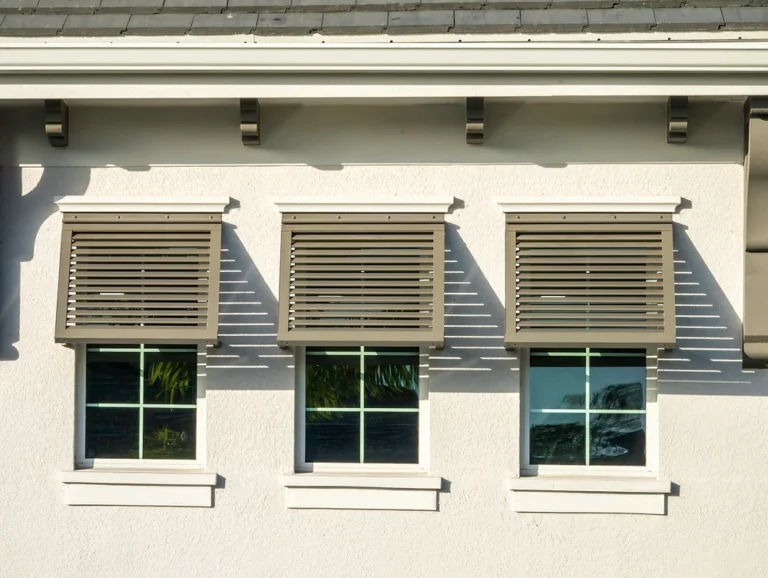
A Bahama shutter does two things that rarely come together. Mounted at the top of a window and propped outward on an angle, it shades the glass and gives a building that unmistakable tropical, coastal look during everyday weather. When a storm approaches, the same shutter folds flat down against the window and locks, turning from a decorative sunshade into a protective cover. That combination of permanent shade, year-round style, and on-demand protection is why Bahama shutters have become a fixture of coastal homes, and why aluminum is the material that makes them last. We produce the louvered and structural extrusion that Bahama shutters are built from, and the points below cover how they work and what makes them perform.
How a Bahama Shutter Works
The design is defined by where it mounts and how it moves. A Bahama shutter hinges along the top edge of the window, above the opening, rather than at the sides. In its open position it props outward and downward at an angle, held by an adjustable arm or telescoping support, so it hangs over the window like a fixed awning made of louvered slats. In that position it blocks high overhead sun while the angled louvers still let breeze and filtered light through, which is exactly what suits a hot, sunny climate.
When weather threatens, the support arms release and the shutter swings down flat against the window, where it latches into place and covers the glass completely. In that closed position, a properly built Bahama shutter provides a barrier against wind-driven debris and the elements. The single top-hinged design is what gives the shutter its dual character, a shade in fair weather and a cover in foul, without any need to remove or store it.
Why the Louvers Matter
The angled slats are the defining feature of a Bahama shutter, and they do real work. In the open, propped position, the louvers shade the glass from direct sun while their angle still admits airflow and soft, indirect light, so the room behind stays cooler and brighter than it would behind a solid cover. This is the quality that gives Bahama shutters their relaxed, breezy, coastal character.
The louver design also matters in the closed position, where the slats and the frame together have to form a barrier that resists wind and debris. The geometry, spacing, and strength of the louvers determine both how well the shutter shades and how well it protects, which is why the slat profile is the heart of the shutter. Extruded aluminum louvers hold a consistent shape and angle, resist the loads applied to them, and keep their finish through years of sun and salt, which is what a Bahama shutter needs to perform season after season.
Why Aluminum Is the Material for Coastal Shutters
Bahama shutters live where the weather is hardest on materials, in the sun, the humidity, and the salt air of coastal climates. That environment is exactly where aluminum earns its place. Its natural corrosion resistance means the shutter survives salt-laden coastal air without rusting, where steel would corrode and wood would rot and warp. The light weight matters because a top-hinged shutter is propped and lowered repeatedly, and a lighter shutter is easier to operate and puts less load on its hinges and mounts.
The strength of structural aluminum lets the louvers and frame resist storm loads when the shutter is closed and latched. And the finish quality of anodized or powder-coated aluminum gives the shutter a color-stable, durable surface that holds its appearance in brutal sun, which matters for a feature that is visible on the building year-round and chosen partly for its looks. Aluminum is the material that lets a Bahama shutter be both beautiful and genuinely protective for the long haul.
What Goes Into a Bahama Shutter That Performs
A Bahama shutter that delivers on both of its jobs depends on how it is built. The louver profile has to be engineered for both shade and strength, with the right thickness, spacing, and angle to shade effectively while resisting wind and debris loads when closed. The frame has to be strong enough to hold the louvers rigid and carry storm loads into the mounting.
The alloy and temper set the structural strength, so a shutter that has to provide genuine storm protection needs structural-grade aluminum rather than a soft architectural grade. The hinges, arms, and latches have to match the strength of the shutter itself, because a shutter is only as protective as its weakest connection, and the top-hinge and latch points carry significant load in a storm. The corrosion resistance has to last through years of coastal exposure between storms, so the shutter is ready when it is finally needed. And the finish has to withstand relentless sun without fading or chalking. These requirements come down to the engineering of the profiles and the extrusion quality behind them, which is why the material source is as important as the shutter design.
How Bahama Shutters Connect to Our Products
Bahama shutters are built from exactly the louvered and structural extrusion we produce, with the strength, corrosion resistance, and durable finishing that coastal storm protection demands. Our vertically integrated facility in Indonesia spans 20,000 square metres and manages alloy, extrusion, and finishing as one chain, delivering the consistency and durability these shutters require.
The profile range covers the components a Bahama shutter is built from:
- Louvers profiles for the angled slats that define the shutter and provide both shade and protection
- Square Hollow and Rectangular Hollow for the shutter frame and structural members
- Equal Angle and Unequal Angle for the brackets, hinges, and mounting connections
- Flat Bars for the frame rails, latch bars, and reinforcement
- Round Bars for hinge pins and the pivot hardware the top-hinge design depends on
- Tubing Pipes for the support arms that prop the shutter open
For shutter makers who need a specific louver profile or frame section, custom extrusion produces the exact geometry the design requires, finished in-house with anodizing or powder coating that survives the coastal environment Bahama shutters are made for.
Coastal Style That Protects
A Bahama shutter is one of the few building features that is genuinely decorative and genuinely protective at the same time, shading the window and shaping the look of the home every day, then closing down to defend it when a storm comes. Aluminum is what lets it do both for decades, by resisting the coastal climate, carrying the storm loads, and holding its finish in the sun. The key is a louver and frame engineered for shade and strength, the right alloy, strong hinges and latches, and a manufacturer whose extrusion you can rely on.
We have supplied louvered, structural, and architectural aluminum extrusion to fabricators and manufacturers since 2009, with the strength, consistency, and corrosion-resistant finishing that coastal applications demand.
Whether you need standard profiles or custom cross-sections designed for your specific shutter system, we have the capacity and expertise to deliver.
Ready to discuss your project or request material specifications? Get in touch with our team directly:
Email: [email protected] WhatsApp: +62 811 9429 970 Website: www.exalummetal.com
When the shutter has to charm in the sun and hold in the storm, start with extrusion you can trust. Make Exalum Metal your standard.