
A homeowner opens a set of heavy living room curtains every morning. They barely notice the metal bar or track running quietly along the top of the window.
That metal component does more work than it gets credit for. It carries the full weight of the fabric and keeps the curtain moving in a straight line. It also anchors the entire system to the wall.
Traditional curtain hardware refers to the rods, tracks, brackets, and small connecting pieces that hold a curtain in place, separate from the fabric panel itself. This article breaks down what each component does, piece by piece, compares the main hardware options, and covers what to check before selecting a system.
Why Curtain Hardware Determines How Well a Room Functions
A curtain looks like a simple piece of fabric. The hardware behind it decides whether that fabric opens smoothly, hangs evenly, and survives years of daily use. A sagging rod or a sticking track quickly becomes a daily annoyance, regardless of how attractive the fabric is. Even expensive fabric cannot hide hardware that fails to perform. A track that sticks can turn a simple daily task into a source of frustration.
For that reason, the hardware often matters more to long-term satisfaction than the fabric choice itself. A well-chosen system disappears into the background. A poorly matched one draws attention every time it gets used.
Strengths and Limitations of Aluminum Curtain Hardware
What Aluminum Curtain Hardware Does Well
Aluminum rods and tracks are light enough to install without heavy wall anchoring. They stay stiff enough to resist bowing under the weight of most curtain fabrics. That combination makes installation easier, particularly near large glazed openings such as a Windows Wall. Installers often notice the weight difference the moment they lift the box.
Aluminum also resists corrosion without extra coating. Tracks and rods keep sliding smoothly for years, even in bathrooms or coastal homes where humidity would eventually corrode untreated steel. This is especially valuable in older homes with less controlled humidity.
Where Aluminum Curtain Hardware Has Limitations
Aluminum is not always the strongest option. For extremely heavy blackout or theatrical drapery spanning a wide opening, a steel rod resists bowing over a long span better than aluminum of the same diameter. Specifiers weigh this trade-off case by case rather than defaulting to one material.
On the opposite end, very short, lightweight curtain runs in a budget project sometimes use plastic track instead. The cost difference simply matters more than the performance gap for that application. This is a common choice for rental properties and short-term installations.
Curtain Rods or Curtain Tracks? Choosing the Right System
Curtain rods and a dedicated Curtain Track system solve the same basic problem in different ways. The right choice depends on how the curtain needs to look and move. Both approaches have earned a permanent place in curtain hardware for exactly this reason.
| System | Best For | Less Suitable For |
| Curtain rod | Decorative curtains, visible hardware as part of the design | Frequent daily opening and closing |
| Curtain track | Smooth, repeated operation, hidden hardware behind a valance | Rooms where the hardware itself is meant to be seen |
Many installations end up using both, with a track handling the movement and a decorative rod finishing the look. Many commercial installations choose a track for exactly this reason.
The Essential Hardware Behind Every Curtain Installation
Curtain Rods
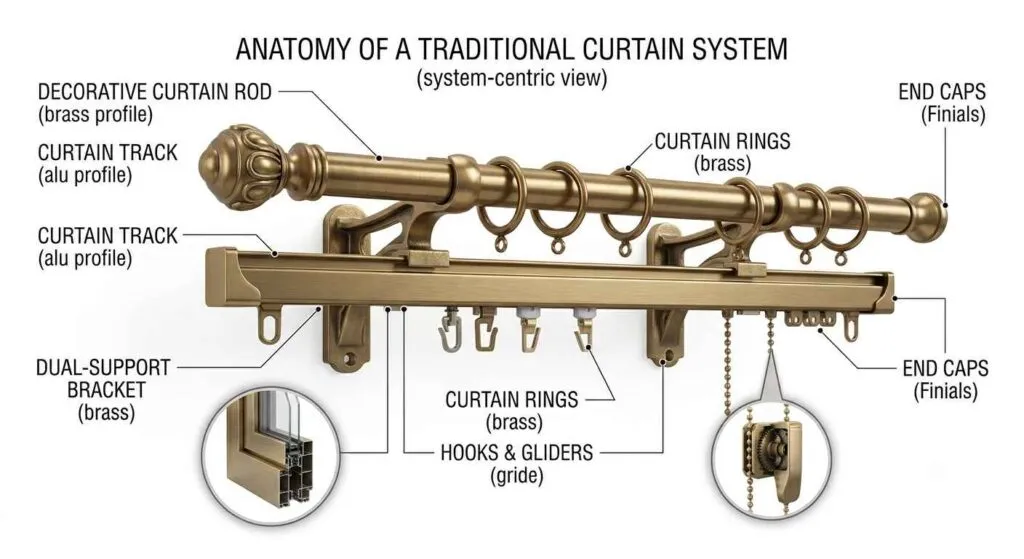
A curtain rod is a straight bar that spans the width of the window opening, carrying the curtain rings or eyelets directly. Many modern curtain rods are manufactured from extruded aluminum tubing because the hollow profile provides sufficient rigidity while remaining lightweight and easy to install.
Exalum Metal’s Decorative Tubing Pipes are engineered for applications where appearance and structural performance are equally important. During the extrusion process, surface patterns such as ribbed, fluted, reeded, wave, or oval designs are formed directly into the profile, eliminating the need for secondary machining while creating a distinctive decorative finish.
The profiles are commonly produced in 6063 aluminum alloy for excellent surface quality and 6463 alloy for bright anodized decorative finishes. Available surface finishes include mill finish, anodizing, and powder coating, allowing manufacturers to match different interior styles and durability requirements.
| Model | Profile | Typical Use |
| 55041 | Ribbed Ø25 mm | Decorative curtain rods |
| 55043 | Wave Ø25 mm | Contemporary curtain rods |
| 55050 | Oval ribbed | Premium curtain systems |
| 55212 | D-shape | Decorative interior hardware |
These examples represent only a small portion of Exalum Metal’s decorative tubing range. Additional profiles, dimensions, surface patterns, and finishing options are available to accommodate a wide variety of curtain rod designs and interior applications.
Curtain Tracks
A curtain track is a slotted channel, usually mounted overhead, that lets a hidden glider or hook move along its length. Tracks are typically the preferred choice for curtains that open and close often.
Exalum Metal manufactures extruded aluminum Curtain Track profiles for residential, commercial, hospitality, and healthcare projects. The aluminum channel is designed to allow gliders and carriers to move smoothly inside a concealed slot, creating a clean appearance while supporting repeated daily operation.
Depending on the application, curtain tracks are available in several configurations, including:
- Straight tracks for standard window openings
- Curved tracks for bay windows and corner installations
- Heavy-duty tracks for blackout curtains and theater drapery
- Motorized tracks compatible with automated curtain systems
| Model | Thickness & Weight | Application |
| 63010 | 0.80 mm & 0.144 kg/m | C-Track / C-Profile Curtain Track |
| 63020 | 0.80 mm & 0.150 kg/m | Runner Track |
| 63030 | 1.00 mm & 0.195 kg/m | M-Track / M-Profile Curtain Track |
Manufactured from extruded aluminum, these curtain tracks provide higher stiffness than plastic alternatives while remaining lightweight and corrosion resistant. They support both ceiling-mounted and wall-mounted installations, making them suitable for everything from residential interiors to hotels, hospitals, and commercial buildings.
Brackets and Supports
Brackets anchor the rod or track to the wall or ceiling and carry the entire weight of the system. An Equal Angle profile is a common base shape, since its two even legs make fixing and supporting simple.
Rings, Hooks, and Gliders
Rings, hooks, and gliders connect the fabric to the rod or track, and are what actually moves when the curtain opens. These small components are usually the first parts to wear out.
What to Consider Before Selecting Curtain Hardware
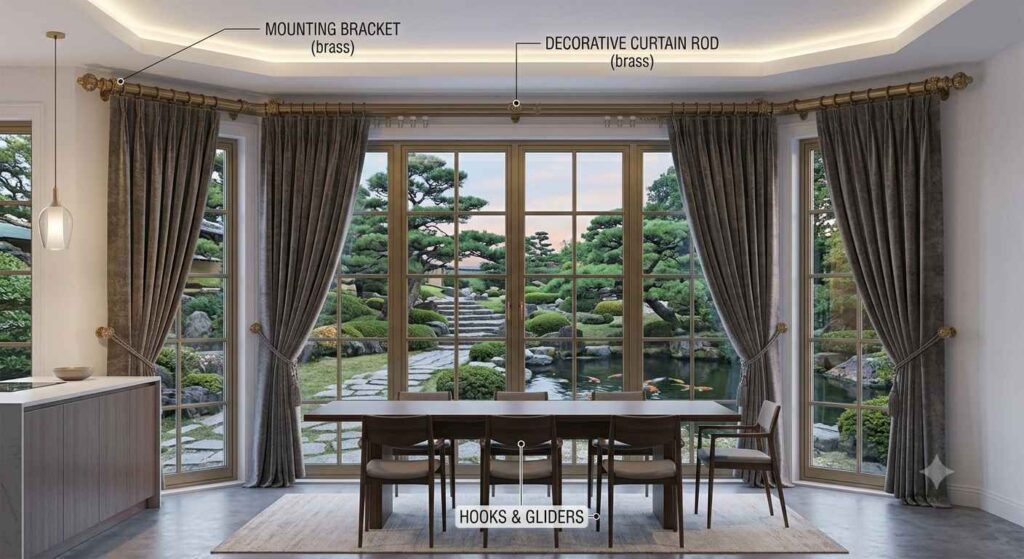
Choosing the right hardware starts with a few practical questions about the window and the fabric. Getting these details right the first time avoids a costly hardware swap later.
- Window size: wider openings need a thicker rod or reinforced bracket spacing to avoid sagging.
- Curtain weight: heavy blackout or lined fabric puts more load on the system than light, sheer fabric.
- Mounting method: ceiling-mounted tracks distribute weight differently than wall-mounted brackets.
- Indoor environment: bathrooms, kitchens, and coastal homes benefit from corrosion-resistant aluminum over untreated steel.
- Raw profile source: fabricators often source rod and bracket stock from Flat Bars rather than custom-tooling every component.
- Operating mechanism: a wand, cord, or Handle style pull needs to match the track type before final assembly.
- Finish matching: anodized or powder-coated hardware should match nearby window frames or a Curtain Wall system for a consistent look.
Aluminum Curtain Hardware Profiles from Exalum Metal
Exalum Metal extrudes and finishes the rod, track, and bracket profiles that curtain hardware manufacturers rely on for smooth, long-lasting systems. Many curtain hardware brands standardize on a small set of profiles across multiple product lines. This consistency simplifies manufacturing and keeps replacement parts easy to source.
Custom extrusion is available for project-specific rod diameters and track profiles. Finishing services include mill finish, anodizing, and powder coating. Volume order support extends to manufacturers producing hardware lines at scale, including complementary product ranges such as Furniture trim that shares the same finish specification.
If you are developing a curtain hardware product line, send us your drawings, dimensions, or an estimated volume. Our team will confirm what runs as a standard profile and what needs custom tooling.
Get in touch with our team directly:
Email: [email protected] WhatsApp: +62 811 9429 970 Website: www.exalummetal.com