
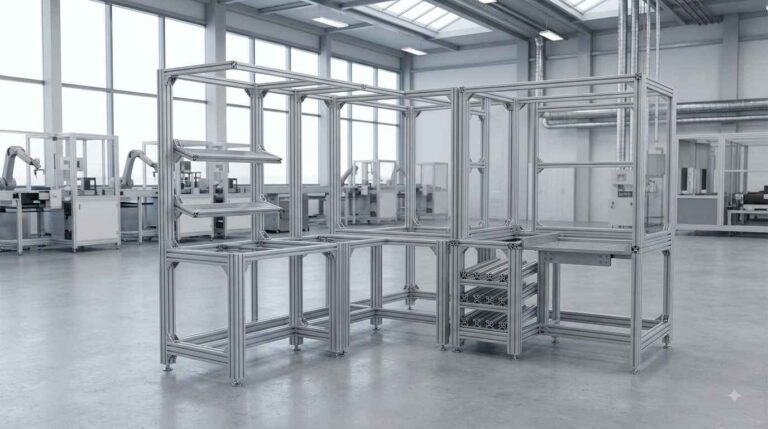
A modular frame sits on a production floor, with bolted sections ready to move as the layout changes.
Aluminum profiles are extruded sections with consistent shapes and sizes. These profiles can form modular structures without permanent fabrication for every change.
That flexibility helps when layouts change. It also gives businesses more options when equipment, workspaces, or production systems need to expand.
This article explains why aluminum suits modular construction, which profiles fit common structures, and what to consider before ordering.
Why Aluminum Profiles Suit Modular Systems
Aluminum balances low weight, useful rigidity, corrosion resistance, and fabrication ease. As a result, it suits structures that need assembly, relocation, or expansion.
Lightweight Profiles Make Assembly Easier
Aluminum weighs less than steel, making modular sections easier to lift and position. Profile geometry still provides rigidity without unnecessary material.
Extruded Shapes Simplify Connections
Extrusion shapes heated aluminum through a die, which is a tool that creates a consistent cross-section. Square Hollow, channels, angles, and flat bars provide surfaces for bolts and brackets.
Standard Profiles Make Replacement and Expansion Easier
Standard sections let manufacturers use an existing profile instead of developing a new extrusion. Exalum’s range can simplify replacement when dimensions already fit.
Aluminum Profiles Used in Modular Structures
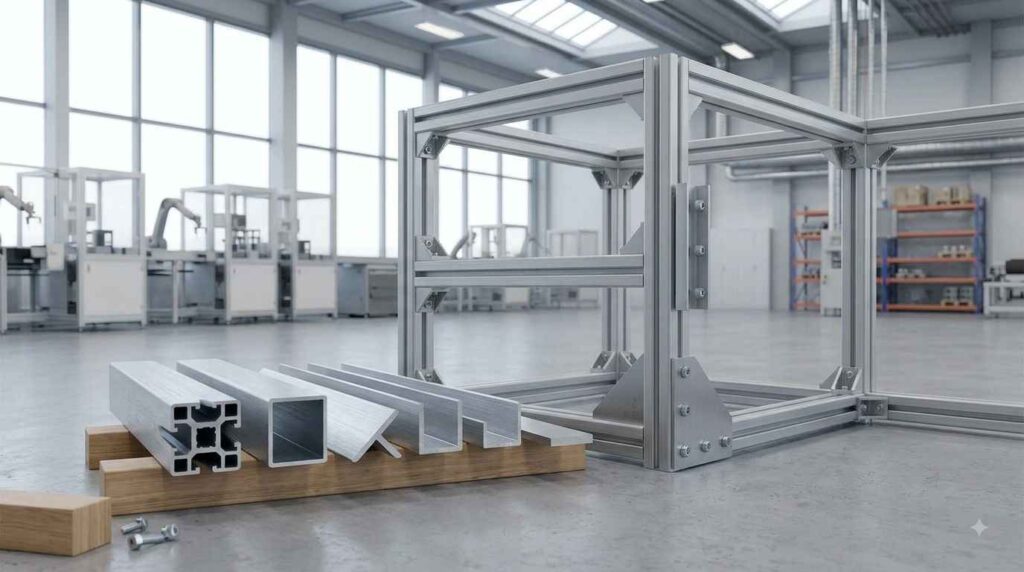
Each profile shape suits different structural tasks, so selection should start with how it will support or connect components. Exalum offers several practical shapes for modular construction.
Square and Rectangular Hollow Profiles for Structural Frames
Hollow profiles have an enclosed space that reduces material while maintaining stiffness. Rectangular Hollow sections suit workstations, equipment frames, supports, and lightweight structures.
Equal Angles for Corners and Structural Connections
An equal angle has two legs of the same width meeting at a right angle. Equal Angle profiles can reinforce corners, join perpendicular sections, or form simple brackets.
Equal and Unequal Channels for Mounting and Support
Channels have a U-shaped cross-section that creates a mounting surface and side walls for support. Equal Channel and unequal channels work when one side needs more reach or support.
Flat Bars for Simple Brackets and Reinforcement
Flat bars are solid rectangular strips for straightforward reinforcement and mounting. Flat Bars can complement hollow sections when a simple connection piece is enough.
Where Modular Aluminum Profiles Are Used
Modular profiles help when structures must fit changing equipment, spaces, or workflows. The same principle applies to industrial systems, commercial spaces, and interior structures.
Modular Conveyor Frames
Aluminum profiles can form conveyor frames that support rollers, guides, and related components. Conveyor systems benefit when frame sections need adjustment or replacement.
Partitions and Interior Structures
Profiles can create lightweight frames for office, commercial, and industrial partitions. Partition systems can make individual sections easier to install or reconfigure.
Modular Furniture and Display Structures
Furniture and display frames need manageable weight and clean geometry. Furniture structures can use aluminum sections for different sizes and configurations.
Sliding Doors and Windows
Aluminum profiles support systems where panels move along tracks or fit different opening dimensions. Sliding Doors can combine structural support with practical movement and replacement.
What Makes a Modular Aluminum System Easy to Modify?
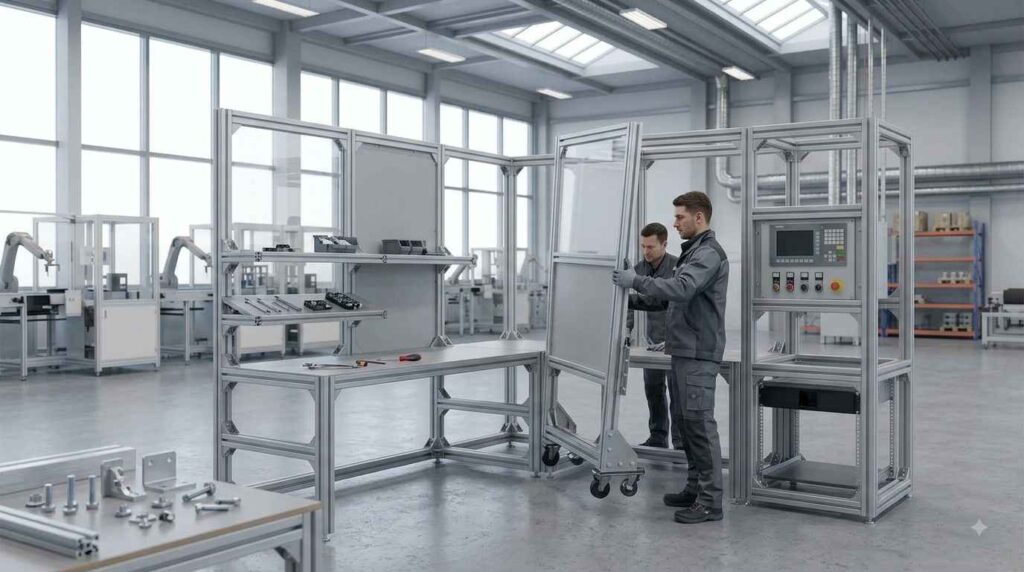
A modular system is not flexible simply because it uses aluminum. Connections, standardized dimensions, adjustable supports, and repeatable module sizes determine how easily the structure can be assembled, repositioned, or expanded.
Mechanical Connections Instead of Permanent Fabrication
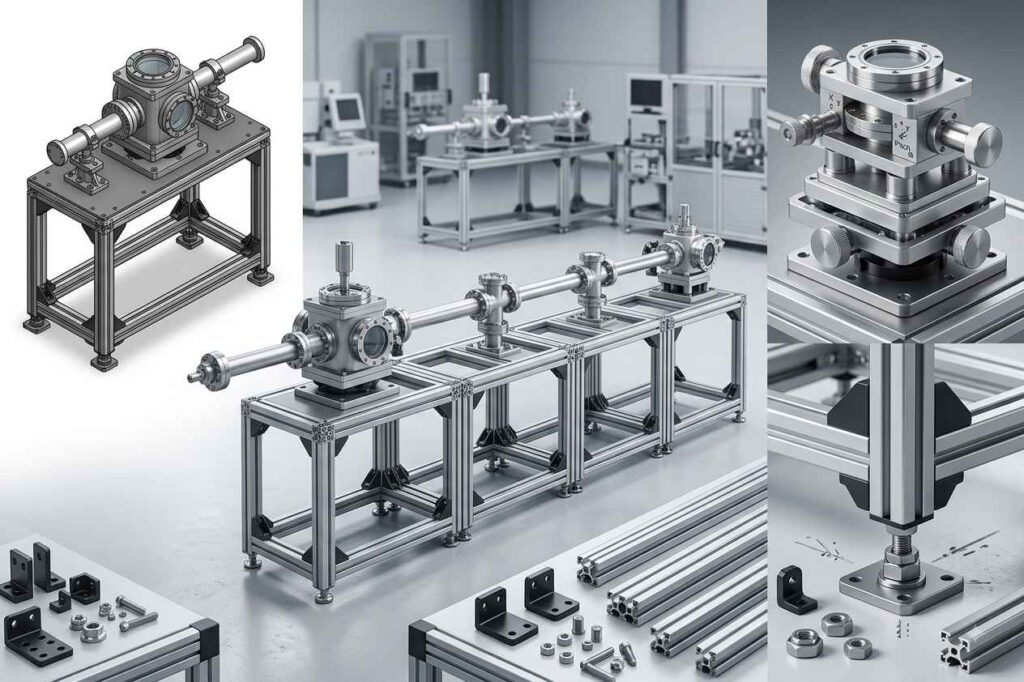
Bolts, brackets, nuts, and other mechanical fasteners connect aluminum profile sections without permanently joining them. As shown in the modular frame design, this allows individual sections to be disassembled, repositioned, or replaced without rebuilding the entire structure.
Standard Profiles Reduce the Need for New Tooling
The frame uses consistent aluminum profile sections across its repeated modules. An extrusion die creates a specific profile cross-section, so using an existing standard profile can avoid developing new tooling when its dimensions and performance already meet the project’s requirements.
Consistent Dimensions Support Repeatable Assembly
Consistent profile dimensions help modules maintain the same proportions and connection points during assembly. In the illustrated design, each module measures 1,000 mm × 600 mm and can be combined into a longer structure, while adjustable leveling feet allow the assembled frame to be fine-tuned without modifying the main profiles. For systems using Sliding Windows, consistent sections can similarly support repeatable panel and frame fit.
Aluminum Profiles or Steel for Modular Structures?
Both materials can provide strong structures, but they suit different priorities. Aluminum often fits lightweight modular systems, while steel can be better for high loads and severe impact.
| Material | Best For | Less Suitable For |
| Aluminum | Lightweight modular systems | Extreme heavy loads |
| Steel | Heavy-duty structures | Frequent lightweight modification |
A machine base with severe impact loads may benefit more from steel. By contrast, a relocatable workstation may gain from aluminum’s lower weight.
What to Consider When Choosing Modular Aluminum Profiles
The best profile meets structural needs without adding unnecessary material or complexity. For modular commercial framing, Shop Front is another relevant profile category.
- Dimensions and fit: Check width, height, and length against surrounding components and installation space.
- Wall thickness: Thicker walls can improve rigidity, but they also add weight and material cost.
- Alloy grade: The alloy affects strength, corrosion behavior, and fabrication suitability.
- Connection method: Confirm where bolts, brackets, panels, tracks, or other components will attach.
- Surface finish: Mill finish suits basic uses, while anodizing or powder coating can change appearance and surface protection.
- Operating environment: Consider moisture, outdoor exposure, chemicals, temperature, and cleaning conditions.
- Standard or custom extrusion: Check existing profiles first, then consider a custom die when no standard section meets the dimensions.
A custom profile can make sense when its geometry provides a clear functional benefit at sufficient volume. However, a standard section may be simpler when it already meets the project’s needs.
Modular Aluminum Profiles from Exalum Metal
Exalum Metal provides aluminum extrusion profiles for modular structures, including hollow sections, angles, channels, and flat bars. These profiles can support projects that require repeatable components for frames, partitions, furniture, conveyors, and other structures.
For project-specific dimensions, Exalum can support custom extrusion and finishing services such as mill finish, anodizing, and powder coating. Volume order support can also help businesses plan consistent supply for production runs, replacement parts, or larger construction projects.
Bring your drawings, specifications, target finish, or estimated volume to the Exalum team for discussion. The right starting point may be an existing profile or a custom extrusion based on the project’s actual requirements.
Get in touch with our team directly through our contact inquiry or click the “Contact Us” button below.