
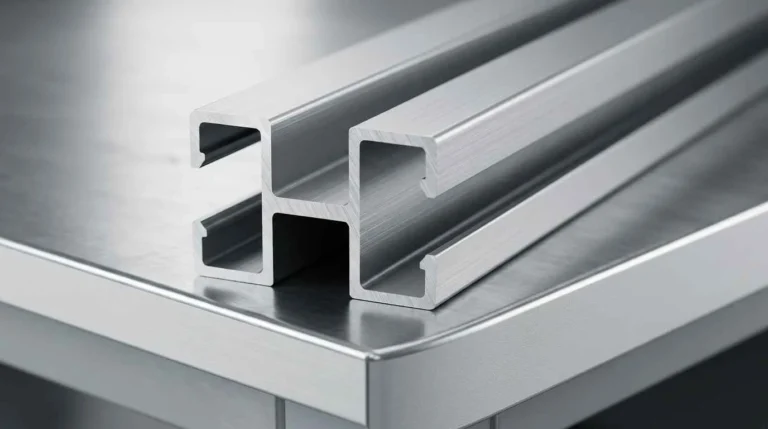
A fabricator lining up two acrylic display panels for a retail fit-out needs more than adhesive to keep the seam straight. An aluminum H Profile, named for the H shape formed by its cross-section, slides over both panel edges at once and holds them in a single aligned line. Each side channel grips one panel, keeping the joint square and protected once the project is finished. This guide covers how H Profiles work, where they appear, and how alloy selection affects strength, appearance, and cost.
What Is an Aluminum H Profile?
An aluminum H Profile is an extruded section shaped like the letter H in cross-section, also sold as an H-section, H-bar trim, or joining channel. The two outer channels sit opposite each other, each sized to accept the edge of a panel.
- How Does an H Profile Join Two Panels?
One panel slides into one channel, and the adjacent panel slides into the opposite channel. This keeps the seam aligned during installation and gives the finished joint a clean, consistent appearance.
What Are Aluminum H Profiles Used For?
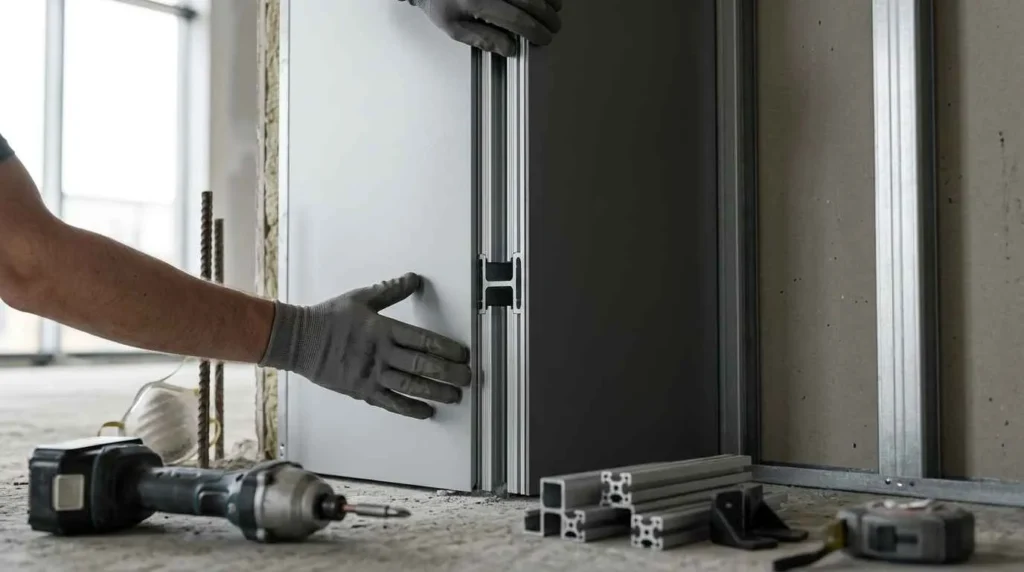
H Profiles appear anywhere two flat panels meet along a shared edge, though material and finish requirements shift by setting.
- Panel Joining and Edge Alignment
Fabricators use H Profiles to join plywood, composite boards, acrylic sheets, and decorative panels, often in 6063 alloy for its smooth extrusion and finishing.
- Edge Protection and Sealing
The profile can shield exposed panel edges from mechanical wear, impact, chipping, and moisture. Where mechanical stress is also a factor, 6061 alloy may be a better fit.
- Interior Partitions and Modular Framing
Office dividers, modular walls, exhibition panels, and temporary partitions often use H Profiles to join sections, connecting naturally to Partition systems built for reconfigurable interior work.
- Facade Cladding and Spandrel Panels
On exterior work such as composite cladding and spandrel boards, the profile must account for thermal movement alongside durability, which is part of why exterior work tends to favor 6005 or 6061.
- Signage and Light Box Structures
Retail displays, advertising boards, light boxes, and shop front panels can use H Profiles to join lightweight display panels without adding structural weight.
- Furniture and Modular Joinery
Cabinets, shelving, and modular furniture sometimes use H Profiles to connect panels without concealed fasteners, overlapping with Furniture profile ranges built for similar joinery.
Panel Materials an H Profile Joins
The panels themselves vary widely, and each material pairs with the channel in a slightly different way.
| Panel Material | Notes for H Profile Joining |
| Acrylic display sheet | Common in retail displays and light boxes, with channel depth matched to sheet gauge |
| Plywood and MDF panels | Interior joinery and modular furniture seams |
| Aluminum composite panel (ACP) | Facade cladding seams, where the channel accommodates thermal movement |
| Glass panels | Display cases and glazing infills that need a setting allowance |
| Diamond plate and checker plate | Trailer and industrial wall linings |
| Spandrel board | Exterior spandrel seams held along a shared line |
Aluminum H Profile Applications by Industry
Beyond general panel work, the same joining logic carries into specific industrial and architectural settings where panel gauge and exposure vary.
| Industry | Example Applications | Related Exalum Product |
| Automotive and Transportation | Truck and trailer body framing, cargo wall joining, and chassis trim | Automotive |
| Industrial Machinery and Assembly | Machine frames, automation guarding, anti-static workbenches, and cable routing channels | Conveyor, Heatsink |
| Renewable Energy and Glazing | Solar panel mounting rails, curtain wall transoms and mullions, and glass light boxes | Solar Rail & Solar Panel, Curtain Wall |
Why Use Aluminum for H Profiles?
Aluminum is not the only material capable of joining two panels, but several properties make it a common choice.
- Lightweight Construction
Aluminum can reduce overall system weight compared with heavier metals, useful where the structure behind the panel has limited load capacity.
- Corrosion Resistance
Where moisture or weather exposure is a factor, aluminum’s natural corrosion resistance can reduce long-term maintenance versus untreated steel.
- Extrusion Flexibility
Extrusion lets manufacturers adjust channel width and wall thickness to match different panel thicknesses without redesigning the system.
- Surface Finishing Options
H Profiles can be supplied in mill finish, anodized, or powder-coated options, letting the visible face match the surrounding panel or frame.
How to Choose the Right Aluminum Alloy for an H Profile?
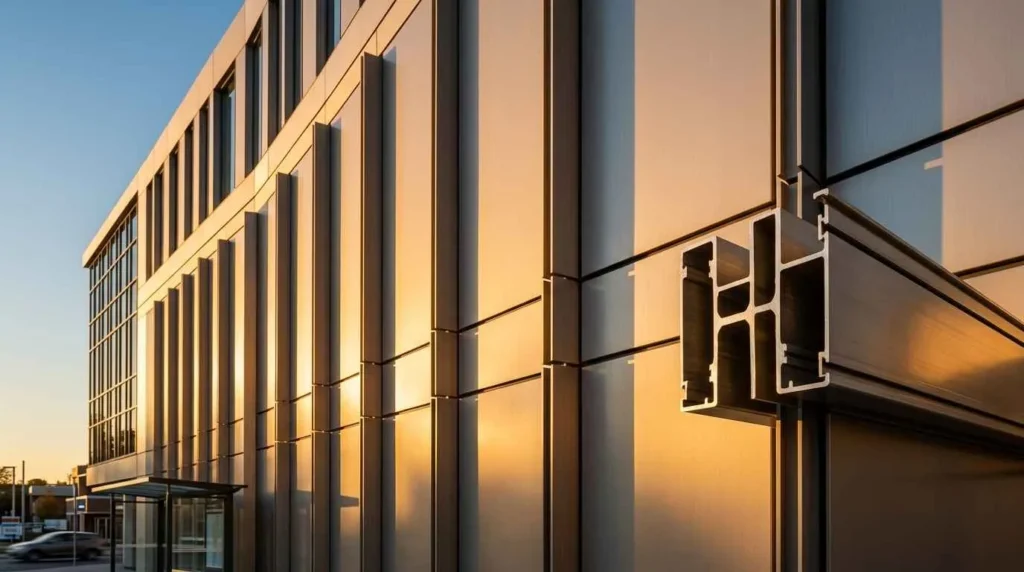
Alloy choice depends on the strength the joint carries, how visible the profile will be, and whether the application sits indoors or outdoors.
- Series 6063 for Smooth and Decorative Applications
6063 is commonly used for interior partitions, doors and windows, and modular furniture, largely because it extrudes cleanly and takes a smooth finish well.
- Series 6061 for Higher-Strength Applications
6061 is typically considered for heavy-duty frameworks and edge protection such as door jamb framing, since T6-temper 6061 commonly reaches a yield strength around 270 to 280 MPa, noticeably higher than 6063.
- Series 6005 for Exterior and Structural Applications
6005 sits between the two in practice, with published T6-temper yield strength generally falling between roughly 250 and 300 MPa, often evaluated for facade systems, spandrel panels, and structural joinery.
Mechanical Properties at a Glance
The figures below put the three Exalum alloys side by side so the strength and finish trade-offs are easier to weigh.
| Alloy and Temper | Typical Yield Strength | Relative Strength | Standout Trait | Best-Fit H Profile Use |
| 6063-T5/T6 | ~150 to 215 MPa | Lower | Cleanest extrusion and smoothest anodized finish | Interior partitions, furniture, visible trim |
| 6005-T6 | ~250 to 300 MPa | Medium to high | Balances strength with weather performance | Exterior cladding, spandrel panels, structural joinery |
| 6061-T6 | ~270 to 280 MPa | Highest | Strongest of the three, with good impact resistance | Heavy-duty framing, door jamb edges, high-stress joints |
Choosing an Aluminum H Profile Based on the Application
The table below summarizes how application and alloy choice tend to line up, though the right combination should still be evaluated against the project’s own structural and finish requirements, including curtain wall systems where panel movement and exposure both matter.
| Application | Recommended Consideration |
| Interior partitions | 6063 and smooth surface finish |
| Furniture | 6063 and decorative finishing |
| Heavy-duty protection | 6061 and higher strength |
| Exterior cladding | 6005 or 6063 depending on structural requirements |
| Spandrel panels | 6005 or 6063 |
| Signage | Lightweight profile with suitable dimensions |
Related Aluminum Profiles for Panel and Architectural Systems
H Profile decisions rarely happen in isolation. The table below summarizes how it lines up with the Exalum Metal product categories already discussed in this guide.
| Exalum Product | How It Aligns with H Profile |
| Partition | H Profile joins adjoining panel sections in office dividers, modular walls, and reconfigurable interior partition systems. |
| Spandrel | On exterior work, H Profile helps align spandrel boards along a shared seam while accounting for thermal movement. |
| Furniture | Cabinet, shelving, and modular furniture panels can use H Profile to connect sections without concealed fasteners. |
| Door Jamb | Shares the same edge-framing logic as H Profile, though door jamb wraps a single opening rather than joining two panels. |
| Curtain Wall | H Profile may be specified where curtain wall infill panels meet, with panel movement and exposure both factored into alloy choice. |
Find the Right Aluminum Profile for Your Project
Choosing the right H Profile comes down to a few practical questions: panel thickness, structural demands, indoor or outdoor environment, surface finish, and the alloy that best balances strength and appearance.
Exalum Metal supports these decisions with custom extrusion for project-specific dimensions, mill, anodized, and powder-coated finishing, and volume order support for larger commercial projects.
Sharing drawings, panel dimensions, and an estimated order volume helps our team recommend the right profile and alloy combination.
Get in touch with our team directly through our contact inquiry or click the “Contact Us” button below.