
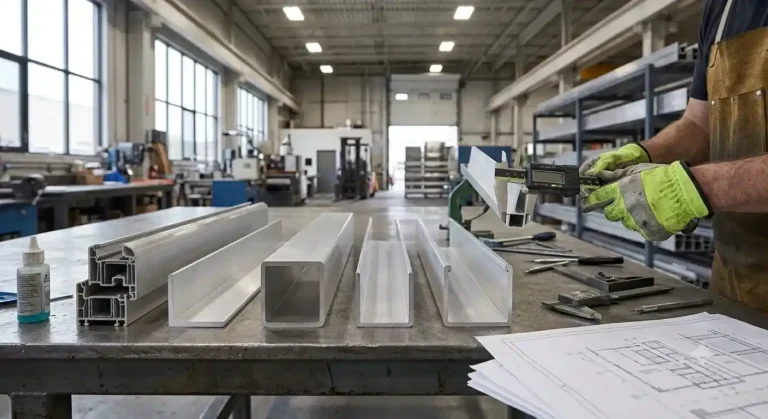
You walk through a commercial building project and spot two profiles in the same crate, nearly identical in shape. One has a slight inward fold at the tip of each flange. A fabricator grabs that one and sets the other aside. Why?
Both aluminum C channel and U channel are open, three-sided profiles that wrap around edges, guide panels, and frame openings. The wrong selection leads to deflection problems and rework that cost far more than the profiles themselves. This guide explains when C channel is the right call, when U channel wins, and what to verify before ordering.
C Channel vs U Channel at a Glance
The terms C channel and U channel can describe slightly different geometries depending on the material and manufacturing process.
| Factor | C Channel | U Channel |
|---|---|---|
| Geometry | May include lip returns or, in structural steel terminology, tapered flanges | Typically uses two open, parallel flanges |
| Load behavior | Better suited to profiles designed for additional stiffness or spanning | Better suited to supported sections and light structural or retention roles |
| Manufacturing | Commonly extruded in aluminum or hot-rolled/formed in steel | Commonly extruded, roll-formed, or hot-rolled depending on the material |
| Installation | Lip geometry may require channel nuts or specific fastening methods | Open parallel flanges simplify panel insertion and alignment |
| Typical uses | Framing, runners, structural members, panel support | Panel edging, glazing, tracks, guides, and supported framing |
| Cost considerations | Depends on geometry, alloy, wall thickness, and tooling | Simpler open profiles can be more economical for straightforward applications |
Choose C Channel If
- The application needs additional edge retention.
- The profile must resist loading across an unsupported section.
- A runner, frame, or enclosure benefits from a more enclosed geometry.
- The specific cross-section meets the required structural calculation.
Choose U Channel If
- Glass, panels, or sheet material need to fit into an open slot.
- The channel receives continuous support.
- Easy alignment and installation are the priority.
- The application involves glazing, trimming, or panel guides.
Why C Channel Is Often Confused with U Channel
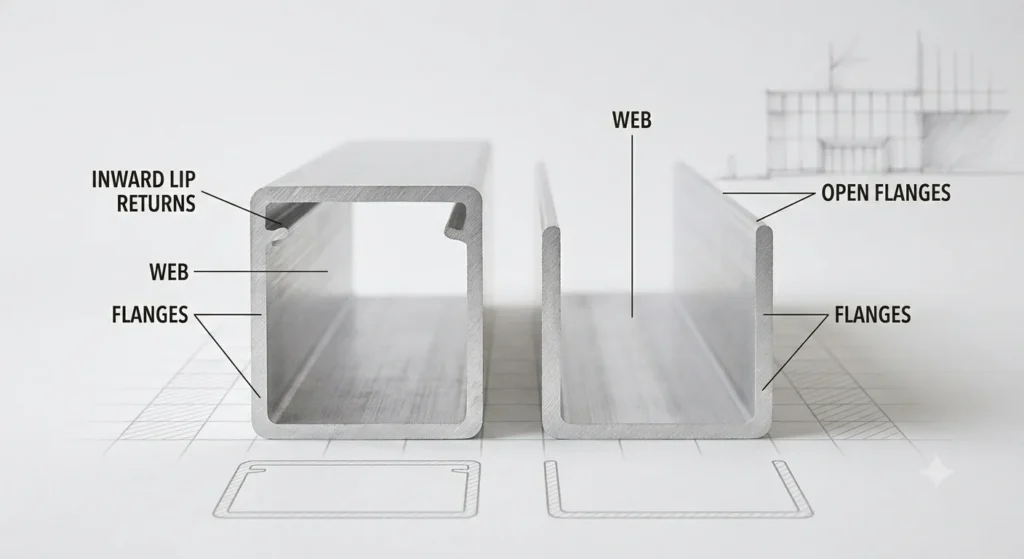
Both profiles use a flat web connected to two flanges, which is why they can look almost identical in a quick cross-section sketch. The confusion becomes greater because the terms C channel and U channel are not always used in exactly the same way across aluminum extrusion, structural steel, and roll-formed products.
In structural steel, a C channel may refer to a standardized channel section with flange geometry that differs from a parallel-flange U channel. Some European structural channel classifications, including UPN sections, use tapered flanges rather than perfectly parallel ones.
In aluminum extrusion, however, C channel often describes a profile with inward lip returns at the edge of the flanges. A U channel generally keeps both flanges open and parallel. The exact geometry should therefore always be confirmed from the profile drawing rather than the product name alone.
Structural Differences That Matter
Lip Design and Additional Stiffness
The inward lips found on certain extruded C channel profiles add material near the outer edge of the flanges, which can increase section stiffness compared with an otherwise similar open profile. However, the actual difference depends on the full cross-section, wall thickness, alloy, orientation, and unsupported span.
For that reason, a C channel should not automatically be treated as stronger than every U channel of a similar size. Structural performance needs to be evaluated from the specific profile dimensions and loading conditions.
This matters wherever the profile carries load along its length. A partition system or curtain wall frame should use a profile selected according to the actual span and loading requirement rather than its channel name alone.
Load Distribution
A U channel distributes load across its web and open flanges, making it suitable for continuously supported applications or light lateral loads. Edge capping, trim, and simple panel retention all fit this profile.
C channel concentrates resistance along its bending axis, making it the more reliable choice when a profile must bridge a gap, absorb repeated force, or carry cladding weight without continuous backing.
Applications Where C Channel Performs Better
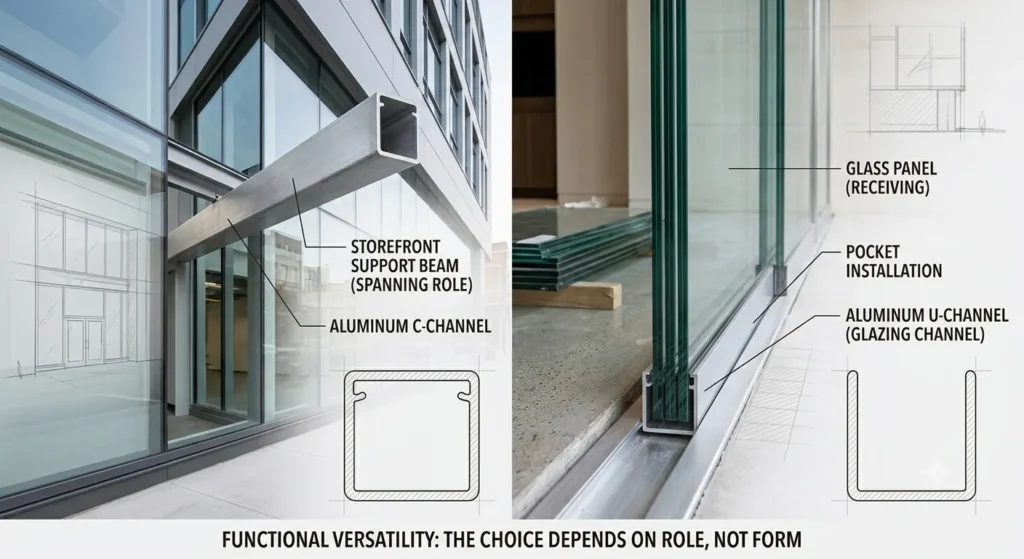
C channel is the correct choice when structural function and channel shape must coexist in the same profile.
- Framing and spanning: C channel used as a head or sill member resists deflection that an open-flanged U channel would show under the same cladding load. This applies directly in sliding door frame assemblies and perimeter framing for shop fronts.
- Track and runner systems: Conveyor side rails and industrial runner tracks benefit from C channel’s lip returns, which stabilize the profile under repeated lateral loading that would gradually deform an open-flanged alternative.
- Structural panel enclosures: Where a channel must hold panels under continuous pressure or vibration, C channel maintains its geometry more consistently than U channel.
When U Channel Is the Better Choice
U channel is appropriate when the priority is a clean, unobstructed slot for inserting panels, glass, or edge material. The open flanges allow straightforward insertion without the interference that lip returns can create in tight-tolerance applications.
Sliding windows, casement windows, and glazing perimeters commonly use U channel because the fit clearance between the panel and the channel mouth is predictable and easy to control. In these cases, the structural advantage of C channel provides no benefit and the lip returns would complicate installation.
For steel-intensive structural applications where high tensile strength is the primary requirement, neither aluminum channel may be the appropriate choice. Hot-rolled steel channel offers higher stiffness-to-section ratios and may be more cost-effective at large spans. Aluminum excels where corrosion resistance, weight, and finish quality matter alongside structural function.
Installation and Fastening Considerations
Channel geometry also affects how the profile connects to the surrounding structure.
A U-channel with open, parallel flanges provides a clear slot for inserting glass, panels, or sheet material. The flat surfaces can also simplify alignment when the channel is continuously supported or mechanically fastened to another surface.
A lipped C-channel can provide additional retention around the edge of a component, but the lip geometry may limit how a panel is inserted. Depending on the design, fastening may use channel nuts, screws, brackets, or purpose-built mounting features.
The important point is to design the fastening method together with the profile. Choosing a channel based only on its outside dimensions can create clearance problems once bolts, panel thickness, gaskets, or other hardware are added.
Choosing Dimensions and Alloy
The right profile dimensions depend on the specific load and gap the channel must serve.
- Web width: Sets the slot opening or spanning depth. Match this to panel thickness or span calculation, not an estimated fit.
- Flange height: Determines contact area against adjacent structure. Taller flanges increase grip and load transfer surface.
- Lip return length: Longer returns add stiffness on C channel but reduce slot clearance. Specify from structural data, not convenience.
- Wall thickness: Heavier walls increase load capacity. Specify from load calculations rather than a catalog default.
- Alloy grade: 6063 suits architectural applications where finish quality matters most. 6061 suits structural applications where tensile strength takes priority.
- Surface finish: Mill finish works for concealed locations. Anodizing resists corrosion in coastal environments; powder coating adds color and an extra protective layer.
Available Aluminum U-Channel and C-Channel Profiles
Exalum Metal offers a range of extruded aluminum channel profiles for architectural, industrial, framing, and custom fabrication requirements. The following standard sections provide a starting point before moving to a project-specific extrusion.
Aluminum U-Channel Profiles
| Section Code | Dimension A | Thickness T | Weight W |
|---|---|---|---|
| 30012 | 9.50 mm | 0.90 mm | 0.064 kg/m |
| 30042 | 12.70 mm (1/2″) | 0.90 mm | 0.088 kg/m |
| 31020 | 15.88 mm | 0.90 mm | 0.112 kg/m |
| 31022 | 9.53 mm | 0.90 mm | 0.065 kg/m |
| 31030 | 19.05 mm (3/4″) | 0.90 mm | 0.135 kg/m |
| 31032 | 12.70 mm (1/2″) | 0.90 mm | 0.089 kg/m |
| 31033 | 19.05 mm (3/4″) | 1.00 mm | 0.149 kg/m |
| 31040 | 25.40 mm (1″) | 1.00 mm | 0.201 kg/m |
| 31042 | 15.88 mm | 0.90 mm | 0.112 kg/m |
| 31050 | 25.00 mm | 0.90 mm | 0.179 kg/m |
Aluminum C-Channel Profiles
| Section | Dimension A | Dimension B | Thickness T | Weight W |
|---|---|---|---|---|
| 31021 | 15.20 mm | 9.10 mm | 1.00 mm | 0.085 kg/m |
| 32032 | 25.40 mm | 12.70 mm | 0.90 mm | 0.119 kg/m |
| 32042 | 12.70 mm | 50.80 mm | 0.90 mm | 0.182 kg/m |
| 32052 | 38.10 mm | 25.40 mm | 0.90 mm | 0.212 kg/m |
| 32053 | 101.60 mm | 19.05 mm | 0.90 mm | 0.336 kg/m |
These standard profiles vary in opening dimensions, wall thickness, and weight. The right option depends on whether the channel is being used for panel retention, framing, guiding, edge protection, or a more load-sensitive application.
Where the available section does not match the required dimensions, Exalum Metal can develop a custom extruded profile based on the project’s drawing and specifications.
C Channel and U Channel Solutions from Exalum Metal
Exalum Metal supplies aluminum C channel and U channel profiles for structural, architectural, and industrial projects across the United States, Australia, Europe, and Asia.
Custom extrusion covers non-standard web widths, specific lip return lengths, and tight tolerances. Finishing services include mill finish, anodizing in standard and custom colors, and powder coating, with volume supply available for large-format orders.
Bring your drawings or load specifications and our team will confirm the right profile, alloy, and finish.
Get in touch with our team directly through the “Contact Us” button below.