
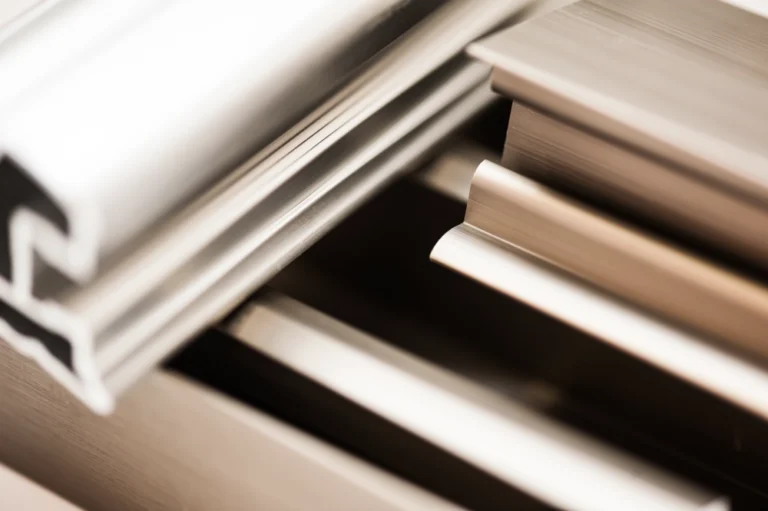
If you’ve ever installed soffit, vinyl siding, or aluminium cladding, you’ve handled an F channel. It’s the profile that finishes the edge where the soffit meets the wall, capturing the panel ends and giving the install its clean, professional line. Specify it wrong and the soffit sags, water gets behind the cladding, or your crew burns hours field-cutting workarounds.
For fabricators, soffit installers, and cladding contractors, here’s the practical detail that actually matters when ordering aluminium F channel.
What Is an Aluminium F Channel?
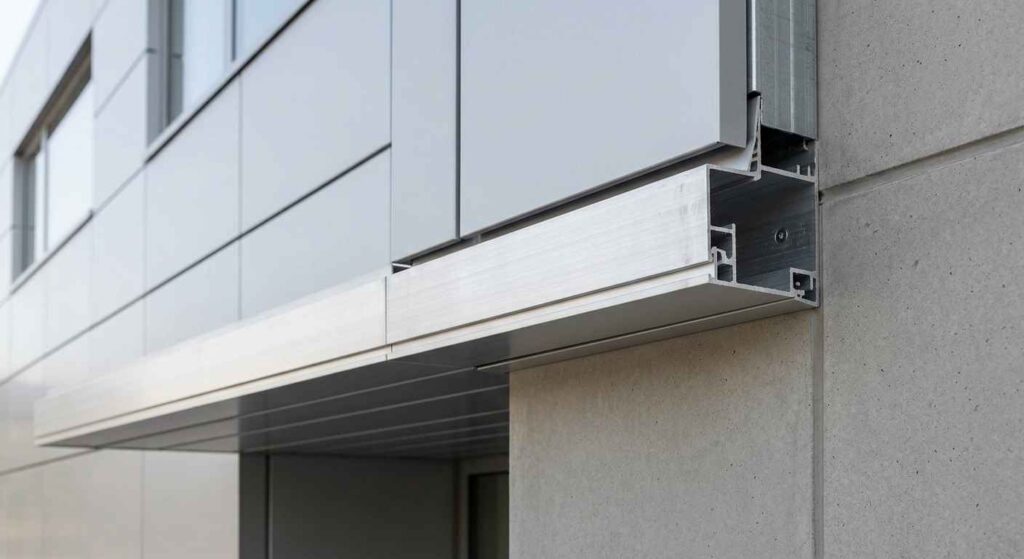
An aluminium F channel is an extruded profile shaped like the letter F when viewed from the end. It has a long flat back that fastens to the wall or fascia, a horizontal flange that projects outward, and a return lip that creates a slot to receive the soffit panel.
The slot does the real work. It captures the panel edge, allows for thermal expansion, and creates a finished edge without exposing fasteners or raw cuts. Done right, the F channel disappears into the design while doing all the load and weatherproofing work in the background.
F Channel vs J Channel: A Detail That Matters
Soffit and siding work involves both F channels and J channels, and contractors confuse them constantly.
A J channel is a single-slot profile used to terminate panel ends at corners, windows, and trim. It’s mounted on the receiving surface and the panel slides into it.
An F channel has a back leg that lets it mount to the wall or under the fascia at a right angle, with the slot running parallel to the wall. It’s specifically designed to support soffit panels along their inner edge where they meet the building wall.
Order J channel where F is needed and you’ll be improvising flashing details on site. Order F where J is needed and the geometry simply won’t work.
Why Aluminium Is the Right Material for F Channels
PVC and steel F channels exist, but aluminium dominates serious cladding work for clear reasons:
- Weight. Aluminium F channel is light enough for a single installer to handle 6 metre lengths without a second pair of hands.
- Corrosion performance. Soffits sit exposed to humidity, condensation, and wind-driven rain year after year. Aluminium handles that without rusting or coating breakdown.
- Dimensional stability. Aluminium doesn’t warp like PVC under temperature swings, which keeps soffit lines straight over the building’s life.
- Finish quality. Aluminium accepts anodising and powder coating cleanly, allowing colour matching to match fascia, gutters, or panel colour exactly.
- Fire performance. Aluminium is non-combustible, an increasingly critical factor on commercial and high-rise cladding work after recent regulatory changes.
Common Failure Points and How to Avoid Them
Most F channel problems trace back to three preventable mistakes:
Undersized slot depth. If the slot is shallower than the panel’s expansion allowance, the soffit buckles in summer or pulls out in winter. Spec a slot deep enough to allow at least 6mm of free movement.
Wall thickness too thin. A thin-walled F channel deforms under fastener pressure or panel weight, creating wavy lines along the soffit. For commercial work, 1.2mm to 1.5mm wall thickness is the safer minimum.
Wrong alloy for the environment. A 6063-T5 F channel works for most applications, but coastal and industrial environments benefit from upgraded finishing or thicker walls to extend service life.
What to Spec When Ordering Aluminium F Channel
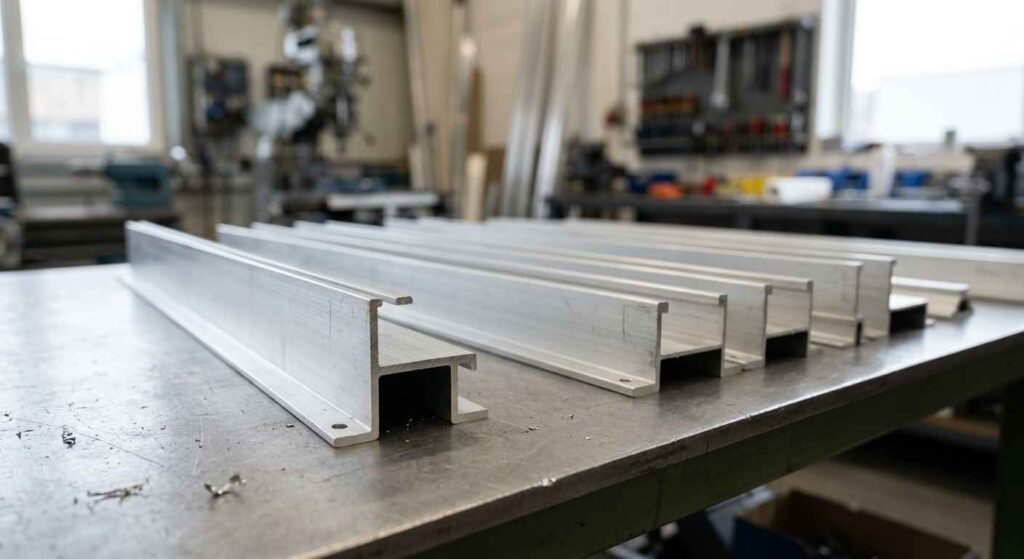
Three details to lock down before placing the order:
- Slot width. Match it to your soffit panel thickness with at least 1mm clearance on each side for thermal movement.
- Back leg length. Longer back legs spread fastener load and accommodate uneven wall surfaces, reducing shimming on site.
- Length and finish. Standard is 6 metre lengths in mill, anodised, or powder-coated finish. Anodising holds colour better than paint over a 20-year service life.
For high-volume jobs, ordering directly from an extruder lets you customise slot dimensions and back leg geometry to your panel system, eliminating field adjustments.
Dimensional Standards & Slot Opening Specifications
To ensure seamless component alignment during installation, aluminium F channels are engineered around standardized panel thicknesses and structural depth ratios:
- Standard Slot Opening Widths: To accommodate diverse cladding panels, F channels are extruded with slot openings sized for 3.2mm (1/8 in.), 6.35mm (1/4 in.), 9.5mm (3/8 in.), 12.7mm (1/2 in.), and 19mm (3/4 in.) material thicknesses.
- Expansion Clearance Ratios: For exterior soffits exposed to thermal variations, the internal slot width should maintain a minimum of 1mm total clearance above nominal panel thickness to prevent binding or oil-canning.
- Linear Mass Consistency: Lightweight architectural trim profiles typically range from 0.17 kg/m to 0.40 kg/m, maintaining structural rigidity along 6-meter mill lengths without introducing excessive overhead dead load.
- In-House Custom Extrusion Dies: For non-standard architectural designs or custom spandrel panel integration, Exalum Metal develops custom extrusion dies to match specific back-leg lengths, return flange angles, and custom slot tolerances.
Advanced Applications & Protective Packaging Protocols
Aluminium F channels extend beyond standard soffit and fascia installations into specialized commercial and industrial applications:
- Multi-Wall Roofing & Ceiling Spandrels: F channels function as primary perimeter tracks, securing polycarbonate sheets or aluminium spandrel profiles cleanly against structural beams.
- Display Cabinets & Architectural Glass Framing: Functioning as precision edge guards, F channels hold glass panels or composite boards securely while hiding raw cut edges.
- Stair Nosing & Interior Edge Protection: Extruded F profiles protect laminate or timber step edges from localized impact wear.
- Transit & Surface Protection Protocols: To preserve pristine anodized or powder-coated finishes, profiles are wrapped with protective polyethylene film, cushioned at the open flange lips, and bundled into reinforced wooden crates for shipment.
Sourcing Aluminium F Channel for Your Fabrication Needs
A clean soffit or cladding install depends on F channel that runs straight, holds tolerance, and finishes consistently across every length. That’s only possible from a manufacturer who controls extrusion and finishing under one roof.
Whether you need standard profiles or custom cross-sections designed for your specific fabrication requirements, Exalum Metal has the capacity and expertise to deliver.
Ready to place an order or discuss your requirements? Get in touch with the Exalum Metal team directly by clicking the “Contact Us” button.