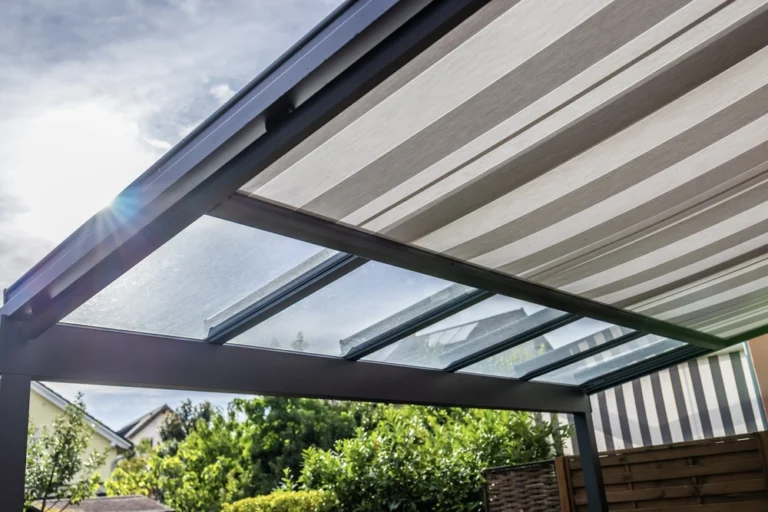
An awning earns its keep the moment the sun hits a window. By shading the glass before the heat gets inside, it lowers cooling loads, protects interiors from fading, and shelters doorways and patios from sun and rain. Aluminum has become the material of choice for awnings that are meant to last, because it carries the span without sagging, shrugs off weather without rusting, and holds a finish for decades without repainting. We produce the aluminum profiles that frame and form awnings, and the points below cover how they work, the main styles, and what makes an awning that performs.
What an Awning Does for a Building
The value of an awning starts with heat. Sunlight striking a window passes straight through the glass and warms everything behind it, which drives up cooling costs and fades furnishings, flooring, and merchandise. An awning intercepts that sunlight outside the glass, before the heat enters, which is far more effective than blocking it with interior blinds after it has already come in. The shading it provides can meaningfully reduce the cooling load on the rooms behind the shaded windows.
Beyond heat, an awning shelters. It keeps rain off a doorway, lets a window stay open during a shower, and creates usable shaded space over a patio or storefront. And it shapes the appearance of a building, adding depth, line, and color to a facade that lifts curb appeal for a home and signals quality for a business. A well-designed awning does all of this at once, which is why it remains a fixture of both residential and commercial architecture.
Why Aluminum Outperforms Fabric and Other Materials
Awnings have been made from fabric, steel, and aluminum, and each has its place, but aluminum answers the durability question that the others struggle with. Fabric awnings look soft and inviting, but they fade, tear, stain, and need replacement on a regular cycle, particularly in harsh sun and weather. Steel frames carry load well but rust over time, especially in coastal and humid settings where awnings are most useful.
Aluminum sidesteps both problems. It carries the span of an awning without the weight of steel, which makes installation easier and puts less load on the wall it mounts to. It resists corrosion on its own, so an aluminum awning survives sun, rain, and salt air for decades without rusting. It holds a finish, since anodizing and powder coating give it a color-stable surface that does not fade or peel the way painted steel or sun-bleached fabric does. And it needs almost no maintenance, which is the quiet advantage that matters most over the life of the awning. For an awning meant to last, aluminum is the material that does not ask to be replaced.
The Main Styles of Aluminum Awning
Aluminum lends itself to several awning designs, each suited to a different need. A fixed awning is permanently mounted and built to stay, offering constant shade and shelter with no moving parts to maintain, which makes it the most durable and the most common choice for windows, doors, and patios.
A standing-seam or panel awning uses interlocking aluminum panels to form a solid, sloped roof-like surface, giving a clean architectural look and excellent rain shelter. A louvered awning uses angled aluminum slats that block direct overhead sun while allowing air to circulate and some light to filter through, which suits patios and outdoor living spaces. A retractable awning, while often fabric, uses aluminum framing and arms for the structure that extends and folds it. And a corrugated or formed-panel awning offers economical, durable coverage for utilitarian applications like walkways and carports. Each style draws on extruded and formed aluminum for its frame, supports, and often its covering surface.
What Goes Into an Awning That Lasts
The performance of an aluminum awning comes down to the frame and how it is built. The frame profile has to be strong enough to carry the awning’s own weight plus the loads that wind, rain, and in some climates snow apply to it, which means the structural members need adequate section depth and wall thickness for the span. An undersized frame sags, flexes, or fails under load.
The alloy and temper set the strength of the material, so structural awning framing benefits from an alloy with genuine load capacity rather than a soft architectural grade. The mounting and connections have to match the strength of the frame, because an awning is only as secure as its attachment to the wall, and wind uplift on an awning can be considerable. The finish has to withstand constant exposure, which is where anodizing and powder coating earn their place by resisting the UV, moisture, and temperature cycling that an exposed awning faces year-round. And the dimensional consistency of the profiles has to hold, so the awning assembles cleanly and the panels align. These come down to the extrusion quality behind the profiles, which is why the material source matters as much as the awning design.
How Aluminum Awnings Connect to Our Products
Building a durable awning draws on the structural and panel extrusion we produce, with the strength, weather resistance, and finishing that an exposed exterior element demands. Our vertically integrated facility in Indonesia spans 20,000 square metres and manages alloy, extrusion, and finishing as one chain, delivering the consistency and durability that outdoor applications require.
The profile range covers the components an awning is built from:
- Square Hollow and Rectangular Hollow for the structural frame, supports, and brackets that carry the awning
- Equal Angle and Unequal Angle for the mounting connections and bracing that secure it to the wall
- Tubing Pipes for support posts and the framing of larger patio and freestanding awnings
- Louvers profiles for louvered awning designs that combine shade with airflow
- Flat Bars for mounting plates, fascia, and trim
- Spandrel and panel profiles for solid awning surfaces and infill
For awning systems that need a specific frame profile or panel section, custom extrusion produces the exact geometry the design calls for, finished in-house with anodizing or powder coating that survives the weather an awning lives in.
Adding Shade and Style That Endures
A good awning pays back every season, cutting cooling costs, protecting interiors, sheltering doorways and patios, and lifting the look of the building. Aluminum is what lets it do all that for decades rather than a few years, by carrying the load, resisting the weather, and holding its finish without maintenance. The key is a frame engineered for the loads, the right alloy, secure mounting, and a manufacturer whose extrusion you can rely on.
We have supplied structural and architectural aluminum extrusion to fabricators and builders since 2009, with the strength, consistency, and weather-resistant finishing that exterior applications demand.
Whether you need standard profiles or custom cross-sections designed for your specific awning system, we have the capacity and expertise to deliver.
Ready to discuss your project or request material specifications? Get in touch with our team directly:
Email: [email protected] WhatsApp: +62 811 9429 970 Website: www.exalummetal.com
When the awning has to shade, shelter, and last, start with extrusion you can trust. Make Exalum Metal your standard.