
Many buyers treat a door as one of the final items on a project checklist. They choose a style, color, and size that matches the rest of the building, assuming most Doors will perform similarly once installed.
However, the real differences appear over time. After thousands of opening and closing cycles and years of weather exposure, material quality becomes much more important than appearance. A door that begins to sag, a frame that swells and sticks, or a finish that fades unevenly often reflects the material’s long-term performance rather than an installation issue.
Choosing the right material from the beginning helps reduce maintenance, improve durability, and extend the service life of the entire door system. This article compares aluminum, timber, steel, and uPVC based on the factors that matter most for fabricators, contractors, architects, and project owners.
What a Door Actually Has to Handle
Unlike many other building components, a door experiences constant movement throughout its lifespan. Walls remain stationary, and most windows move only occasionally. Doors, on the other hand, must open and close repeatedly while maintaining alignment, structural stability, and a reliable seal.
Over time, even small changes can create noticeable problems. A door leaf may drop slightly, the latch may no longer align with the strike plate, or water and air may begin passing through small gaps. The frame also carries a significant portion of these loads, which makes the Door Jamb just as important as the door panel itself.
Selecting the right material helps minimize these issues before they become costly repairs.
Aluminum, Timber, Steel, and uPVC at a Glance
Each material offers clear advantages, but each also has situations where another option performs better.
| Material | Where It Excels | Where It Falls Short |
|---|---|---|
| Aluminum | Large, heavy, or high-traffic doors | Requires a thermal break in cold climates |
| Timber | Natural appearance, repairability, heritage projects | Swells and shrinks with moisture |
| Steel | Security and fire resistance | Can corrode if protective coatings are damaged |
| uPVC | Affordable with good thermal insulation | Less rigid for wide openings and prolonged heat exposure |
Rather than focusing only on strengths, it is equally important to understand each material’s limitations. Those limitations often determine which option performs best over the long term.
Where Aluminum Has the Edge
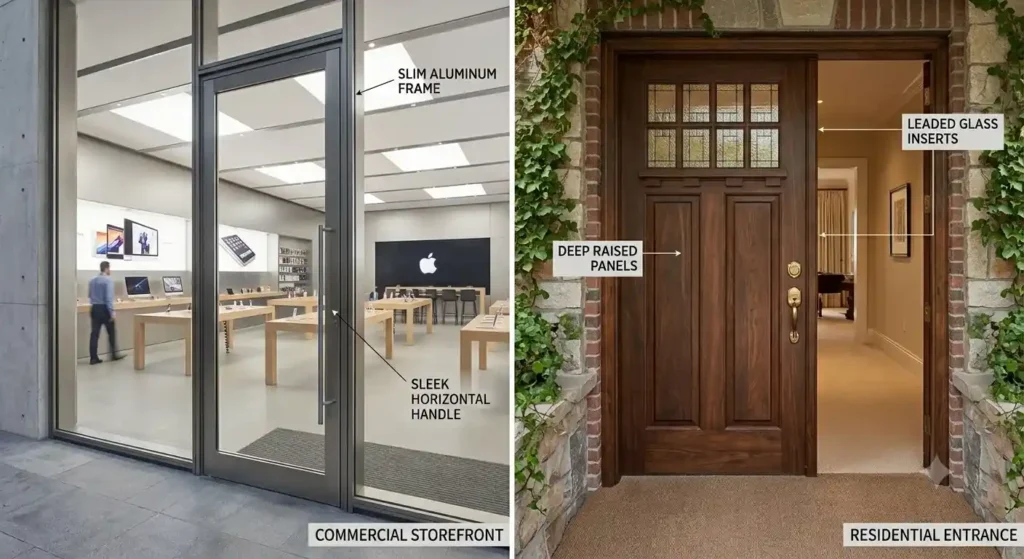
Large and Heavy Doors
Aluminum offers an excellent balance between strength and weight. Manufacturers can create hollow, multi-chamber extrusion profiles that remain rigid without becoming excessively heavy.
As a result, aluminum supports large glazed door panels while maintaining proper alignment over years of daily use. This is one reason commercial entrances, storefronts, and high-traffic buildings frequently use aluminum framing systems.
Humid and Coastal Environments
Aluminum naturally forms a protective oxide layer when exposed to air. This barrier helps resist corrosion without requiring constant maintenance.
Furthermore, anodizing and powder coating strengthen this protection while improving appearance. In humid or coastal environments, aluminum generally maintains its structural integrity better than materials that absorb moisture or develop rust after surface damage.
Where Other Materials Still Make Sense
Although aluminum performs exceptionally well in many situations, other materials remain the better choice for certain applications.
Timber
Timber provides a warm, natural appearance that many architectural styles require. It also allows on-site repairs because installers can sand, fill, and refinish damaged surfaces.
For residential entrances, heritage buildings, or restoration projects where aesthetics take priority, timber remains a practical option. However, moisture fluctuations can cause expansion, contraction, and long-term warping.
Steel
Steel continues to lead where security or fire resistance takes priority. Its high strength allows relatively slim sections to support substantial loads while resisting forced entry.
For this reason, Rolling Doors, industrial facilities, and secure service entrances commonly use steel despite its higher maintenance requirements in corrosive environments.
uPVC
uPVC offers one of the most economical solutions for residential applications. It also provides good thermal insulation without additional materials.
However, wider openings may experience deflection over time, especially in areas exposed to prolonged sunlight and high temperatures. Therefore, uPVC works best for smaller residential installations with moderate daily use.
Climate Can Change the Best Choice
Environmental conditions often determine which door material delivers the longest service life.
In tropical and coastal regions, humidity, rainfall, and airborne salt accelerate corrosion and moisture damage. Timber requires regular maintenance to prevent swelling, while exposed steel needs protective coatings to resist rust. uPVC may also soften after prolonged heat exposure.
By comparison, aluminum performs consistently in these conditions. Its corrosion resistance and dimensional stability explain why commercial buildings throughout Southeast Asia frequently specify aluminum entrance systems.
Cold climates present a different challenge. Because aluminum transfers heat efficiently, standard profiles may create cold surfaces and condensation. Fortunately, thermal-break technology significantly improves insulation performance. For projects in colder regions, verifying the thermal-break specification is an important part of the design process.
Where You’ll Notice the Difference
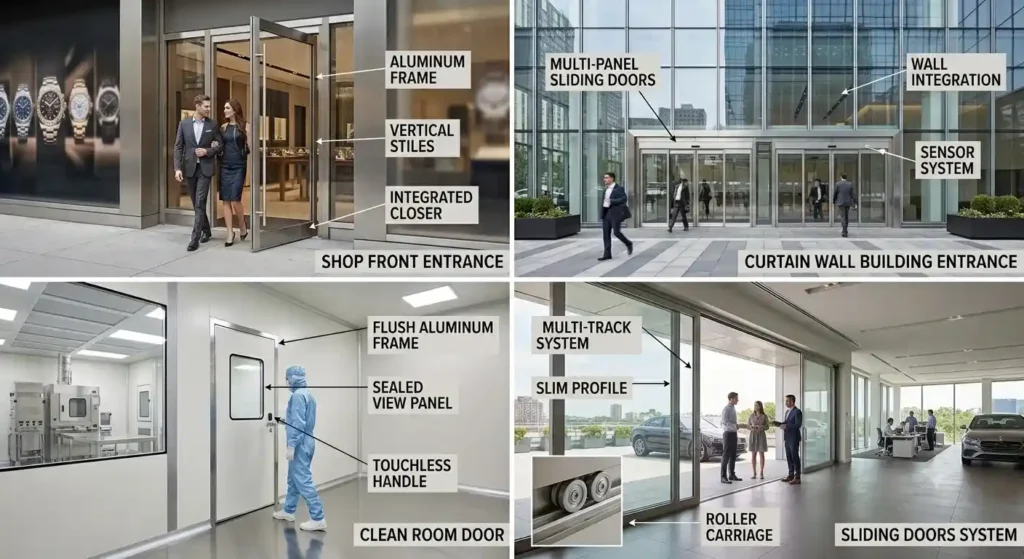
The performance of each material becomes obvious once you understand where it is commonly used.
Retail buildings typically use aluminum because Shop Front entrances experience constant daily traffic while maintaining precise alignment.
Likewise, modern commercial buildings often integrate aluminum entrance systems directly with the surrounding Curtain Wall façade. Matching materials helps maintain consistent movement, appearance, and finishing across the building envelope.
Specialized environments demand even higher performance. For example, Clean Room doors require airtight sealing and resistance to frequent cleaning with chemical agents. Aluminum provides these characteristics while maintaining dimensional stability throughout continuous operation.
What to Decide Before Ordering
Making several key decisions early helps prevent unnecessary changes during fabrication and installation.
Consider the following factors before selecting your door system:
- Overall leaf dimensions and total glass weight
- Expected daily opening frequency
- Environmental exposure, including humidity, coastal air, or direct sunlight
- Whether thermal-break insulation is required
- Compatibility between the frame, Handle, hinges, and other hardware
It is also worth considering the finish at an early stage. When a door sits alongside Sliding Windows or other glazed systems, matching colors and surface treatments creates a more consistent architectural appearance.
Aluminum Door Profiles for Production-Scale Projects
Large construction projects require more than quality materials. They also depend on consistent manufacturing, reliable finishing, and accurate dimensional control throughout every production batch.
Exalum Metal has specialized in aluminum extrusion and finishing since 2009. Our capabilities include custom die development, precision extrusion, anodizing, and powder coating under one roof. This integrated production process helps ensure consistent dimensions, uniform finishes, and dependable delivery schedules for aluminum door systems, including Sliding Doors and other architectural profiles.
Whether your project requires standard profiles or fully customized extrusions, our team can review your drawings, finish specifications, and production volume to recommend the most suitable solution.
Email: [email protected] WhatsApp: +62 811 9429 970 Website: www.exalummetal.com