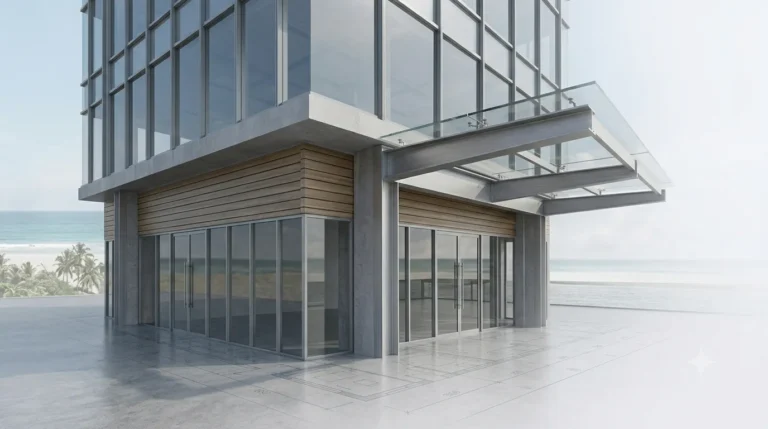
A structural bracket on a beachside building in Queensland fails after two years because someone specified steel angle iron where aluminum angle should have gone. Salt air corroded the steel from the inside out, and by the time it showed on the surface, the damage was structural.
The terms “angle iron” and “aluminum angle” get used interchangeably, but they describe two different materials with different strengths and lifespans. An angle profile is an L-shaped bar with two flat legs at a 90-degree corner. This article explains what separates the two, when to use each, and what to check before ordering.
What Is an Aluminum Angle Profile?
An aluminum angle profile is an L-shaped length of aluminum, made by pressing a heated billet through a shaped die to produce a consistent cross-section. It is lightweight, corrosion-resistant, and can be cut, drilled, welded, and finished without rust concerns.
The two variants are equal angle, with two legs of the same length, and unequal angle, with one longer leg for applications needing more coverage on one face. Most use 6063 alloy for architectural work or 6061 alloy for structural applications.
What “Angle Iron” Actually Means
Angle iron refers specifically to a steel L-profile, typically hot-rolled from carbon steel. It is heavier than aluminum angle at the same dimensions, rusts without a protective coating, and costs less per kilogram in raw material. For heavy structural uses such as industrial frames, crane rails, and load-bearing mezzanines, steel angle iron is often the right specification because its yield strength exceeds that of standard aluminum alloys.
The confusion arises because many people call any L-shaped bar “angle iron” regardless of material. Knowing the distinction upfront prevents costly misspecification.
Aluminum Angle vs Steel Angle Iron: Which One to Choose
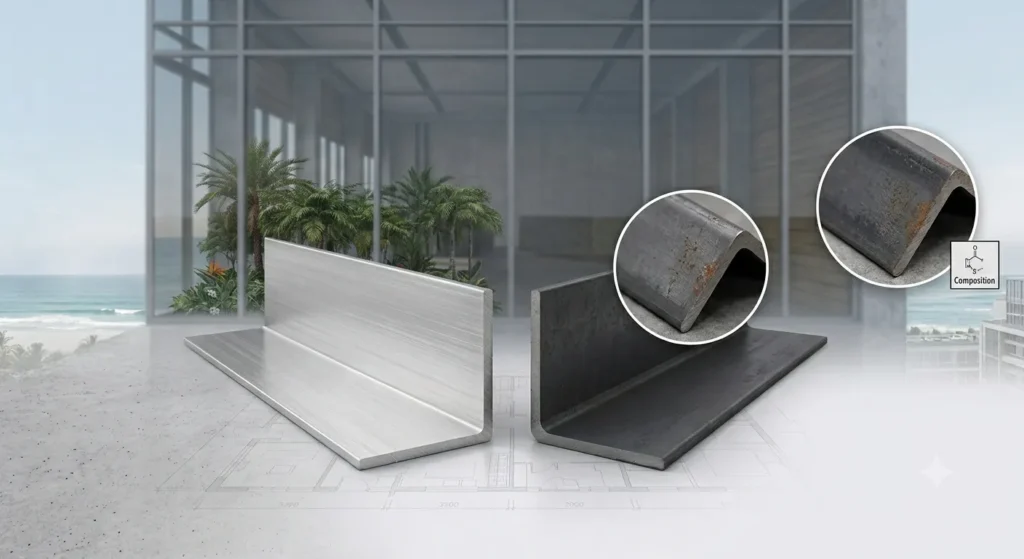
Both profiles share the same L-shape, but they behave differently in real-world conditions.
| Profile | Best For | Less Suitable For |
| Aluminum angle | Coastal, outdoor, and architectural uses | Very heavy structural loads |
| Steel angle iron | Heavy structural and industrial frames | Humid, coastal, or exposed environments |
| Aluminum unequal angle | Asymmetric brackets, cladding clips | Applications needing identical leg coverage |
Choose aluminum angle when the project involves outdoor exposure, coastal environments, weight restrictions, or visible finishing. Aluminum does not rust and holds an anodized or powder-coated finish permanently.
Choose steel angle iron when the load requirements exceed what standard aluminum alloys can handle economically, and the installation is in a dry, protected environment where corrosion is not a concern.
Choose unequal angle in aluminum when one leg needs to span a larger surface, clip a thicker substrate, or carry an asymmetric load. The longer leg does the structural work while the shorter leg fixes into place.
Strengths and Limitations of Aluminum Angle
What Aluminum Angle Does Well
Aluminum angle is roughly one-third the weight of steel at the same dimensions. For furniture frames, fit-out work, and display fixtures, that weight saving simplifies handling and installation. Aluminum also forms a natural oxide layer on exposure to air, resisting corrosion without any coating.
In coastal environments across Florida, Queensland, or Southeast Asia, this gives aluminum a service life that steel cannot match. Clean room framing benefits similarly, since corroding steel introduces particulate contamination. Aluminum also anodizes cleanly and takes powder coating without primer.
Where Aluminum Angle Has Limitations
Aluminum’s yield strength is lower than structural steel at the same section size. For crane brackets, heavy gantries, or loaded mezzanines, steel angle iron is the correct specification, and using aluminum there would require a much larger section to compensate.
Common Applications of Aluminum Angle
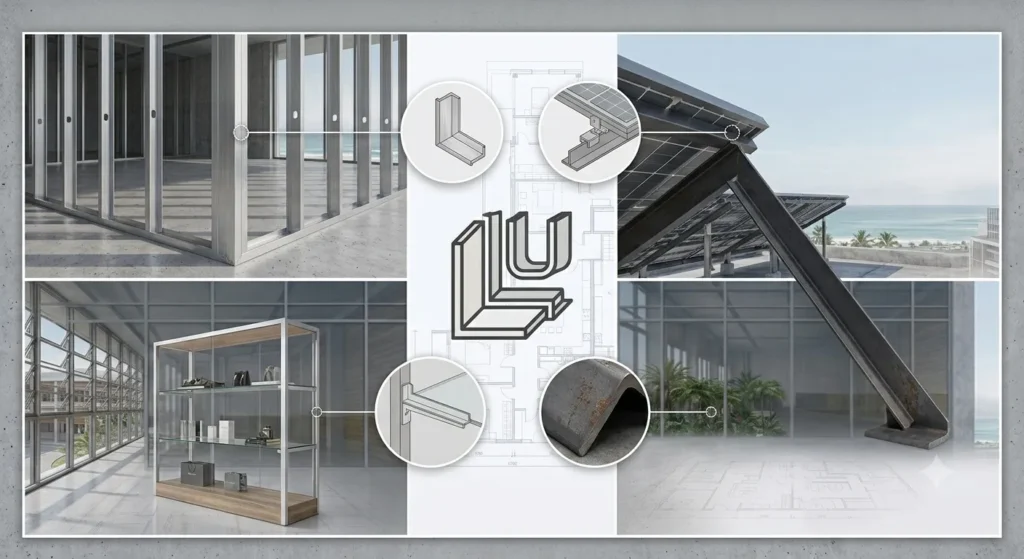
Structural Framing and Partition Systems
Aluminum equal angle forms the corner posts in lightweight partition systems. The L-shape locks two panels at a 90-degree joint while equal legs spread contact pressure evenly across both faces.
Solar Panel Mounting Structures
Solar rail and solar panel mounting systems use aluminum angle as bracket bases that fix rails to rooftop substrates. Aluminum’s corrosion resistance eliminates the maintenance that steel mounting hardware requires outdoors.
Shelving, Brackets, and Display Fixtures
Retail fit-outs use aluminum angle as shelf brackets and corner reinforcements for showcase cabinets. Its light weight and clean finish outperform steel angle, which needs painting and adds mass.
What to Consider When Choosing Aluminum Angle
Several factors shape the right angle specification.
- Leg length and ratio: Equal legs suit symmetrical joints; unequal legs suit asymmetric loads. Specify exact dimensions rather than accepting a close catalog size.
- Wall thickness: Thicker legs carry higher loads. Base this on a load calculation, not a default.
- Alloy grade: 6063 for architectural work; 6061 for structural applications.
- Surface finish: Mill finish suits concealed use; anodizing suits coastal exposure; powder coating adds color and weather protection.
- Environment: Coastal and humid environments favor aluminum; dry, heavily loaded environments may favor steel on upfront cost.
- Fasteners: Use stainless or aluminum fasteners at bolted connections to prevent galvanic corrosion.
Aluminum Angle Solutions from Exalum Metal
Exalum Metal supplies equal and unequal aluminum angle profiles for construction, industrial, and commercial projects across the United States, Australia, Europe, and Southeast Asia. Custom extrusion covers non-standard leg lengths, specific wall thicknesses, and tight tolerances. Finishing options include mill finish, anodizing, and powder coating, with volume supply for large procurement orders. Bring your drawings or load requirements and our team will confirm the right profile, alloy, and finish.
Get in touch with our team directly:
Email: [email protected] WhatsApp: +62 811 9429 970 Website: www.exalummetal.com