Have you ever wondered why two aluminum profiles of the same shape perform differently? One holds tolerances across its full length; the other warps or shows defects after anodizing. The answer usually starts with the billet.
A billet is a dense, solid cylindrical rod of aluminum alloy. This article covers what billets are, how they become finished extrusion profiles, why quality matters at the billet stage, and how to choose the right alloy.
What Is an Aluminum Billet?
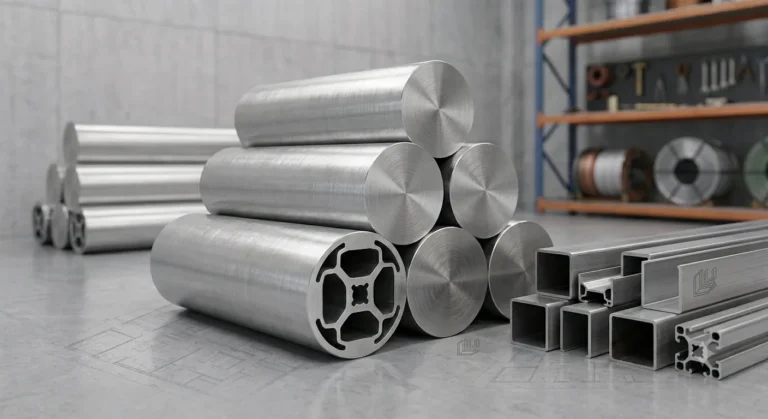
An aluminum billet is a dense, cylindrical log of aluminum alloy produced through a process called direct chill casting. In this process, molten aluminum is poured into a water-cooled mold, where it solidifies from the outside in. The result is a homogeneous cylinder with a consistent grain structure throughout.
The billet’s alloy composition is fixed at the casting stage. Trace elements such as magnesium, silicon, and manganese are added to the aluminum melt in precise ratios before casting to produce the desired alloy. Once cast and cooled, the billet moves to a soaking oven for homogenization, a heat treatment that evens out remaining composition gradients and prepares the metal for consistent flow through the extrusion press.
Visually, a billet looks like a thick aluminum pipe without a hole: solid, dull gray, and heavy. A standard billet weighs between 10 and 60 kilograms depending on diameter and length. The same alloy and process can produce everything from structural equal angle sections to complex precision profiles with multiple cavities and fins.
Not all billets are the same quality. Reputable billet producers test each batch for chemical composition, internal soundness, and surface condition. Billets that fail these checks produce profiles with hidden defects, which may only appear after anodizing or under mechanical stress in the field.
From Billet to Finished Profile
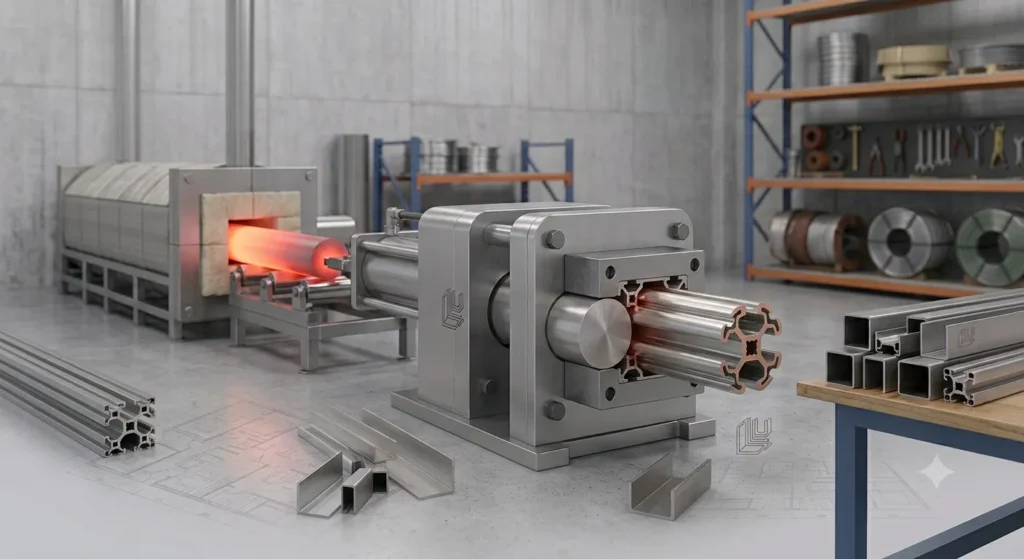
Taking a billet from a cold log to a shaped aluminum profile requires three distinct stages. Each stage directly affects the quality and consistency of the result, and a failure at any one of them shows up in the finished profile. Here is how each stage works.
Billet Heating
Before the billet enters the press, it must reach 400°C to 500°C. At that temperature, aluminum becomes plastic, meaning it flows under pressure without cracking. Temperature uniformity across the billet is critical: uneven heating causes inconsistent flow through the die, resulting in surface streaking and dimensional variation.
The Extrusion Press
A hydraulic ram applies force, typically 1,000 to 15,000 tonnes, pushing the heated aluminum through a shaped steel die. The die opening defines the profile cross-section, and as aluminum exits the die it emerges as a continuous length with that exact shape. This is how flat bars, square hollow sections, and round bars all come from the same fundamental process.
Cooling and Finishing
After exiting the die, the profile moves along a runout table where air or water quenching cools it to room temperature. Controlled cooling locks in the material properties set by the alloy and press temperature. Rapid or uneven cooling introduces internal stress that causes bow or warp after installation.
After cooling, profiles are stretched under tension to relieve any twist, then cut to length, aged in an oven to reach final temper hardness, and prepared for surface finishing.
Why Billet Quality Affects the Final Profile
The billet is the source of every structural and cosmetic property in the finished profile. A billet with inconsistent alloy distribution produces profiles that vary in hardness along their length. A billet with internal voids or oxide inclusions, tiny pockets of trapped material from the casting process, causes cracks or surface defects that only reveal themselves after anodizing or under mechanical stress in service.
High-quality billets come from controlled casting environments with tight chemistry specifications. Reputable manufacturers test for composition and internal soundness before pressing. This costs more upfront but reduces scrap, rework, and surface finish failures.
For large-volume projects such as curtain wall systems, solar rail and solar panel mounting structures, or HVAC component lines, billet quality is as important a procurement question as alloy selection.
Common Aluminum Billet Alloys
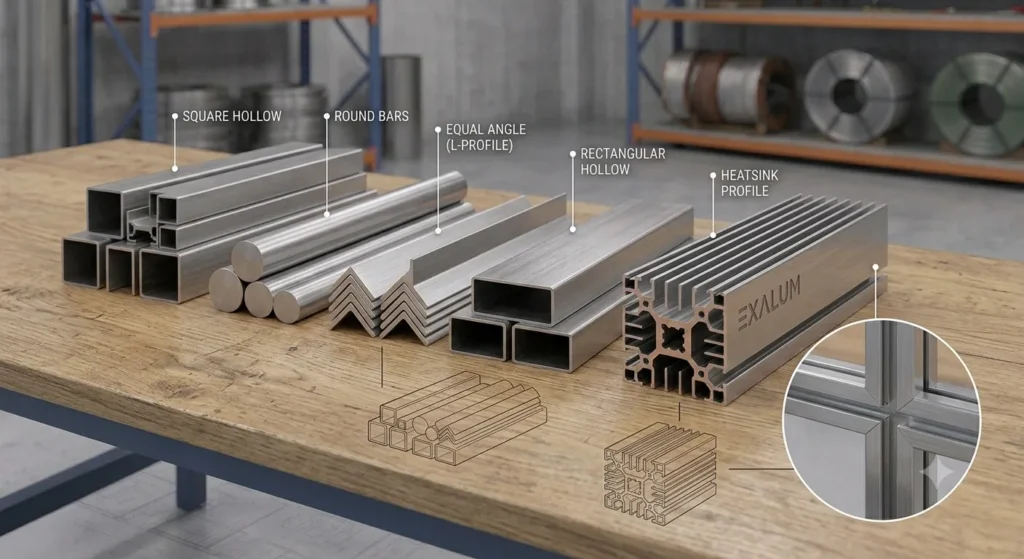
The alloy series used for most architectural and structural extrusion falls within the 6000 series, where the primary alloying elements are magnesium and silicon. Their combined presence makes the alloy workable and heat-treatable, which is why 6000-series billets dominate the extrusion industry. The balance between these elements determines how well the profile anodizes, how much load it can carry, and how cleanly it exits the die. Within that series, two alloys cover the applications Exalum Metal produces.
Here is how they compare:
| Alloy | Best For | Less Suitable For |
| 6063 | Architectural profiles, anodized finishes, window and door frames | High-load structural applications |
| 6061 | Structural frames, load-bearing brackets, industrial components | Fine architectural surface finishing |
Choose 6063 when the finished profile will be anodized or powder-coated for an architectural application such as rectangular hollow framing or diffuser grilles. Its smooth extrudability and clean surface response to anodizing make it the standard choice for any profile where appearance matters.
Choose 6061 when the profile must carry structural load and surface appearance is secondary to performance. It is the correct specification for brackets, industrial frames, conveyor components, and any part that operates under sustained mechanical stress or repeated loading.
Billet Aluminum and Extrusion Quality at Exalum Metal
Exalum Metal uses certified-grade aluminum billets with chemistry verification at intake, ensuring alloy consistency across every production run. That consistency flows through to heatsink profiles, structural sections, and architectural extrusions alike.
Custom extrusion is available in 6063 and 6061 alloys, with finishing options including mill finish, anodizing, and powder coating. Volume orders are supported across architectural, structural, and industrial applications.
Bring your drawings or profile specifications and our team will confirm the right alloy, die, and finish.
Get in touch with our team directly:
Email: [email protected] WhatsApp: +62 811 9429 970 Website: www.exalummetal.com