
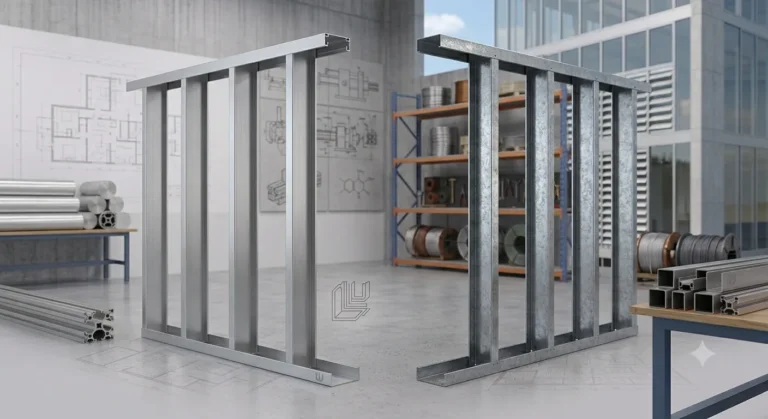
A fit-out contractor unpacks metal studs for a hotel renovation three blocks from Miami Beach. Six months after installation, with aluminum stud framing in the bathroom partitions, the walls are clean, dimensionally stable, and free of rust staining.
That outcome is not guaranteed with galvanized steel in high-humidity coastal environments. Metal stud framing is the standard skeleton for non-load-bearing interior walls: a C-shaped stud running between a U-shaped floor track and ceiling track, forming the frame for plasterboard, cladding, or glazing. The track resembles a flat bar bent into a U-shape; the stud resembles an equal channel with two flanges.
This article explains how aluminum and steel studs differ, where each material is the right call, and what to evaluate before specifying.
What Metal Stud Framing Looks Like
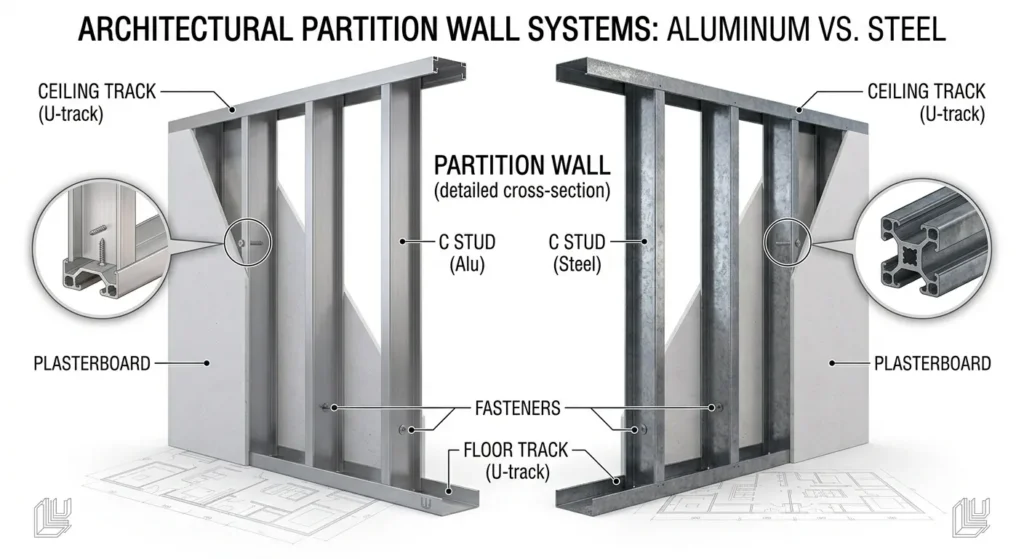
A metal stud system has two components: the track, a flat U-shaped section fixed to the floor and ceiling; and the stud, a C-shaped vertical member that clips into the track at 400mm or 600mm intervals. Stud height, section depth, and spacing together determine the wall’s resistance to lateral load.
Both aluminum and steel studs share this geometry and integrate with standard doors and glazing frames within the partition system. The difference lies entirely in material properties: aluminum studs are lighter and corrosion-resistant; steel studs are stronger and cost less per linear meter. The right choice depends on which of those properties the application demands most.
Aluminum Studs vs Steel Studs: Which One to Choose
Aluminum and steel metal stud systems each suit a different set of project conditions.
| Material | Best For | Less Suitable For |
| Aluminum studs | Coastal, wet, or high-humidity environments; lightweight partitions | Tall or heavily loaded walls; tight upfront budgets |
| Steel studs | Standard commercial partitions; tall walls under load | Coastal salt-air environments; projects where rust staining is a risk |
“font-weight: 400;”>Choose aluminum studs when the project involves bathrooms, wet areas, coastal locations, or any environment where moisture exposure could cause galvanized steel to corrode through its protective coating over time.
“font-weight: 400;”>Choose steel studs when the partition wall is tall, carries significant lateral load, or requires a lower upfront material cost. Steel’s higher yield strength, which measures resistance to permanent deformation, makes it the standard in most commercial office, retail, and industrial fit-out work.
Strengths and Limitations of Aluminum Studs
What Aluminum Studs Do Well
Aluminum studs resist corrosion without surface treatment. Unlike galvanized steel, which relies on a zinc coating to prevent rust, aluminum forms a natural oxide layer that protects the metal even if scratched during installation. In coastal environments across Florida, Queensland, and Southeast Asia, this eliminates the rust staining and structural degradation that eventually affects coated steel.
Aluminum is roughly one-third the weight of steel at the same section size. Aluminum studs pair naturally with aluminum track sections and partition system components, and they suit clean room applications where ferrous metal contamination is a concern.
Where Aluminum Studs Have Limitations
“font-weight: 400;”>Aluminum’s yield strength is lower than steel’s at equivalent section sizes. For walls taller than 3 meters, walls under heavy cladding load, or walls subject to frequent impact, steel studs are the correct specification.
“font-weight: 400;”>Aluminum studs also cost more per linear meter than galvanized steel. In dry interior environments where corrosion is not a concern, galvanized steel remains the standard and more economical choice.
Where Aluminum Studs Offer the Greatest Advantages
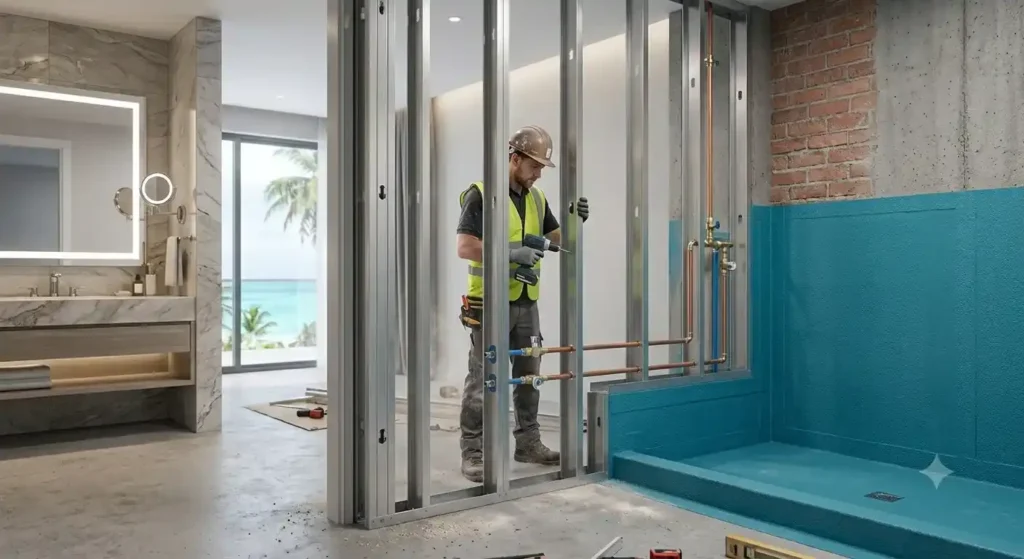
The case for aluminum studs is strongest where moisture and corrosion exposure are present throughout the building’s service life. In these conditions, steel studs can fail at cut edges and fastener points long before the building requires refurbishment.
- Bathrooms and wet rooms: Aluminum frames resist long-term moisture migration behind cladding surfaces, while galvanized steel corrodes at cut edges and screw penetrations where the zinc coating is breached.
- Coastal commercial buildings: Hotels, beachfront retail, and marine facilities benefit from aluminum framing in moisture-exposed locations, including shop front partitions and window surrounds adjacent to sliding doors.
- Healthcare environments: Sterile-area partitions specify aluminum framing to prevent rust contamination from compromising hygiene standards.
- Lightweight upper-floor fit-outs: Renovations in Southeast Asia and Australia specify aluminum where floor load limits constrain the weight of fit-out materials.
Specification and Design Considerations
Choosing the right stud system requires evaluating several factors beyond material type.
- Wall height: Taller walls require deeper studs and closer spacings to resist lateral deflection. For walls above 3 meters, consult a structural engineer to confirm section size, spacing, and bracing requirements.
- Section depth: Standard stud depths range from 50mm to 150mm. Deeper sections resist bending across taller wall heights. Match section depth to wall height and cladding weight, not just the floor plan dimension.
- Wall thickness: Thicker stud walls carry heavier cladding loads. Specify based on the weight of the intended finish, whether plasterboard, tile, or composite panel.
- Alloy grade: For aluminum, 6063 alloy suits standard architectural partition work. 6061 alloy suits structurally demanding frames where yield strength is a design requirement.
- Track specification: Match the track material to the stud material. In curtain wall adjacent framing, coordinate aluminum stud profiles with the curtain wall system for consistent corrosion resistance across the assembly. Mixing aluminum studs with steel tracks creates a galvanic corrosion risk where the two metals contact each other in the presence of moisture.
- Fastener type: Use aluminum-compatible fasteners to avoid galvanic corrosion. Stainless steel screws are the standard specification for aluminum stud systems in wet areas.
Aluminum Stud and Framing Solutions from Exalum Metal
Exalum Metal supplies aluminum extrusion profiles for stud, track, and partition framing systems for commercial, hospitality, healthcare, and residential projects across the United States, Australia, Europe, and Asia.
Custom extrusion is available for non-standard section depths, specific wall thicknesses, and integrated clip or fastener slots. Finishing options include mill finish, anodizing, and powder coating, with volume supply for large-format procurement orders.
Bring your drawings, wall specifications, or estimated project quantities and our team will confirm the right profiles, alloy grade, and finish for your framing system.
Get in touch with our team directly:
Email: [email protected] WhatsApp: +62 811 9429 970 Website: www.exalummetal.com