
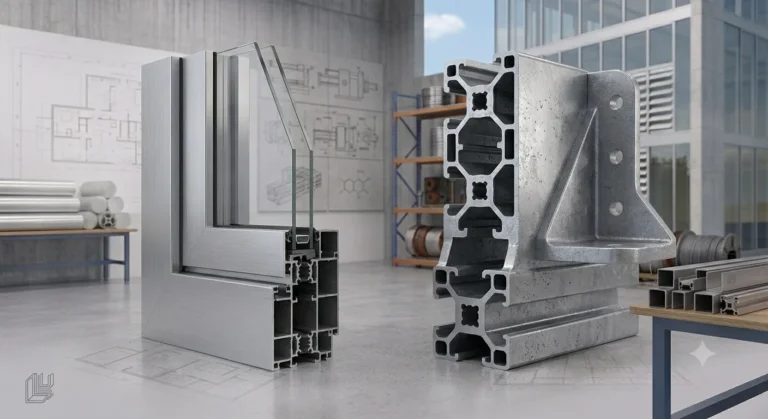
A procurement manager orders profiles for a curtain wall project. Same dimensions, same geometry on the drawing, but one batch in 6063 and one in 6061. The 6061 batch shows surface streaking after anodizing; the 6063 batch comes out perfectly even.
That outcome illustrates the most common alloy specification mistake in architectural aluminum. Both alloys belong to the 6000 series, using magnesium and silicon as their primary alloying elements, but they behave differently through the press and in the finishing process. This article explains what separates them, how they compare on the properties that matter, and how to decide which one to specify.
What Makes 6061 and 6063 Different
The difference lies in element ratios and the resulting behavior under heat, pressure, and finishing processes.
6063 has a composition optimized for extrudability. It flows more smoothly through a die, allowing complex cross-sections, thinner walls, and tighter tolerances. For that reason, it dominates the architectural extrusion market.
6061 contains higher total alloy content that increases tensile strength and hardness. It is less extrudable at fine section sizes but produces reliable output at standard industrial thicknesses.
6061 vs 6063 Aluminum: Which Alloy to Choose
Both alloys suit extrusion applications, but they serve fundamentally different purposes.
| Alloy | Best For | Less Suitable For |
| 6063 | Architectural profiles, anodized finishes, complex thin-wall shapes | High structural loads, impact-resistant components |
| 6061 | Structural frames, industrial brackets, load-bearing components | Fine architectural finishes, complex thin-wall profiles |
Choose 6063 when the finished profile will be visible, anodized, or powder-coated and the design requires complex cross-sections with thin walls. This covers casement windows, sliding door tracks, and most architectural trim profiles.
Choose 6061 when the profile carries structural load, operates under mechanical stress, or forms a component that must resist deformation rather than look perfect. This applies to industrial machine frames, structural brackets, and load-bearing components in building systems.
Mechanical Properties: What the Numbers Mean in Practice
Tensile strength measures how much force a material resists before breaking. In T6 temper, 6061 reaches around 310 MPa while 6063 reaches approximately 205 MPa.
In practical terms, a 6061 structural bracket carries roughly 50% more load than a 6063 bracket of the same section. For a window frame, that gap is irrelevant; the structural demands fall well within either alloy’s capability. For a load-bearing mezzanine or crane platform, it is the specification decision.
Yield strength, measuring resistance to permanent deformation, follows the same pattern: 6061 T6 at around 276 MPa, 6063 T6 at approximately 170 MPa. In applications with repeated loading or vibration, this gap matters.
Surface Finish and Extrudability
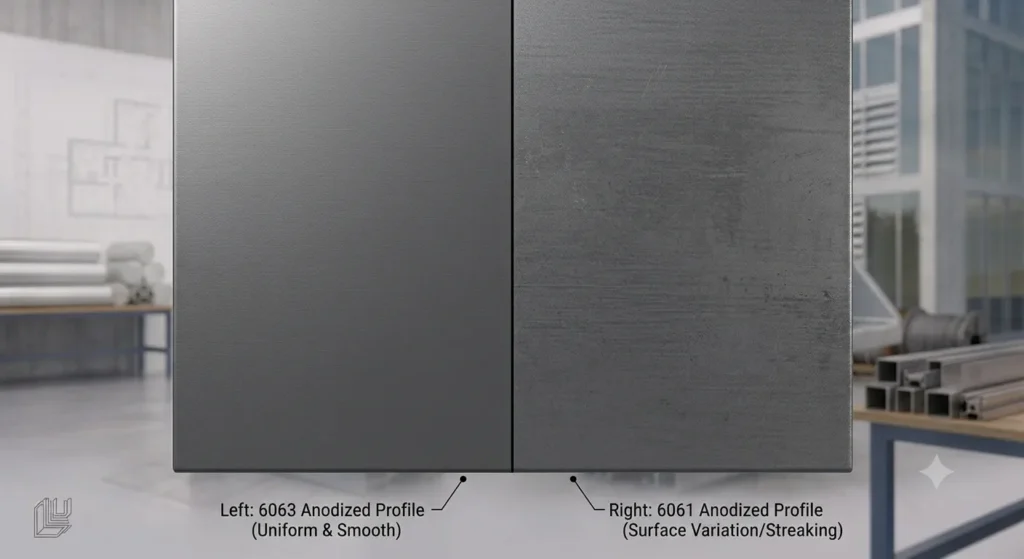
6063 produces a smoother as-extruded surface than 6061 because of how it flows through the die. That smoother surface means more consistent anodizing: the oxide layer builds uniformly across the profile face, producing even color and sheen with no mottling or variation across a panel width.
6061 can be anodized, but the result is typically less uniform on architectural profiles. The higher alloy content creates microscopic surface variations that become visible after anodizing, particularly on wide flat faces. The higher alloy content introduces microscopic surface variations that become visible after anodizing, particularly on wide flat faces. For that reason, 6061 is not standard for visible elements such as partition frames, shop fronts, or window wall systems where consistent finish across panels matters.
Powder coating is more forgiving on both alloys since the powder layer covers surface variation. Where anodizing is specifically required, 6063 is the correct specification.
Typical Applications of Each Alloy
Architectural Extrusions
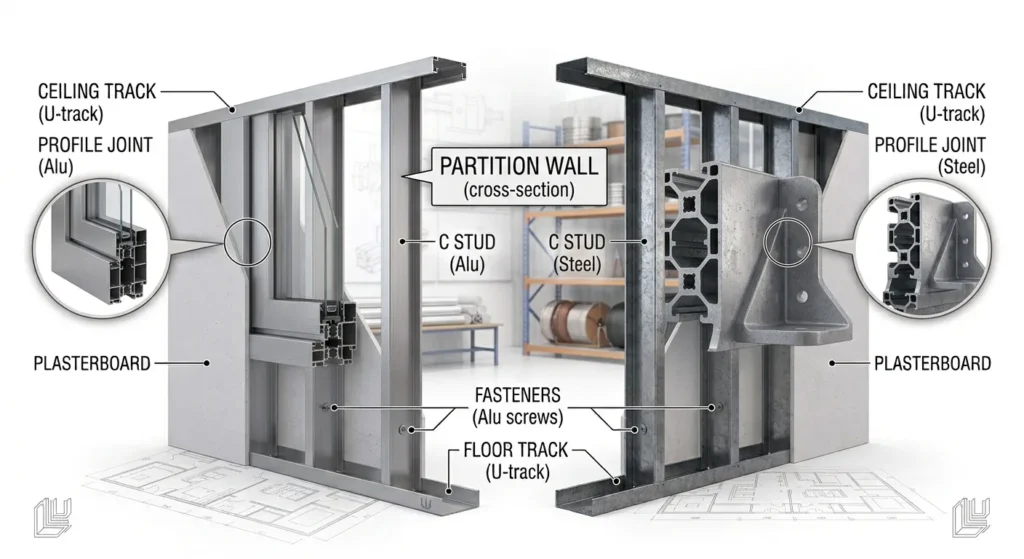
6063 is the standard alloy for virtually all architectural aluminum extrusion. Sliding windows, door frames, and louver blade profiles all require the smooth extrudability and finishing quality that 6063 delivers. Its ability to produce complex thin-wall shapes cleanly and consistently is why it dominates the market for visible profiles.
Structural and Industrial Components
6061 suits components under sustained mechanical load: structural brackets, conveyor structural members, and industrial machine guards. It also suits profiles that will be welded into a structural assembly, as it maintains better post-weld strength than 6063.
Solar and Outdoor Structural Systems
Solar rail mounting structures benefit from 6061 alloy in their load-bearing rail sections, where structural performance takes priority over surface finish. Architectural clips and trim components in the same system typically use 6063.
What to Consider When Choosing Between 6061 and 6063
Several factors should guide the alloy decision before ordering.
- Load requirement: If the profile will carry structural load, bear weight, or absorb repeated impact, 6061 is the correct starting point. If the load is minimal or transferred to an adjacent structural element, 6063 suits the application.
- Surface finish requirement: Anodizing on visible surfaces requires 6063 to achieve a consistent, even result. Powder coating works acceptably on both alloys.
- Profile complexity: Complex cross-sections with thin walls extrude more reliably in 6063. Simple sections such as rectangular hollow sections at standard wall thicknesses produce reliable output in 6061.
- Welding: If the profile will be welded into a structural assembly, 6061 retains better strength in the heat-affected zone around the weld. 6063 weakens more noticeably in welded areas. 6063 weakens more noticeably in the welded area.
- Environment: Both alloys perform well in coastal and humid environments when anodized or powder-coated. Bare 6061 in coastal environments may require more attention to surface protection than anodized 6063.
6061 and 6063 Extrusion at Exalum Metal
Exalum Metal produces extrusion profiles in both 6061 and 6063 alloys for architectural, structural, and industrial projects across the United States, Australia, Europe, and Asia.
Custom extrusion is available for project-specific cross-sections, wall thicknesses, and dimensional tolerances in both alloys. Finishing services include mill finish, anodizing for 6063 architectural profiles, and powder coating for both alloys. Volume supply is supported for large procurement orders across multiple profile types.
Bring your drawings, load specifications, or finish requirements and our team will confirm the right alloy and finish for your project.
Get in touch with our team directly:
Email: [email protected] WhatsApp: +62 811 9429 970 Website: www.exalummetal.com