
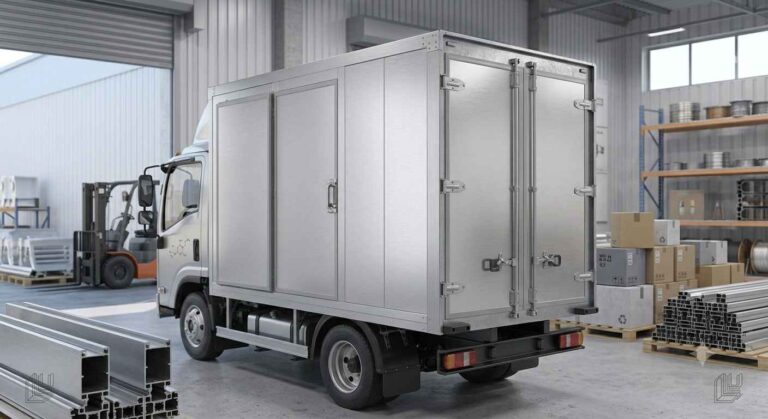
A fleet mechanic runs a hand along the side rail of a new delivery truck body. It feels noticeably lighter than the steel version parked next to it.
That weight difference is not just a technical detail. For a business running trucks every day, it changes how much cargo fits within legal weight limits. It also affects fuel use and ride quality once the truck is loaded. Many fleet owners only notice this once fuel and maintenance bills start adding up.
An aluminum truck body is the boxed structure mounted behind the cab. Builders assemble it from extruded aluminum panels, rails, and posts, not the welded steel sheet most people picture. This article looks at how that structure stays strong while cutting weight, and where a business might still choose steel instead.
Why Weight Matters More Than Most Fleet Owners Realize
Every kilogram removed from a truck body becomes a kilogram of extra payload, within the same legal weight limit. For a fleet running dozens of trucks, that difference adds up to real revenue over a year. This matters most on routes with strict axle weight limits.
Weight also affects cost long after the truck leaves the lot. A lighter body reduces fuel consumption and eases the load on brakes, suspension, and tires. As a result, the savings from a lighter body continue well past the purchase date.
Strengths and Limitations of Aluminum Truck Bodies
What Aluminum Truck Bodies Do Well
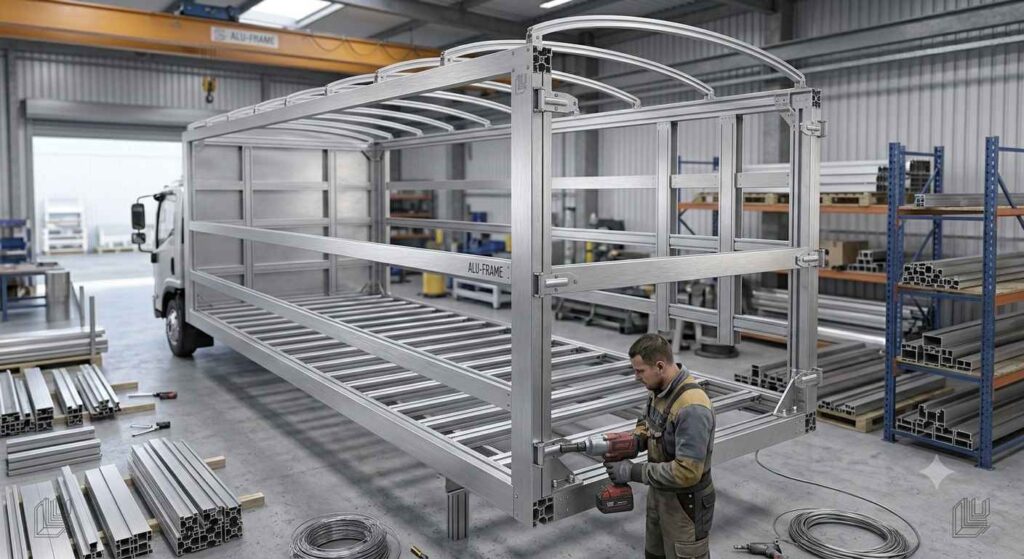
Extruded aluminum profiles can be shaped with internal ribs and chambers. This geometry adds stiffness exactly where the load needs it, without adding material everywhere else. As a result, an aluminum panel can match the strength of a heavier steel panel at a fraction of the weight.
Aluminum also resists corrosion on its own, since it forms a thin oxide layer as soon as it meets air. For a truck body exposed to road salt and constant vibration, that natural resistance means less rust maintenance over time. That stiffness also holds up well under the constant vibration of daily routes.
Where Aluminum Truck Bodies Have Limitations
Aluminum is not always the better choice. In heavy-impact work such as scrap hauling or demolition debris, steel’s raw toughness often outlasts aluminum. Steel is also easier to weld and repair in the field with basic equipment. This is why some scrap and demolition fleets still specify steel exclusively.
For businesses running that kind of abrasive cargo, a steel body may still be the more practical option. That holds true even with the added weight.
Automotive Aluminum Profiles Available from Exalum Metal
Understanding alloy selection is only part of the specification process. Profile geometry, wall thickness, and weight also influence the strength, weight, and fabrication efficiency of a truck body. To support different commercial vehicle applications, Exalum Metal offers a range of standard automotive aluminum extrusion profiles that can be incorporated into truck bodies, trailers, utility vehicles, and other transportation equipment.
Standard Automotive Profile Specifications
| Model | Thickness & Weight | Application | Description |
| 98061 | 1.50 mm & 0.410 kg/m | Outer Window Frame Profile with Drip Rail / Bus and Truck Window Frame Trim. | Used around the outer edge of window assemblies on buses, trucks, minibuses, and campervans. |
| 97011 | 1.35 mm & 0.272 kg/m | Bus/Truck Glass Stopper Trim. | Used as the frame or surrounding trim for sliding glass window assemblies on buses, trucks, minibuses, and commercial vans. |
| 97009 | 1.30 mm & 0.656 kg/m | Box Roof Corner Profile / Top Corner Roof Profile (Aluminum Box Cap) | Used as the main upper corner frame of a box truck or van body. It is installed at the exterior upper corner where the roof panel meets the side wall panel of box trucks, refrigerated trucks (reefers), and trailers. |
| 97007 | 2.00 mm & 0.644 kg/m | Bumper Angle Profile / Truck Body Corner Trim (Corner Trim / Edge Mold Profile) | Installed on the outer corners where the walls meet the roof or floor of box trucks, vans, or trailers. It reinforces the structure while covering the joints between panels. |
| 97005 | 1.30 mm & 0.372 kg/m | Roof Rack / Roof Rail Crossbar | |
| 97006 | 1.25 mm & 0.279 kg/m | Glass Sliding Rail Profile / Sliding Window Rail (Double Track Channel) or Truck Body Sliding Door Rail. | Commonly used in bus, truck, minibus, and commercial vehicle bodies to provide parallel tracks for two sliding glass panels. |
| 97003 | 1.50 mm & 0.372 kg/m | Roof Rack Crossbar / Wing Bar. | Primarily used as a crossbar on a vehicle roof. The oval teardrop shape minimizes wind drag, while the double T-slot underneath is used to attach foot locks or fitting kits to the roof rail. |
| 97001 | 1.20 mm & 0.882 kg/m | Ribbed Box Wall Profile |
Aluminum Alloys Used for Automotive Extrusions
Different applications require different mechanical properties. Exalum Metal produces automotive extrusion profiles using several aluminum alloys to match various structural and finishing requirements.
| Alloy | Mechanical Properties | Surface Quality | Extrudability | Typical Applications |
| 6061 | High | Fair | Fair | Structural members, boats, medical equipment |
| 6063 | Medium | Very Good | Good | Window and door systems, exterior profiles |
| 6005 | High | Good | Good | Structural frameworks, solar rail systems |
By combining the appropriate alloy with the right extrusion profile, manufacturers can achieve the balance of weight, structural performance, corrosion resistance, and surface finish required for different truck body applications. Standard profile availability also helps reduce tooling costs and shortens production lead times for volume manufacturing.
Choosing the Right Aluminum Alloy for Truck Body Components
Not every part of a truck body needs the same alloy. Different components face different loads.
- 6061 for heavy-duty structural members: the main frame rails and crossmembers usually use this alloy for its high strength.
- 6005 for framework and reinforcement: this alloy balances strength and weldability well, which suits the internal framework.
- 6063 for exterior and finishing profiles: panels, trim, and Decorative Tubing Pipes style accents use this alloy for its clean extrusion and smooth finish.
Matching the alloy to the job keeps the whole structure strong and efficient at the same time. This same alloy-matching approach is common in aerospace and marine aluminum construction.
Aluminum or Steel? The Better Choice Depends on the Job
Aluminum and steel remain the two main choices for truck body construction. Aluminum components such as Automotive Motor Accessories show how far the lightweight approach has spread into commercial vehicle manufacturing.
| Material | Best For | Less Suitable For |
| Aluminum | Payload-sensitive routes, corrosion-prone climates | Extreme impact or abrasion-heavy cargo |
| Steel | Heavy-impact, abrasive, or repair-in-field work | Routes where every kilogram of payload counts |
For most regional and long-haul fleets, the payload and fuel savings from aluminum outweigh steel’s toughness advantage. Coastal fleets in particular tend to favor aluminum for this reason.
Truck Body Components Commonly Made from Aluminum Extrusions
Side Rails
Side rails form a truck body’s main structural spine, running the length of the frame under the floor. Builders often extrude these from Rectangular Hollow sections, since the closed shape resists bending under load.
Floor Supports
Floor supports sit crosswise beneath the deck, carrying cargo weight down into the main frame rails. Flat Bars are a common choice, since a flat profile spreads the load evenly.
Roof Bows
Roof bows arch across the top of the body, supporting the roof panel against wind pressure. Many manufacturers extrude these from Round Bars, since the curve sheds water and stays rigid.
Door Frames
Door frames need to stay square through thousands of open-and-close cycles. A Door Jamb style channel holds the door edge firmly while still allowing smooth hinge movement.
What to Consider Before Specifying Aluminum Truck Body Profiles
Getting the specification right up front avoids costly changes once fabrication has started.
- Wall thickness: thicker walls add strength but also add weight, so aim for the thinnest wall that still meets the load.
- Alloy grade: structural members need a higher-strength alloy than trim or finishing pieces.
- Surface finish: anodized or powder-coated finishes resist corrosion better than raw mill finish.
- Dimensional fit: every profile needs to match the truck body’s exact frame dimensions.
- Hardware compatibility: confirm door components such as a Handle against the frame profile before ordering.
- Climate exposure: coastal or winter salt routes call for a more corrosion-resistant alloy and finish.
- Fastener compatibility: rivets or bolts joining panels should match the aluminum alloy to avoid galvanic corrosion.
Aluminum Truck Body Profiles from Exalum Metal
Exalum Metal supplies extruded and finished aluminum profiles for truck body manufacturers. Structural members, panels, and trim all come from a single production run. Many manufacturers work with us across several truck body programs each year.
Custom extrusion is available for project-specific dimensions. Finishing services include mill finish, anodizing, and powder coating. Volume order support extends to fleets and manufacturers ordering profiles on a recurring basis, including cross-industry applications such as Conveyor framing for material handling equipment.
If your project needs a specific profile, bring us your drawings, dimensions, or an estimated volume. Our team will confirm what runs as a standard section and what needs custom tooling.
Get in touch with our team directly:
Email: [email protected] WhatsApp: +62 811 9429 970 Website: www.exalummetal.com