
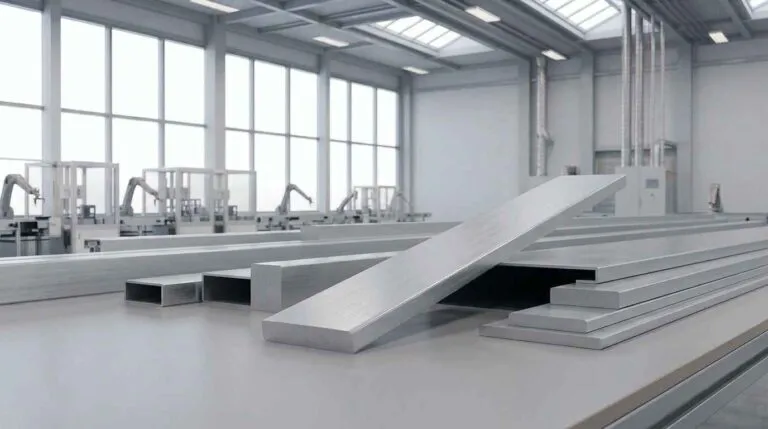
A fabricator pulls a length of flat aluminum stock off the rack and cuts it to size for a bracket in under a minute. No forming, no bending, no special tooling required. The part is ready for the next step almost as soon as the saw stops.
That ease is exactly why flat bar shows up on so many job lists and price sheets. It is one of the most basic shapes a mill produces, yet it ends up in furniture, boat railings, machine frames, and building trim. Fabricators reach for it precisely because it needs so little setup before it can be used.
Few other aluminum profiles offer that same combination of simplicity and range. An aluminum flat bar is simply a rectangular strip of aluminum, longer than it is wide, and much wider than it is thick. This article covers why it is used so widely, where it fits best, and when a different profile makes more sense.
What Is an Aluminum Flat Bar?
A flat bar is defined by its plain rectangular cross-section. It has no curves, no internal chambers, and no folded edges. That simplicity is what separates it from more specialized structural shapes.
Manufacturers produce it through extrusion, pushing heated aluminum through a flat rectangular opening in a die. The die itself is inexpensive to build compared with dies for hollow or multi-chamber profiles. This keeps setup costs low even for smaller custom orders. That plain geometry is what makes Flat Bars so flexible for so many unrelated jobs, from furniture trim to industrial spacers.
Aluminum Flat Bar Sizes and Specifications
Aluminum flat bars are available in different widths, thicknesses, edge profiles, and weights to suit different fabrication requirements. Exalum Metal offers both square-edge and rounded-edge flat bars, with standard 6-meter lengths and cut-to-size services available for projects requiring specific dimensions.
Square Edge Flat Bars
Square-edge flat bars provide a straightforward rectangular section for applications such as structural supports, electrical busbars, architectural trims, and custom-machined components.
| Section | Width (A) | Thickness (T) | Weight (kg/m) |
|---|---|---|---|
| 10013 | 19.05 mm (3/4″) | 1.59 mm | 0.081 |
| 10022 | 12.7 mm (1/2″) | 0.8 mm | 0.028 |
| 10023 | 12.7 mm (1/2″) | 0.9 mm | 0.031 |
| 10025 | 19 mm | 0.9 mm | 0.046 |
| 10026 | 20 mm | 3 mm | 0.163 |
| 10027 | 15.4 mm | 2 mm | 0.083 |
| 10028 | 19.05 mm (3/4″) | 2.8 mm | 0.145 |
| 10030 | 25 mm | 5 mm | 0.339 |
| 10031 | 25 mm | 3 mm | 0.203 |
| 10032 | 25 mm | 0.9 mm | 0.062 |
| 10033 | 25 mm | 10 mm | 0.678 |
| 10038 | 25.4 mm (1″) | 1.59 mm | 0.109 |
| 10040 | 50 mm | 5 mm | 0.678 |
| 10045 | 80.15 mm | 6.15 mm | 1.346 |
| 10046 | 38.10 mm (1-1/2″) | 1.91 mm | 0.195 |
| 10051 | 31.78 mm | 6 mm | 0.516 |
| 10060 | 30 mm | 5 mm | 0.406 |
| 10062 | 30 mm | 3 mm | 0.243 |
| 10064 | 44.45 mm | 1.59 mm | 0.191 |
| 10065 | 60 mm | 6 mm | 0.976 |
Rounded Edge Flat Bars
Rounded-edge flat bars provide an alternative geometry for applications where the exposed edge, appearance, or fabrication requirements call for a less angular profile.
| Section | Width (A) | Thickness (T) | Radius (R) | Weight (kg/m) |
|---|---|---|---|---|
| 10080 | 62 mm | 8 mm | 1 mm | 1.342 |
| 10081 | 62 mm | 9 mm | 1 mm | 1.509 |
| 10082 | 33 mm | 16 mm | 2 mm | 1.421 |
| 10083 | 38 mm | 19 mm | 2 mm | 1.947 |
| 10090 | 45 mm | 8 mm | 1 mm | 0.973 |
| 10100 | 40 mm | 8 mm | 1 mm | 0.865 |
| 10200 | 100 mm | 9 mm | 1 mm | 2.436 |
| 10201 | 100 mm | 6 mm | 1 mm | 1.624 |
| 10202 | 42 mm | 11 mm | 2 mm | 1.242 |
| 10203 | 25 mm | 8 mm | 2 mm | 0.532 |
| 10204 | 120 mm | 8 mm | 2 mm | 2.592 |
| 10205 | 35 mm | 16 mm | 2 mm | 1.508 |
Aluminum Flat Bar Specifications
The available flat bars can be specified according to the alloy, finish, length, and application requirements.
| Specification | Exalum Metal |
|---|---|
| Standard length | 6 meters |
| Cut-to-size | Available |
| Architectural alloy | 6063-T5 |
| Structural alloy | 6061-T6 |
| Standard finish | Mill finish |
| Additional finishes | Anodized, powder-coated |
| Anodizing | 15-micron architectural standard |
| Warranty | 30-day product quality warranty |
With both standard and custom options available, buyers can select a profile based on the dimensions and performance required for the application rather than relying on a one-size-fits-all section.
Strengths and Limitations of Aluminum Flat Bar
What Aluminum Flat Bar Does Well
Flat bar is lightweight relative to its strength, which matters most when a project needs many identical pieces. A rack full of aluminum flat bar weighs a fraction of the same rack in steel. That weight difference adds up quickly across a large order.
Aluminum also resists corrosion without a protective coating, since it forms a thin oxide layer on contact with air. For marine hardware, outdoor railings, and equipment exposed to weather, that natural resistance avoids the ongoing cost of repainting. Fabricators working near coastlines rely on this property constantly.
Where Aluminum Flat Bar Has Limitations
Flat bar has real limits. Its rectangular cross-section bends more easily under a load applied across its narrow face than shapes designed for stiffness, such as an Equal Angle profile. Adding thickness helps, but only up to a point before the extra weight defeats the purpose.
For structural spans carrying real bending loads, a channel or angle profile usually performs better than flat bar of the same weight. Flat bar works best as a support, a trim piece, or a connector, not as a primary structural beam. Specifiers who treat it as a beam substitute often end up reinforcing the design later.
Aluminum Flat Bar vs Steel Flat Bar
Aluminum and steel flat bar solve the same basic shape problem with very different trade-offs. Neither one is the universally correct choice.
| Material | Best For | Less Suitable For |
| Aluminum flat bar | Weight-sensitive parts, corrosion-prone environments | Heavy structural loads, high-heat applications |
| Steel flat bar | High-strength structural connections, welded frames | Weight-sensitive shipping, coastal or marine exposure |
For most architectural trim and equipment brackets, aluminum’s weight and corrosion advantages outweigh steel’s extra strength. Heavy load-bearing connections are the clear exception.
Common Aluminum Flat Bar Applications
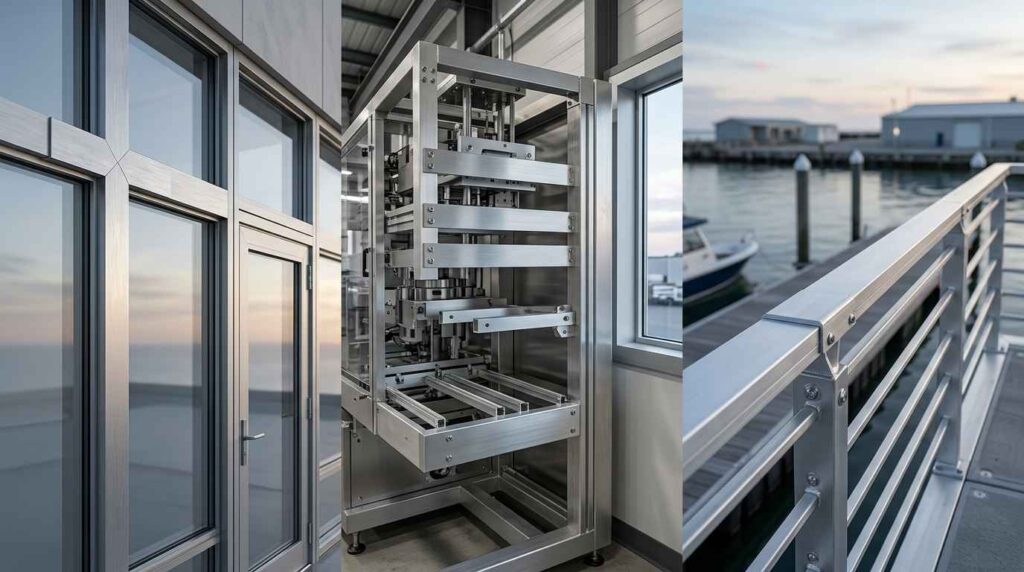
Construction and Architecture
Flat bar reinforces window and door frames and adds rigidity to trim details. Builders often pair it with a Door Jamb assembly where a stiffening strip is needed along one edge.
Industrial Equipment
Machine builders use flat bar for guards, spacers, and small brackets inside equipment housings. It often works alongside heavier shapes such as Rectangular Hollow sections that carry the main structural load.
Marine and Coastal Applications
Flat bar shows up constantly in boat railings, dock hardware, and deck fittings. Builders also use it for Ladder rails and rungs on docks, since it resists salt spray far better than untreated steel.
How to Choose the Right Aluminum Flat Bar
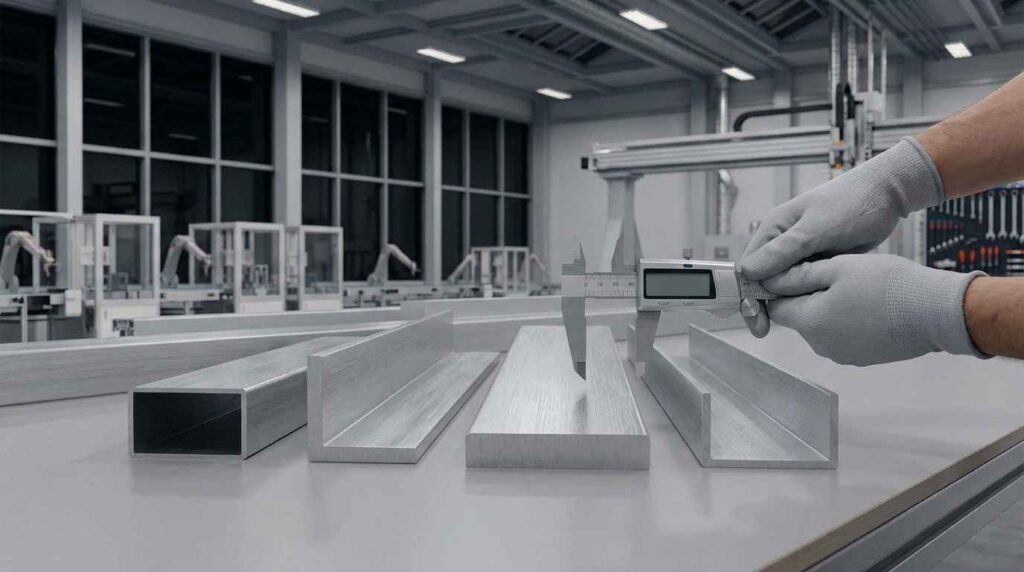
Choosing the right flat bar comes down to a short list of practical factors. Getting these settled early avoids reordering stock partway through a project.
- Thickness: thicker stock resists bending but adds weight and cost.
- Width: wider bar spreads load over a larger surface, useful for brackets and spacers.
- Alloy grade: structural applications need a stronger alloy than trim or decorative pieces.
- Finish: anodized or powder-coated flat bar resists scratching better than raw mill finish.
- Edge profile: rounded edges suit exposed handling, while square edges suit hidden fabrication work.
- Hardware fit: confirm compatibility with fasteners or a Handle if the bar forms part of a moving assembly.
- Order length: standard mill lengths reduce waste compared with custom-cut short runs.
Aluminum Flat Bar from Exalum Metal
Exalum Metal extrudes and finishes aluminum flat bar in standard and custom dimensions for fabricators and manufacturers. Every run is produced to the same tolerance from start to finish.
Custom extrusion is available for project-specific widths and thicknesses. Finishing services include mill finish, anodizing, and powder coating. Volume order support extends to manufacturers ordering flat bar alongside other profiles, including industrial applications such as Conveyor framing. Many manufacturers order flat bar as one part of a larger multi-profile project.
If your project needs a specific size or finish, bring us your drawings or an estimated volume. Get in touch with our team directly through our contact inquiry or click the “Contact Us” button below.