
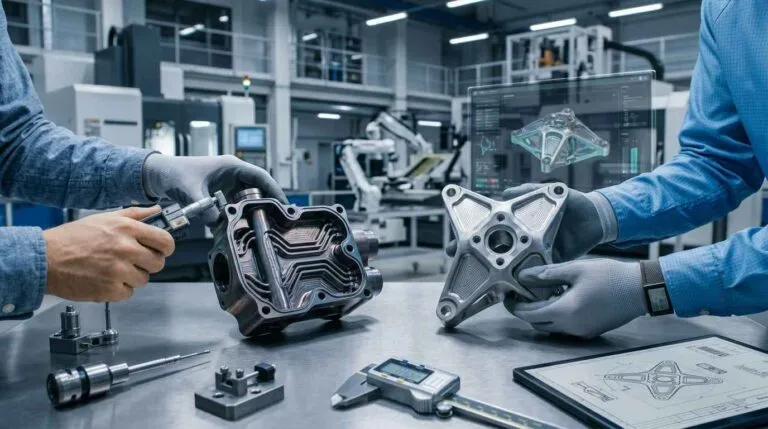
A product designer holds two aluminum parts side by side, one a smooth, detailed housing and the other a long, straight structural rail. They came from two completely different processes, even though both are the same base metal. Neither process is objectively better, only better suited to a specific shape.
That difference matters more than it looks. Die casting and aluminum extrusion both start with the same metal but produce it in entirely different ways, and choosing the wrong one can add real cost to a project. Die casting forces molten aluminum into a mold under pressure, while extrusion pushes solid heated aluminum through a shaped die.
Getting this choice wrong early in a design often means expensive tooling changes later. Understanding the difference upfront saves both time and budget. This article explains how each process works and when each one makes sense.
What Die Casting and Extrusion Actually Do
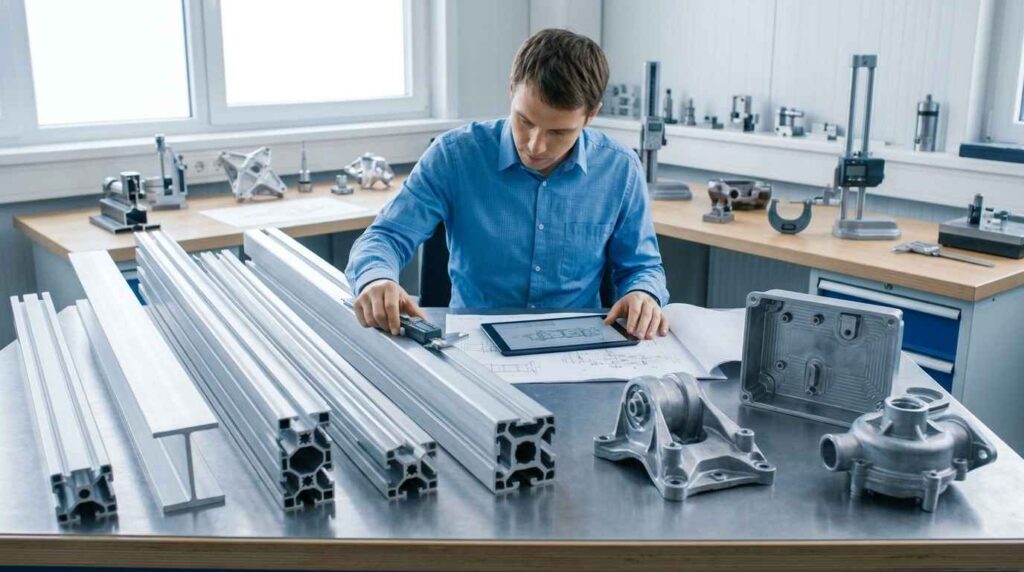
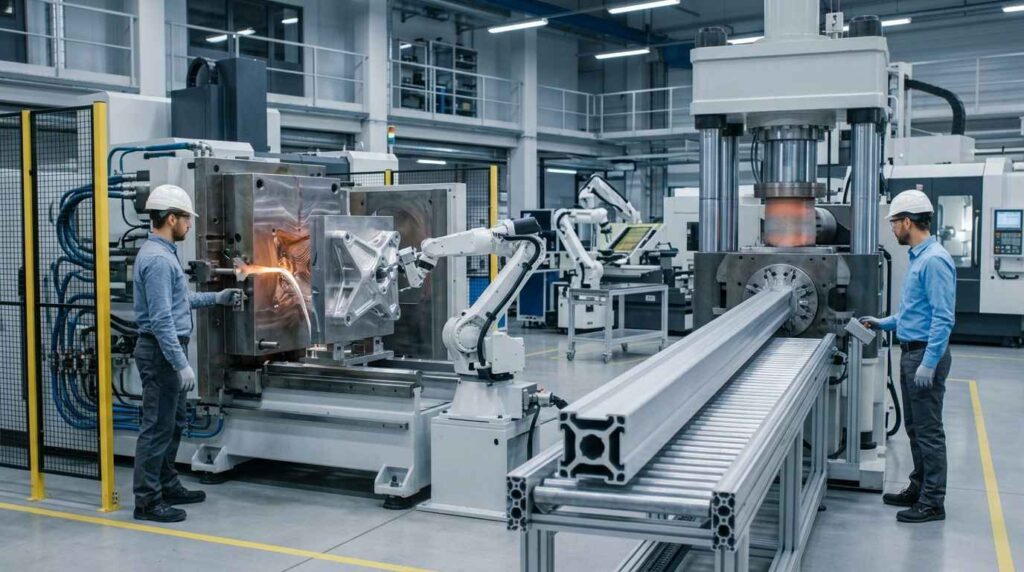
Die casting injects molten aluminum into a steel mold under high pressure, filling every detail of the cavity before the metal cools and solidifies. The result is a complex, three-dimensional part in a single step, ready for minimal further machining. Molds are expensive to build but pay off quickly at high volume.
Extrusion works differently. A heated aluminum billet gets pushed through a shaped opening in a die, producing a continuous length with the same cross-section from end to end. That process is how Flat Bars and other structural profiles get their exact, repeatable shape, cut to length after extrusion. The die itself is far cheaper to produce than a casting mold.
Strengths and Limitations of Aluminum Extrusion
What Extrusion Does Well
Extrusion excels at producing long, constant cross-sections with excellent dimensional consistency. A window frame, a structural rail, or a Windows Wall mullion all rely on this same repeatable geometry, run after run. Once a die is proven, that consistency holds for the life of the order.
Extrusion is also cost-effective for long production runs, since one die can produce thousands of meters of identical profile without retooling. That economics shifts heavily in extrusion’s favor as order volume grows.
Where Extrusion Has Limitations
Extrusion cannot produce the complex three-dimensional shapes that die casting handles easily. Undercuts, internal bosses, and fine surface detail are simply outside what a constant cross-section can achieve, regardless of alloy or die quality. Designers sometimes discover this limitation only after committing to an extrusion-based design.
For small, geometrically complex parts made in very high volumes, die casting usually outperforms extrusion on both cost and capability. Trying to force such a part into an extruded design usually adds cost rather than saving it.
Die Casting vs Aluminum Extrusion: Choosing the Right Process
Choosing between die casting and extrusion, including extruded profiles such as a Curtain Wall mullion, comes down to shape and volume.
| Process | Best For | Less Suitable For |
| Die casting | Complex 3D parts, high-volume small components | Long structural profiles, low-volume custom runs |
| Aluminum extrusion | Long constant cross-sections, structural and architectural profiles | Parts with undercuts or fine internal detail |
For architectural and structural building work, extrusion’s shape consistency and lower tooling cost usually make it the clearly better fit. Small complex hardware tends to favor casting instead, especially at high volume.
Where Each Process Shows Up in Real Projects
Automotive Brackets and Housings
Vehicle manufacturers use die casting for complex housings and extrusion for structural members, including components such as Automotive Motor Accessories.
Custom Architectural Profiles
Building facades rely almost entirely on extrusion, since a Door Jamb or window frame needs the same cross-section repeated across an entire structure.
Retail Fit-Out Framing
Store interiors often mix both processes, using extruded framing such as Shop Front systems alongside die-cast fixtures and hardware.
Consumer Electronics Housings
Compact electronic housings with fine detail and multiple mounting points typically favor die casting over extrusion, since the geometry is too complex for a constant cross-section.
What to Consider Before Choosing a Process
A few practical factors usually settle the decision between casting and extrusion. Working through them before finalizing a design saves a costly redesign later, especially once tooling has already been ordered.
- Part geometry: complex 3D shapes need casting, while constant cross-sections need extrusion.
- Production volume: casting suits very high volumes of one small part, while extrusion suits long continuous runs.
- Tooling cost: extrusion dies are generally cheaper to produce than casting molds.
- Wall thickness: extrusion allows more design freedom in wall thickness along a profile’s length.
- Finish requirements: both processes accept anodizing or powder coating, though surface prep differs.
- Hardware integration: confirm whether the part needs a Handle or fastener point built into the design early.
- Assembly needs: extruded parts often need cutting and joining, while cast parts arrive closer to finished form.
Aluminum Extrusion Services from Exalum Metal
Exalum Metal specializes in aluminum extrusion, producing structural and architectural profiles for projects that need a consistent, repeatable cross-section. Every profile runs to the same tolerance across the full order.
Custom extrusion is available for project-specific dimensions and shapes. Finishing services include mill finish, anodizing, and powder coating. Volume order support extends to manufacturers and contractors ordering profiles such as Furniture trim at production scale, across single or multi-phase projects. Many of these orders run alongside other extruded profiles on the same project.
If your project needs a specific extruded profile, bring us your drawings or an estimated volume. Get in touch with our team directly through our contact inquiry or click the “Contact Us” button below.