
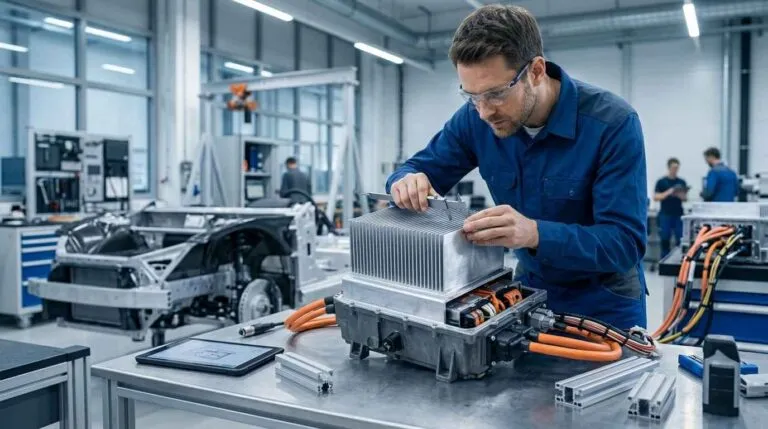
Selecting an aluminum heat sink for automotive electronics requires more than a profile that fits the available space. Heat dissipation, airflow, mounting and operating temperatures must be considered together.
This guide explains the information to prepare for a heat sink inquiry. Exalum’s catalog profiles can provide starting geometries, while suitability for a specific automotive application requires engineering review and validation.
Why Thermal Management Matters in Automotive Systems
Heat is a design issue in automotive systems, not just a cooling problem to solve afterward.
Managing Heat in EV Batteries
EV batteries perform best within a specific temperature range, and uneven heat between cells can shorten pack life. Effective thermal management keeps every cell close to the same temperature.
Cooling Power Electronics
Inverters, DC-DC converters, chargers, and power control modules all generate significant heat during operation. Aluminum profiles help move that heat away before it shortens component life.
Managing Heat Without Adding Excess Weight
Every kilogram added for cooling works against range and efficiency. Aluminum’s low density and decent thermal conductivity make it attractive against heavier cooling materials.
How Aluminum Heat Sinks Work in Automotive Applications
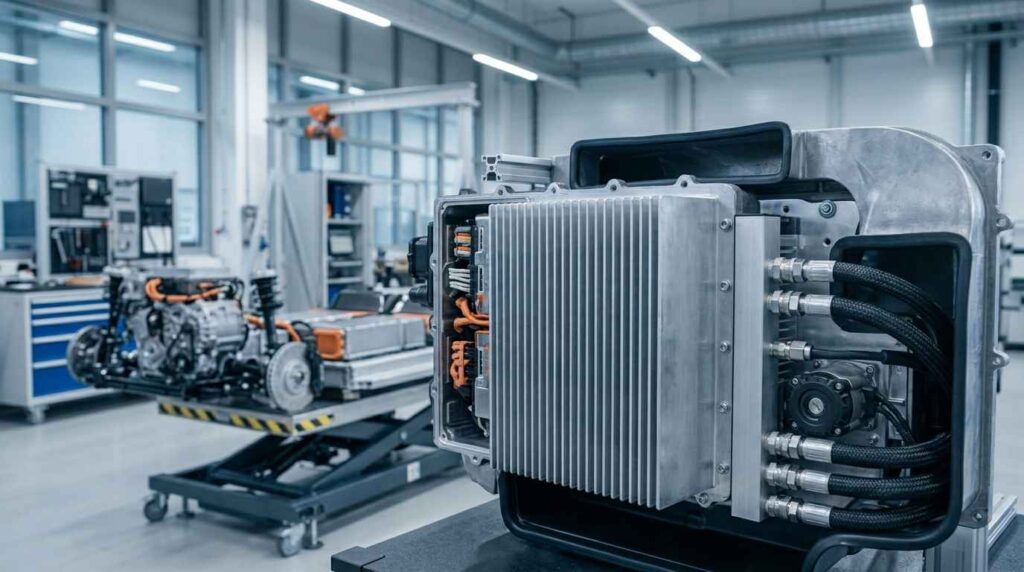
The basic principle behind an aluminum heat sink is simple, even when the application is not.
Increasing Surface Area With Fins
Extruded fins increase the surface area available for heat to escape into the surrounding air. This is the principle behind Exalum’s Heatsink profiles, extruded to maximize that surface area.
Moving Heat Away From Electronic Components
Heat follows a simple path: component, thermal interface, aluminum profile, then fins into the air. A Diffusers style profile can help spread airflow evenly at that final stage.
Why Extrusion Works for Automotive Heat Sinks
Extrusion lets manufacturers repeat fin structures and complex cross-sections across a long run, and build mounting features directly into the profile.
Strengths and Limitations of Aluminum Heat Sinks
What Aluminum Heat Sinks Do Well
Aluminum combines low weight with decent thermal conductivity, exactly what automotive cooling needs. It also extrudes easily into fin geometries that would be costly to machine from solid stock.
Where Aluminum Heat Sinks Have Limitations
Aluminum is not always the top performer. Copper conducts heat more efficiently in a smaller footprint, so extremely compact, high-power designs sometimes still call for copper cold plates instead.
| Material | Best For | Less Suitable For |
| Aluminum | Lightweight profiles, high-volume extrusion | Extremely compact, high-power-density designs |
| Copper | Maximum conductivity in minimal space | Weight-sensitive vehicle applications |
Automotive Applications for Custom Aluminum Thermal Profiles
EV Battery Cooling Profiles
Battery thermal-management systems can use custom profiles such as cooling plates, coolant channels, or multi-port extrusions. These are developed around a pack’s dimensions and cooling needs.
Power Electronics Heat Sinks
Inverters, chargers, and DC-DC converters need heat sinks matched to their footprint and power output, extending Exalum’s heatsink category into automotive dimensions.
Battery Tray and Enclosure Profiles
Battery packs also need structural protection, including frame profiles, cross-members, and bottom sections. A Rectangular Hollow or Square Hollow profile often forms that backbone.
Motor and Other Vehicle Electronics
Electric motors and other onboard electronics also need a lightweight path for heat. Profiles around components such as Automotive Motor Accessories illustrate this reach.
Existing Exalum Heat Sink Profiles
Exalum Metal currently offers extruded heatsink profiles in a range of thicknesses and weights.
| Product Code | Thickness | Weight |
| 96001 | 1.25 mm | 0.799 kg/m |
| 96002 | 1.20 mm | 1.021 kg/m |
| 96003 | 1.50 mm | 0.875 kg/m |
| 96004 | 1.00 mm | 0.378 kg/m |
| 96005 | 0.90 mm | 0.399 kg/m |
| 96006 | 1.00 mm | 0.223 kg/m |
| 96007 | 1.00 mm | 0.277 kg/m |
| 96008 | 1.00 mm | 0.331 kg/m |
| 96009 | 1.00 mm | 0.577 kg/m |
| 96010 | 1.00 mm | 0.313 kg/m |
| 96012 | 1.90 mm | Not specified |
These profiles show the range of heatsink geometries currently available. Automotive manufacturers can discuss custom extrusion when a standard profile does not match the required thermal or mechanical design.
What Information Does a Heat Sink Supplier Need?
Specify the heat to be dissipated in watts, ambient temperature, allowable component temperature and cooling method. Include the available width, height and length, mounting details and expected quantity.
A device’s electrical power rating alone is not enough to select a heat sink. State the thermal load and operating conditions so the proposed profile can be assessed in context.
What to Specify in a Custom Heat Sink Profile
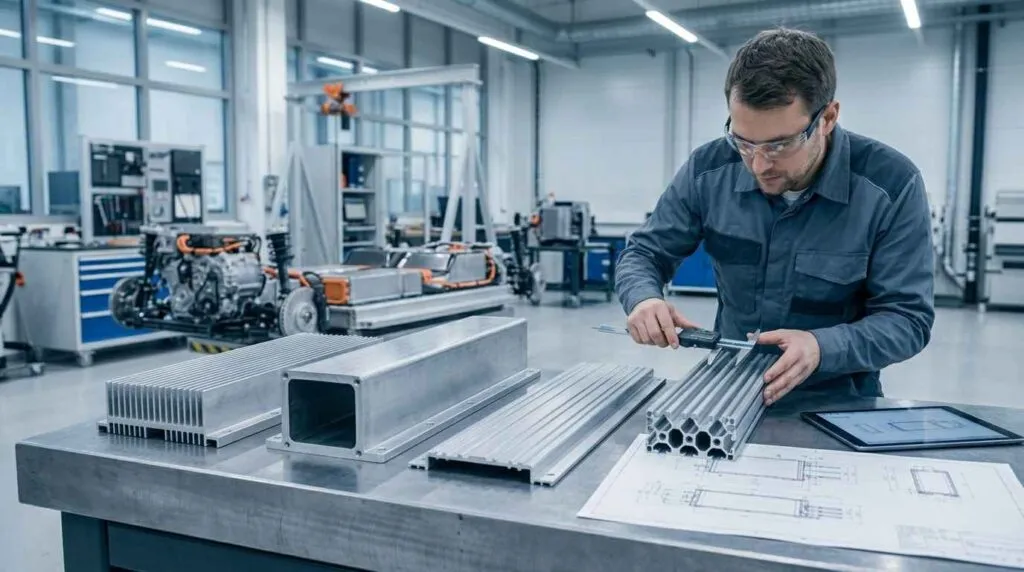
A custom heat sink profile comes down to a handful of practical specifications.
- Fin geometry: fin height, spacing, and count determine how much surface area fits the space.
- Profile width and airflow: wider profiles need enough airflow to use that surface area.
- Thickness and weight: thicker walls improve heat transfer but add weight to carry.
- Mounting features: holes, fastener channels, or grooves work best built into the profile.
- Cooling method: convection, forced-air, liquid cooling, or direct contact favor a different design, with finish depending on exposure near systems such as HVAC equipment.
Why Aluminum Extrusion Fits Automotive Thermal Management
Extrusion brings lightweight construction, complex geometry, and repeatability into one process. A single Equal Channel profile, or something more complex, can replace what would otherwise need several separate parts.
Custom Automotive Aluminum Extrusion From Exalum Metal
Exalum Metal develops custom aluminum profiles for automotive and EV thermal management, built around your dimensions, cooling needs, and weight targets.
Custom extrusion covers project-specific cross-sections and mounting features, alongside finishing services including mill finish, anodizing, and powder coating. Volume production support extends to manufacturers ordering consistent dimensions across a full program, from heatsinks to structural work such as a Clean Room enclosure.
Discuss Your Heat Sink Profile Requirements
Send your drawing, available dimensions, cooling requirements and estimated quantity. Exalum Metal can discuss the profile geometry and manufacturing requirements with you. Discuss a Custom Heat Sink Profile or View Aluminium Heatsink Profiles