
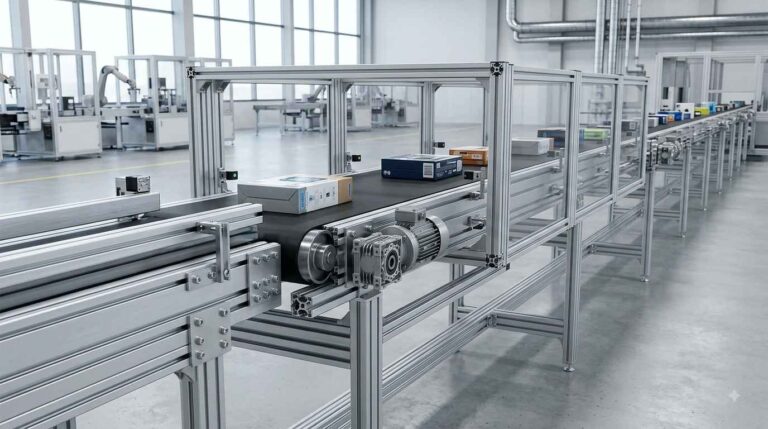
A conveyor frame sits beside the production floor, carrying products through repeated cycles while rollers, motors, guides, and guards stay aligned.
Aluminum extrusion profiles offer a useful balance of strength, low weight, and easy assembly. An extrusion is aluminum shaped through a die, which forms the metal into a consistent cross-section.
A conveyor profile may look like a hollow section, angle, flat strip, or channel. Its shape affects load capacity and how components attach.
This guide covers common profiles, their practical uses, and the factors that matter when selecting sections for a conveyor system.
Why Aluminum Works Well for Conveyor Frames
Aluminum suits conveyor structures when the frame needs rigidity without unnecessary weight. An Aluminum Conveyor system can combine extrusion profiles with belts, rollers, motors, sensors, and guards.
Extrusion can form grooves and channels directly into the profile. These features provide locations for brackets, fasteners, guards, and sensors.
Aluminum Conveyor Profiles: Strengths and Limitations
Aluminum performs well in many conveyor applications, but the right profile still depends on the load, span, and environment.
What Aluminum Conveyor Profiles Do Well
Aluminum weighs less than steel, which can simplify transport and installation. Properly sized profiles can still keep conveyor components aligned.
Aluminum forms a thin oxide layer that helps protect its surface from corrosion. Therefore, it can suit humid areas and regular cleaning.
Where Aluminum Conveyor Profiles Have Limitations
Aluminum is not automatically the best choice for every conveyor. Extremely heavy products, severe impact loads, or long unsupported spans may require steel or a larger structural section.
The environment also matters. Chemicals, salt, trapped moisture, and contact with other metals can affect performance, so the alloy, finish, and joining method should match the site.
Aluminum Profiles Commonly Used in Conveyor Systems
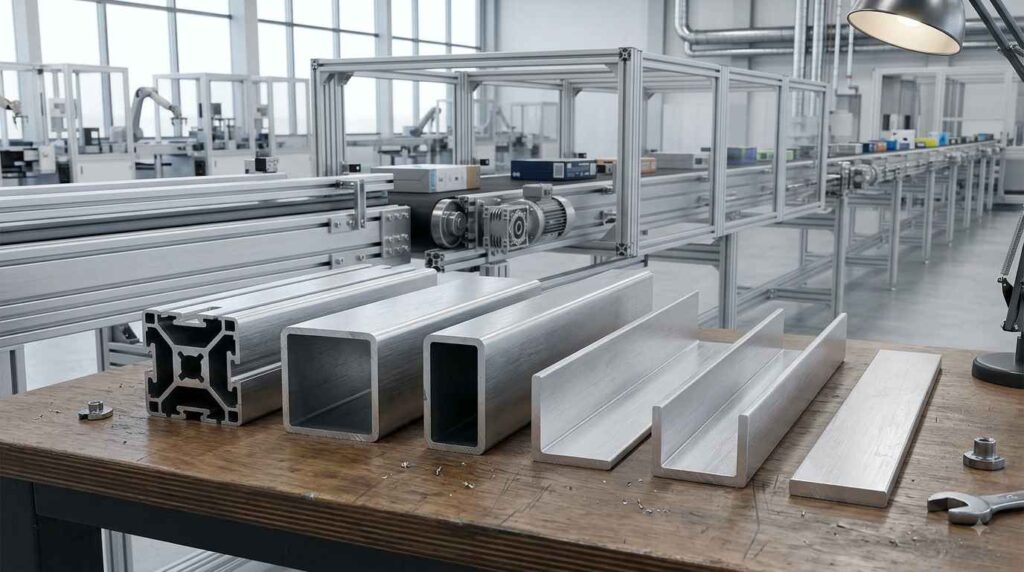
Different shapes serve different structural jobs.
Square and Rectangular Hollow Profiles for Main Frames
Square Hollow profiles can serve as legs and cross members. Rectangular Hollow profiles provide greater depth in one direction, which can help where bending resistance matters.
The hollow center reduces material while keeping metal around the outside, providing useful rigidity without excessive weight.
Equal Angles for Brackets and Reinforcement
An Equal Angle has two equal legs meeting at a right angle. It can reinforce corners, connect frame members, or create mounting points.
Flat Bars for Supports and Mounting Components
Flat Bars provide a simple rectangular section for plates, brackets, spacers, and light supports.
Channels for Guides and Component Mounting
An Equal Channel has a U-like cross-section with two equal sides. It can support guides, brackets, tracks, or hardware that benefits from a recessed mounting area.
How Aluminum Profiles Make Conveyor Systems More Flexible
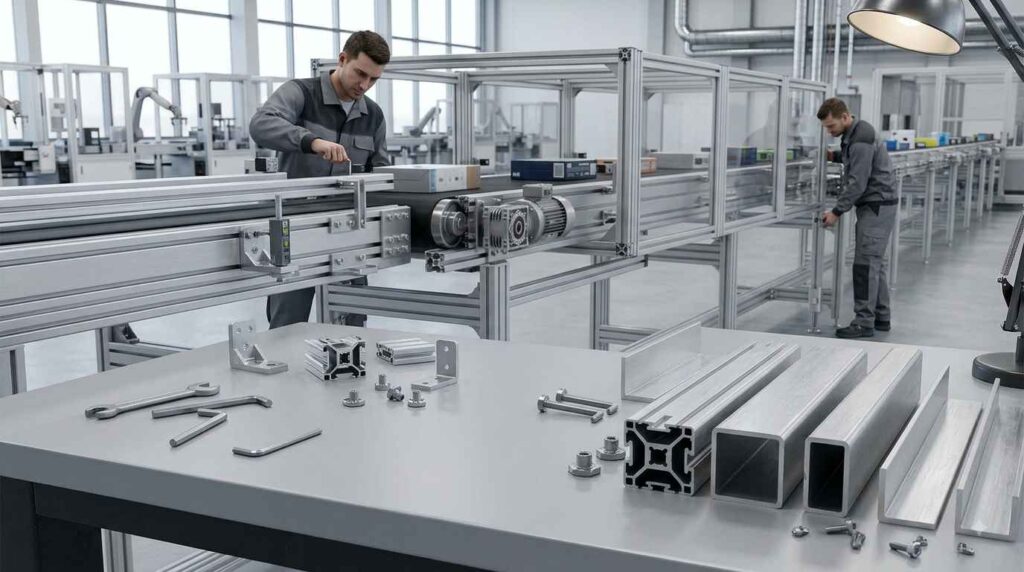
A conveyor may change after installation as production needs evolve. Modular aluminum construction can make those changes easier to manage.
Modular Assembly Makes Layout Changes Easier
Aluminum conveyor profiles can be purchased as separate sections and assembled directly into a conveyor frame on site. T-slot and V-slot profiles can support this approach by providing integrated grooves for bolts, brackets, and other connecting hardware.
Mechanically joined profiles can be loosened, repositioned, and secured again when the conveyor layout needs to change. This can simplify initial assembly as well as later adjustments to conveyor height, length, guarding, or component placement.
Modular Assembly Makes Layout Changes Easier
Mechanically joined profiles can be loosened, repositioned, and secured again. This can simplify changes to conveyor height, length, guarding, or component placement.
Profiles Can Integrate Mounting Points Into the Structure
Extrusion geometry can provide attachment locations for sensors, guards, brackets, and other equipment. Therefore, installers can add components without building a separate support frame.
Standard Sections Can Simplify Maintenance and Expansion
Standard profiles can simplify replacement, extension, and procurement across multiple conveyor lines.
Where Aluminum Conveyor Profiles Are Used
The same profile can serve different purposes depending on the operating environment and conveyor layout.
Packaging and Material Handling Lines
Aluminum frames suit packaging conveyors where products are relatively light and layouts may change. Their lower weight can also simplify installation and repositioning.
Assembly and Manufacturing Lines
Assembly conveyors often combine frames with workstations, sensors, fixtures, and guards. Aluminum profiles provide convenient mounting options when equipment positions need adjustment.
Food and Clean Production Areas
Aluminum can support structures that require regular washing or cleaning. For controlled environments, Exalum’s Clean Room solutions can complement the structural design.
Warehouse and Distribution Systems
Warehouse conveyors can benefit from modular frames when line lengths or transfer points change. However, heavy products and severe impacts may favor steel instead.
Aluminum or Steel for Conveyor Frames?
Steel and aluminum serve different operating demands. Generally, aluminum favors lightweight, modular construction, while steel suits very high loads and severe impacts.
| Material | Best For | Less Suitable For |
| Aluminum | Lightweight modular frames | Extreme loads or impacts |
| Steel | Heavy-duty structures | Weight-sensitive installations |
The decision should consider the complete conveyor, not only the frame material.
What to Consider Before Choosing Conveyor Profiles
Start profile selection with the actual load and operating conditions.
- Conveyor load: Include products, belts, rollers, motors, guards, and other equipment.
- Span and deflection: Long unsupported sections may need larger or reinforced profiles.
- Profile dimensions: Width, height, and wall thickness affect rigidity, material use, and weight.
- Alloy grade: Aluminum alloys differ in strength and fabrication characteristics.
- Mounting compatibility: Check brackets, rollers, motors, sensors, guards, and joining hardware.
- Operating environment: Review moisture, cleaning agents, temperature, salt, and metal contact.
- Custom extrusion: Standard profiles suit common designs, while custom dies can suit repeated specialized sections.
For long spans or high loads, a larger structural section or steel may perform better than a small standard aluminum profile.
Aluminum Conveyor Profiles from Exalum Metal
Exalum Metal supplies aluminum profiles for conveyor fabrication, including standard sections selected around structural and mounting needs.
For specialized designs, Exalum Metal can support custom extrusion with project-specific dimensions, slots, channels, and mounting features. Finishing options include mill finish, anodizing, and powder coating, with volume order support for larger requirements.
If you are planning a new conveyor or expansion, bring drawings, specifications, target finish, or estimated order volume to the discussion. This helps determine whether a standard profile or custom extrusion is more practical.
Get in touch with our team directly through our contact inquiry or click the “Contact Us” button below.