A fabricator runs a hand along the exposed edge of a newly cut wall panel before installing an aluminum J channels as the final trim. The edge looks unfinished, catches dust easily, and could take damage during everyday use.
A length of aluminum J channel can solve these issues without adding a bulky frame around the panel. Its J-shaped cross-section captures the edge while the longer leg creates a clean, finished surface.
J channels are commonly used where exposed edges need protection and a more professional appearance. This article explains how the profile works, why aluminum suits the application, where it is used, and what to consider when specifying one.
What Is an Aluminum J Channel and What Does It Do?
An aluminum J channel is an extruded profile with a cross-section shaped roughly like the letter J. During extrusion, heated aluminum passes through a shaped die, creating the same profile continuously along the finished length.
How the J-Shaped Profile Covers Exposed Edges
The shorter section of the profile wraps around or overlaps the edge of a panel or sheet. Meanwhile, the longer leg sits against the surface and conceals the raw edge from view.
This design makes the profile different from a simple Flat Bar, which can cover a surface but does not provide the same wraparound edge protection.
More Than Appearance: Protection Against Wear and Damage
An exposed panel edge can experience knocks, abrasion, moisture, and repeated contact during installation or daily use. A J channel creates a physical barrier around that vulnerable area while giving the finished assembly a cleaner appearance.
The profile can also help conceal uneven cuts that would otherwise remain visible. However, it should not be treated as a waterproof seal unless the complete assembly has been designed for that purpose.
Why Aluminum Works Well for J Channel Profiles
The geometry of a J channel makes aluminum a practical material for applications where the profile needs to stay light while maintaining its shape.
What Aluminum J Channels Do Well
Aluminum provides useful rigidity without adding the weight associated with steel trim. That makes long sections easier to transport, handle, and install, particularly when the profile runs across a large panel.
It also resists corrosion through its naturally forming oxide layer. As a result, aluminum works well for indoor applications and many outdoor environments where exposed steel could require additional corrosion protection.
Where Aluminum J Channels Have Limitations
A J channel is not a replacement for a structural angle or channel when the assembly needs to carry significant loads. In those situations, a structural profile such as Equal Angle may provide a more suitable geometry.
Aluminum can also be less suitable where the profile faces severe impact or needs very high structural strength. The right choice depends on whether the profile primarily protects an edge or contributes to the structural integrity of the assembly.
Where Aluminum J Channels Are Commonly Used
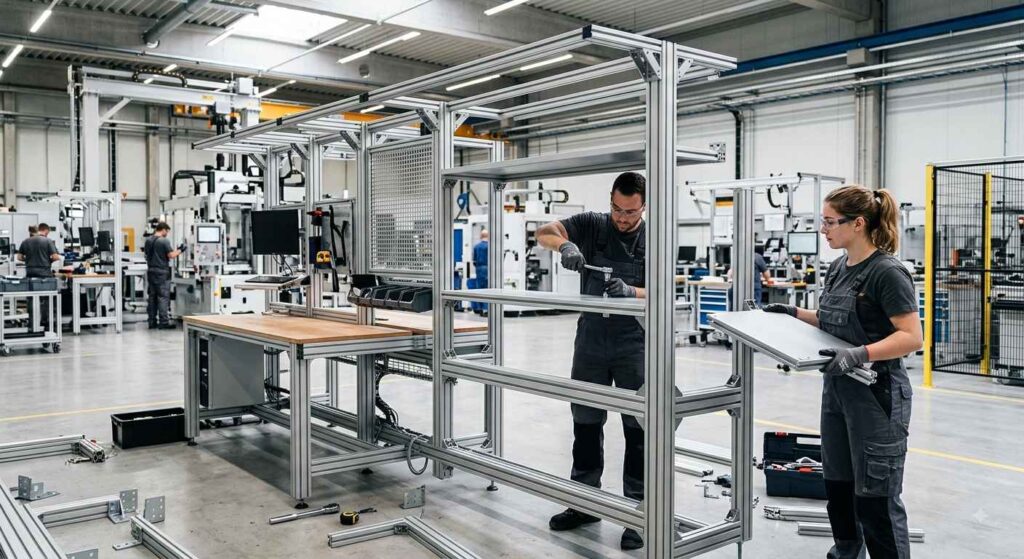
J channels appear in finishing applications where exposed edges need to look cleaner and receive additional protection.
Panel and Sheet Edges
J channels can cover the exposed edges of aluminum panels, composite panels, and other sheet materials used in fabricated assemblies. The profile hides the cut edge while reducing direct exposure to everyday contact and moisture.
Architectural and Interior Finishing
Wall panels and Partition systems can use J channels around exposed perimeter edges. They provide a simple finishing detail without requiring a larger frame around the entire panel.
Furniture and Fabrication Projects
Furniture makers and fabricators can use J channels around cabinet panels, display fixtures, and custom assemblies. For example, a Showcase can incorporate aluminum edge profiles where clean lines and consistent finishing matter.
Door, Window, and Glazing Assemblies
Some door and glazing assemblies use J-shaped profiles as trim or edge-retaining components. The suitability depends on the exact profile dimensions, panel thickness, and whether the component has a structural or purely finishing role.
How J Channels Compare With Other Aluminum Profiles
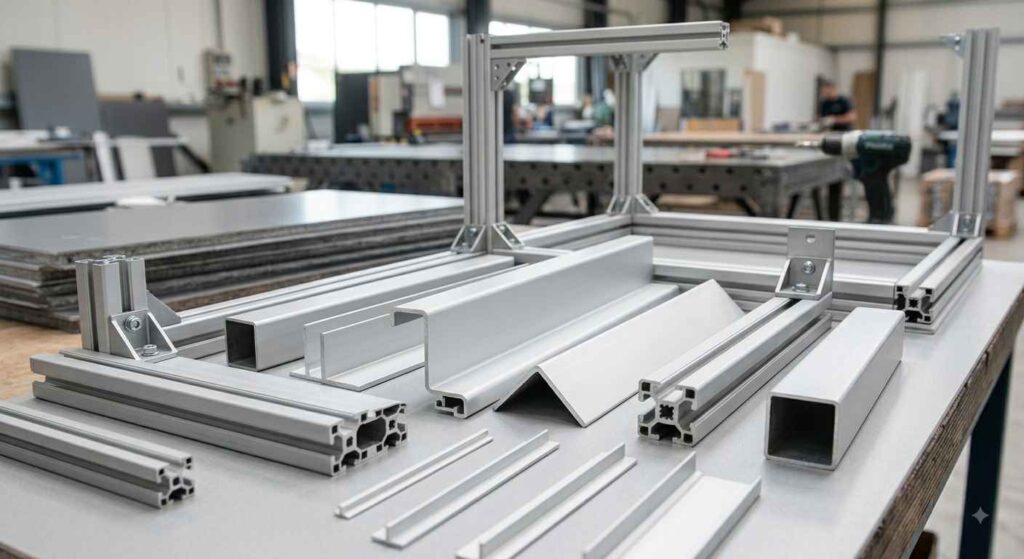
J channels, Equal Angle, Flat Bars, and Equal Channel profiles serve different fabrication needs.
| Profile | Best For | Less Suitable For |
| J Channel | Edge finishing and protection | Load-bearing joints |
| Equal Angle | Corner reinforcement | Edge wrapping |
| Flat Bar | Cover strips and reinforcement | Capturing panel edges |
| Equal Channel | Framing and retaining | Decorative edge finishing |
Choose a J channel when the main requirement is to cover and protect an exposed edge. By contrast, an equal angle suits structural corners, while a channel works better for framing, tracks, or retaining applications.
What to Consider When Specifying an Aluminum J Channel
The right specification depends on the material being covered, the installation environment, and the required appearance.
- Profile dimensions: Match the inside opening to the thickness of the panel or sheet so the channel fits securely without excessive movement.
- Leg dimensions: Check the short and long leg lengths to ensure the profile covers enough of the exposed edge and provides the desired visible finish.
- Wall thickness: A thicker profile provides greater rigidity, while a lighter section can reduce material use where heavy-duty performance is unnecessary.
- Alloy grade: Choose an alloy based on the required combination of strength, surface quality, and extrusion performance.
- Surface finish: Mill finish works for concealed applications, while anodizing and powder coating suit visible installations that require added protection or color.
- Length and quantity: Large projects should consider required lengths and total volume early to reduce unnecessary joints, cutting, and material waste.
- Installation method: Adhesive, fasteners, or friction-fit installation can require different tolerances and profile dimensions.
Aluminum J Channel Profiles for Your Project
Exalum Metal supplies aluminum extrusion profiles for fabrication, architectural, and industrial applications, including projects that require consistent edge-finishing components.
Standard profiles can help simplify procurement when their dimensions match the material being finished. For project-specific requirements, custom extrusion allows manufacturers to specify dimensions that fit their panels, assemblies, and production processes more precisely. Mill finish, anodizing, and powder coating are also available depending on the required application and appearance.
If your project requires aluminum J channels in production quantities, send your drawings, profile dimensions, required lengths, finish specifications, and estimated order volume for review.
Get in touch with our team directly through our contact inquiry or click the “Contact Us” button below.