
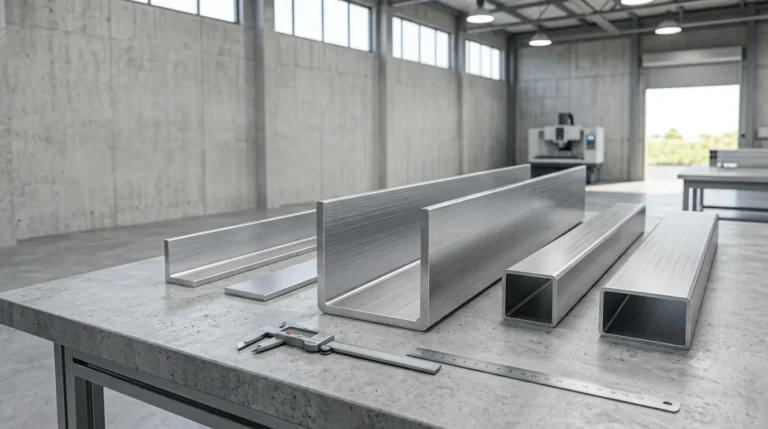
An aluminum U-channel is an open profile with a base and two legs. It can receive panels, protect edges or guide components, depending on its dimensions and the assembly design.
When choosing a channel, check the clear internal opening as well as the outside dimensions. Panel thickness, installation clearance, wall thickness and finish all affect whether the profile will fit your application.
What Is Aluminum U-Channel?
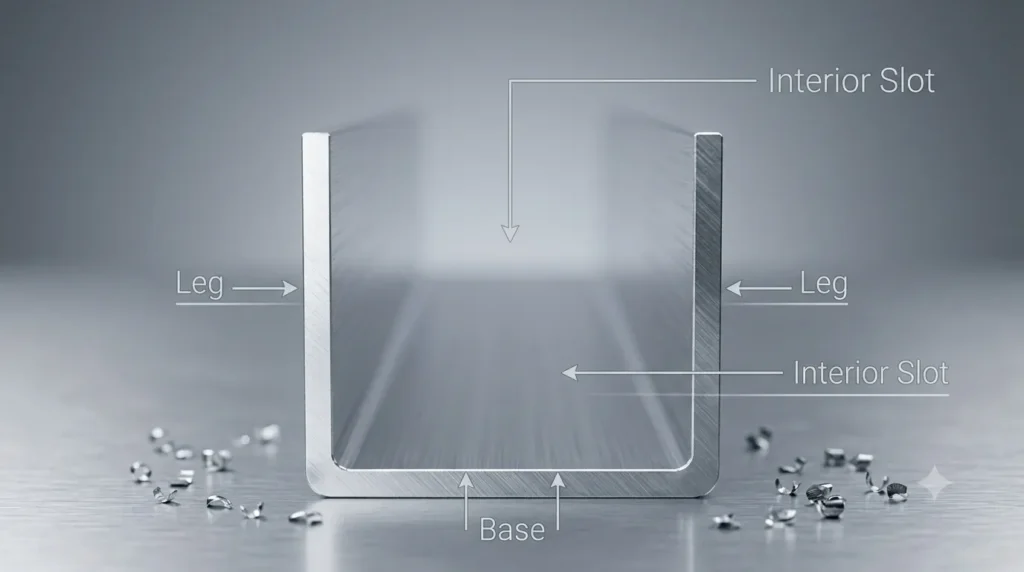
An aluminum U-channel is an extruded profile with a cross-section shaped like the letter “U.” It consists of two parallel legs connected by a flat base, while the center remains open along the entire length.
This open configuration distinguishes it from closed profiles such as Square Hollow and Rectangular Hollow sections. Rather than enclosing an empty space, the channel creates a receiving slot where another component can fit, slide, or remain securely positioned.
When both legs have the same height, manufacturers commonly refer to the profile as an Equal Channel. If one leg is taller than the other, it becomes an Unequal Channel, which serves applications requiring an offset profile.
Manufacturers create U-channel through the aluminum extrusion process by forcing a heated aluminum billet through a specially designed die. This production method allows both standard profiles and custom dimensions to meet different project requirements.
Which U-Channel Dimensions Should You Specify?
Provide the overall width, clear internal opening, leg height, wall thickness and required cut length. If the channel receives a panel, include the panel thickness and any gasket or installation allowance.
Confirm these dimensions on a cross-section drawing before ordering. The outside width alone does not tell you whether the panel will fit.
How Aluminum U-Channel Works
The open slot gives aluminum U-channel its versatility. Instead of relying on multiple brackets or fasteners, the profile itself guides, supports, or secures the material placed inside it.
As a result, aluminum U-channel performs several important functions:
- Guiding: The channel directs sliding panels, rollers, or cables along a fixed path, making it ideal for Sliding Windows and Sliding Doors.
- Framing: The profile wraps around glass, boards, or sheet materials to hold them securely without adhesives.
- Edging and trim: A U-channel protects exposed edges from impact, moisture, and abrasion.
- Enclosing and supporting: In partition systems or display frames, the profile forms a rigid perimeter that strengthens the overall assembly.
Because the profile performs multiple functions at once, installers often use fewer components. Consequently, assembly becomes faster while maintaining a clean and reliable design.
Strengths and Limitations of Aluminum U-Channel
Understanding both the advantages and limitations of aluminum U-channel helps you determine whether it suits your application.
What U-Channel Does Well
Aluminum U-channel combines lightweight construction with excellent corrosion resistance and easy fabrication. Fabricators can cut, drill, punch, or machine the profile using standard equipment, making it suitable for a wide range of manufacturing processes.
The open-slot design also naturally aligns inserted materials, simplifying installation and improving assembly accuracy. In addition, extrusion allows manufacturers to produce long continuous lengths that reduce joints and minimize fabrication work.
Another advantage is finishing flexibility. Aluminum U-channel supports mill finish, anodizing, and powder coating, making it suitable for both concealed structural applications and exposed architectural projects.
Where U-Channel Has Limitations
Although aluminum U-channel performs well in many situations, its open cross-section provides less torsional rigidity than closed profiles. If your application experiences significant twisting loads, Square Hollow or Rectangular Hollow profiles generally provide better structural performance.
Proper dimensional tolerance also matters. Too much clearance allows movement and vibration, while an overly tight fit can make installation more difficult. Selecting the correct channel dimensions helps ensure reliable long-term performance.
U-Channel, Equal Angle, and Flat Bar: Which One Should You Choose?
Aluminum U-channel often appears alongside Equal Angle and Flat Bars, but each profile serves a different purpose.
| Profile | Shape | Best For | Less Suitable For |
|---|---|---|---|
| U-Channel | Three-sided, open slot | Guiding, framing, edging, enclosing | High torsional-load applications |
| Equal Angle | Two-sided, L-shaped | Bracing, corner reinforcement, joining | Enclosing or guiding components |
| Flat Bar | Single flat face | Connecting, capping, surface mounting | Structural framing or guiding |
Choose U-channel when another component needs to sit inside the profile for guidance, support, or enclosure.
Choose Equal Angle when reinforcing corners or connecting two surfaces at a right angle.
Choose Flat Bars when the application requires a cover plate, connector, or surface-mounted strip without an enclosed channel.
Why Tropical and Coastal Environments Suit Aluminum U-Channel
Aluminum naturally forms a protective oxide layer after exposure to air. This layer provides excellent corrosion resistance without requiring additional coatings under many conditions.
As a result, aluminum U-channel performs particularly well in humid, tropical, and coastal environments where steel often requires more frequent maintenance. High humidity, frequent rainfall, and salt-laden air have less impact on properly specified aluminum profiles.
Across Southeast Asia, builders regularly use aluminum extrusion profiles for commercial buildings, residential developments, and industrial facilities. Combined with anodized or powder-coated finishes, aluminum U-channel delivers long-term durability with relatively low maintenance requirements.
Common Applications of Aluminum U-Channel
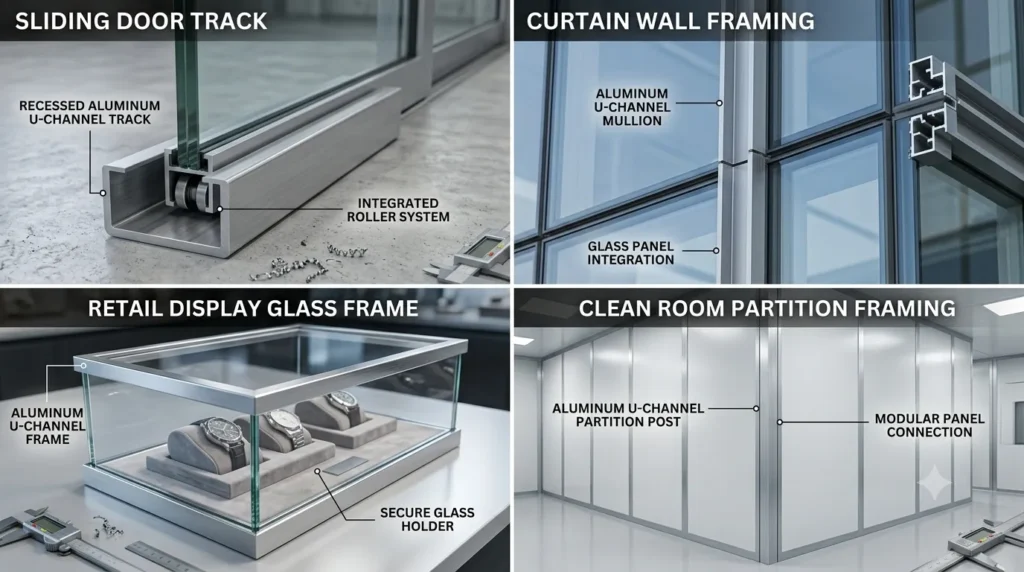
Because aluminum U-channel can guide, frame, edge, and support other materials, it serves a wide variety of industries.
Sliding Door and Window Systems
Most Sliding Doors and Sliding Windows use aluminum U-channel as their upper and lower tracks. The profile keeps each panel aligned while supporting smooth and consistent movement.
Curtain Wall Perimeter Framing
Within Curtain Wall systems, aluminum U-channel receives glass or infill panels around the perimeter. It transfers panel loads into the surrounding frame while maintaining proper alignment.
Retail Display and Showcase Construction
Retail fixtures and Showcase systems frequently use aluminum U-channel to secure glass panels without visible fasteners. This approach creates a clean appearance while maintaining structural stability.
HVAC Duct Supports and Clean Room Framing
HVAC support systems and Clean Room wall assemblies also rely on aluminum U-channel. In these applications, the profile acts as a perimeter receiver for panels while maintaining the dimensional precision required in controlled environments.
What to Consider When Choosing Aluminum U-Channel
Selecting the right aluminum U-channel involves more than choosing the overall size. You should also evaluate several technical factors.
- Interior width and clearance: Match the channel width to the inserted material while allowing sufficient installation clearance.
- Leg height: Choose a height that provides enough support for the enclosed component.
- Wall thickness: Thicker walls improve strength and impact resistance, while thinner walls reduce weight and material costs.
- Alloy grade: 6063-T5 offers excellent surface quality for architectural applications, while 6061-T6 provides greater mechanical strength for structural and industrial uses.
- Surface finish: Mill finish works well for concealed installations, anodizing improves durability, and powder coating provides the broadest range of colors.
- Environment: Coastal or chemically exposed locations may require thicker anodizing or sealed finishes for maximum long-term protection.
Considering these factors together helps ensure the profile delivers reliable performance throughout its service life.
Aluminum U-Channel Solutions from Exalum Metal
At Exalum Metal, we provide aluminum extrusion and finishing solutions for construction, industrial, and commercial applications, including aluminum U-channel in both standard and custom profiles.
Our production capabilities include custom extrusion for project-specific dimensions, along with mill finish, anodizing, and powder coating services. We also support volume orders while maintaining consistent dimensional quality and reliable production schedules.
Need Help Selecting a U-Channel?
Send your panel dimensions, required profile length, quantity and preferred finish. Exalum Metal can discuss the profile requirements and prepare a quotation.
Email: [email protected] WhatsApp: +62 811 9429 970