
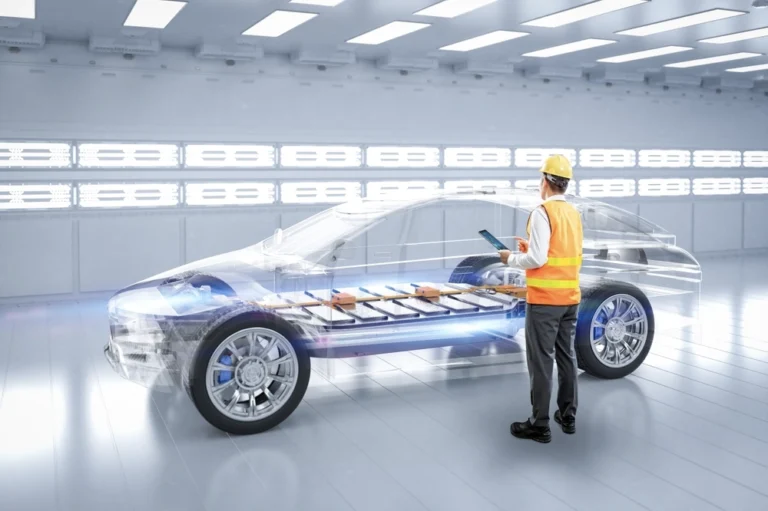
An EV battery enclosure must be designed as a complete system, with requirements for structural performance, sealing, thermal management, and manufacturing accuracy.
Aluminium extrusions can form components within that system, including perimeter sections and cross members. Their suitability depends on the specified alloy, profile geometry, joining method, and validated enclosure design.
This guide explains the extrusion-related details to consider before discussing a battery enclosure profile with a manufacturing supplier.
What an EV Battery Enclosure Has to Do
The battery pack sits at the heart of an electric vehicle, usually mounted low in the floor, and its enclosure carries several critical responsibilities at once. It provides crash protection, forming a rigid structure that absorbs and deflects impact energy in a collision to keep the cells from being crushed or punctured, which is a fundamental safety requirement because damaged lithium cells can fail catastrophically.
It seals the pack, keeping water, dust, and road debris out of the cells and electronics, which demands a watertight enclosure that holds its seal over the life of the vehicle and through constant vibration and temperature cycling. It manages heat, since batteries generate heat in use and charging and perform best within a temperature range, so the enclosure often integrates cooling channels and works as part of the thermal system. And it carries structural load, because the pack enclosure frequently contributes to the stiffness of the whole vehicle floor. Doing all of this while minimizing weight is the central engineering challenge, and it is what makes the material choice decisive.
Why Extruded Aluminum Leads Battery Enclosure Design
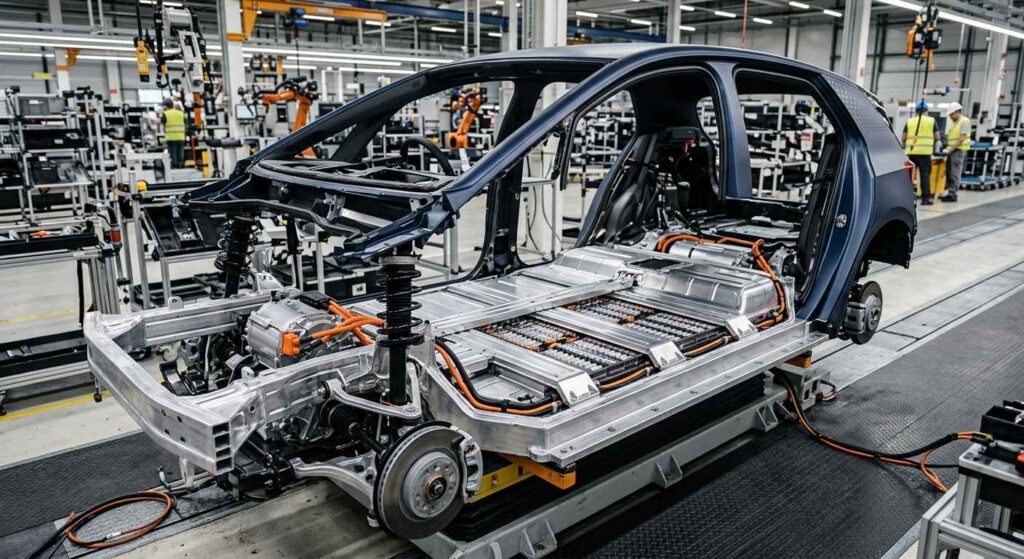
Aluminum has become the material of choice for EV battery enclosures because its properties align almost perfectly with the demands. The strength-to-weight ratio is the foundation. Aluminum delivers the crash-protection strength the enclosure needs at roughly a third the weight of steel, and in an electric vehicle that weight saving translates directly into range, which is the metric that defines the product. An enclosure that protects the pack without weighing it down is exactly what EV engineering requires.
Extrusion adds a second decisive advantage. Aluminum can be extruded into complex hollow profiles with internal chambers and channels, which lets a single extruded section serve as a structural crash member and a coolant channel at the same time, integrating functions that would otherwise need separate parts. This is why extruded aluminum profiles form the frame and the crash structure of so many battery enclosures. The thermal conductivity of aluminum supports the heat management the pack needs, helping move heat to where the cooling system can handle it. And aluminum’s corrosion resistance protects the enclosure against road salt and moisture over the vehicle’s life. Together these make extruded aluminum the natural answer to the enclosure problem.
How the Enclosure Comes Together
A typical aluminum battery enclosure combines several extruded elements into a structural tray. The perimeter frame is built from extruded profiles engineered as crash structure, with internal chambers that absorb impact energy and resist intrusion in a side or underbody collision. These profiles often integrate the cooling channels directly, so the same member that protects the pack also helps cool it.
The floor of the tray, on which the modules sit, may be formed from extruded panels or plate, providing a flat, sealed base. Cross members made from extruded profiles divide the tray and add stiffness, tying the structure together and creating the bays the battery modules sit in. The whole assembly is sealed with a cover and gaskets to achieve the watertight, dust-tight rating the pack requires. The precision of these extruded profiles matters enormously, because the sealing, the module fit, and the structural performance all depend on the profiles holding their dimensions consistently, which is where extrusion quality becomes a safety and performance factor rather than just a manufacturing detail.
Why Extrusion Precision Is a Safety Factor
In a battery enclosure, the dimensional consistency of the extruded profiles is not a cosmetic concern. The enclosure has to seal reliably, which depends on the profiles meeting their dimensions so the gaskets compress correctly and the joints close tight. It has to fit the modules precisely, since the cells and modules are packed densely and rely on the structure being exactly as designed. And it has to deliver the crash performance the engineers calculated, which depends on the profiles having the wall thickness, the internal geometry, and the alloy temper that the design assumed.
A profile that drifts in dimension or falls short on temper compromises the seal, the fit, or the crash protection, any of which is serious in a component protecting energy-dense cells. This is why battery enclosure profiles demand a manufacturer with strict extrusion control. Our vertically integrated facility in Indonesia spans 20,000 square metres and manages alloy, extrusion, and heat treatment as one chain, which is what keeps profile dimensions consistent and temper reliable across the production runs that demanding structural applications require.
How Battery Enclosures Connect to Our Products
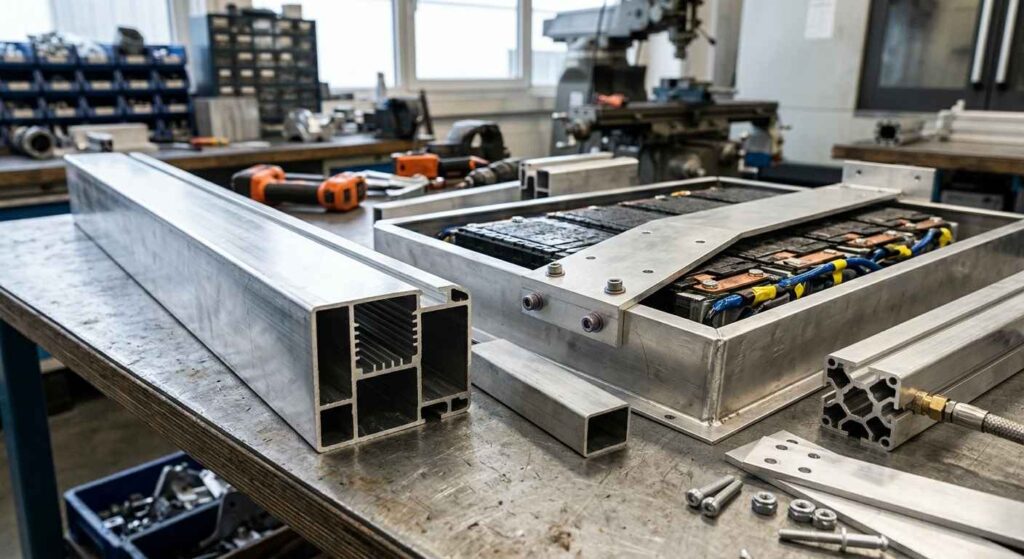
EV battery enclosures are built from precisely the kind of structural and hollow extrusion we produce, and the broader automotive and structural profile range supports the systems around them. Our facility produces the profile families that battery enclosure and EV structural work draws on:
- Automotive profiles developed for vehicle structural and component applications
- Rectangular Hollow and Square Hollow for the perimeter crash structure, cross members, and frame of the enclosure tray
- Flat Bars and plate stock for tray floors, mounting plates, and structural reinforcement
- Heat Sinks that apply aluminum’s thermal conductivity to the heat management the pack requires
- Equal Angle and Unequal Angle for brackets, mounts, and structural connections
- Tubing Pipes for structural members and routing
For battery enclosure designs that need a specific structural crash profile or an integrated cooling-channel section, custom extrusion produces the exact geometry the engineering calls for, in the alloys and tempers that structural and safety-critical applications depend on.
Engineering Enclosures for a Safer Future
The EV battery enclosure brings together crash protection, sealing, thermal management, structural contribution, and weight reduction into a single component, and extruded aluminum is what lets all of those requirements be met at once. The design depends on profiles engineered for the crash loads, alloys and tempers that deliver the calculated strength, integrated channels that handle heat, and the dimensional precision that sealing and module fit require. Getting that right is a safety matter as much as an engineering one, which is why the extrusion behind the enclosure has to be reliable.
We have supplied structural and automotive aluminum extrusion to fabricators and manufacturers since 2009, with the dimensional precision and temper consistency that safety-critical applications demand.
Whether you need standard profiles or custom cross-sections designed for your specific enclosure requirements, we have the capacity and expertise to deliver.
What to Specify for an EV Battery Enclosure Profile
Prepare the following information before requesting a quotation:
• Profile cross-section and component drawings.
• Alloy, temper, and dimensional tolerances.
• Joining methods and machining requirements.
• Sealing interfaces and surface requirements.
• Prototype and production quantities.
• Required material documentation and inspection criteria.
• Applicable project standards and validation requirements.
A quotation for an extruded profile does not establish the safety or certification of the complete battery enclosure. Final suitability must be confirmed through the project’s engineering and validation process.
Structural Benchmarks & Enclosure Metrics
To provide technical context for automotive OEMs and structural engineers evaluating EV battery enclosures, primary industry metrics highlight the physical trade-offs in pack design:
Pack & Enclosure Mass Proportion: A standard 70 kWh electric vehicle battery pack weighs approximately 500 kg, with the enclosure tray, skid protection, and top cover accounting for ~100 kg (roughly 20% of total pack weight).
Component Cost Share: Automotive manufacturers estimate the complete battery assembly represents 30% to 50% of total vehicle production costs.
Market Share Distribution: Extruded and sheet aluminium currently accounts for 80% of all battery enclosure production, while steel holds 20%.
Primary and Secondary Weight Savings: Substituting 400 kg of structural steel framing with 240 kg of extruded aluminium achieves a 160 kg primary mass reduction. This triggers an additional 40 kg to 60 kg in secondary savings across downsized braking systems, suspension components, and motor sizing.
Recycling & Energy Consumption: Recycling aluminium consumes only 5% of the energy required for primary smelting, cutting carbon emissions by $>90\%$ to meet European End-of-Life Vehicle (ELV) directives.
Material Comparison: Aluminium, Steel, and Composites
While extruded aluminium remains the leading structural framework choice, understanding the comparative strengths of competing materials guides hybrid multi-material enclosure designs:
1. Extruded Aluminium
- Key Advantages: High energy absorption per kilogram in side-pole crash scenarios; extrudable into multi-chamber profiles with integrated cooling channels; natural corrosion resistance.
- Technical Considerations: Lower melting point (610°C to 650°C) requires engineered multi-chamber geometry to prevent melt-through during prolonged thermal runaway.
2. High-Silicon / Advanced High-Strength Steel
- Key Advantages: Higher melting point (1410°C) provides fire resistance (over 20 minutes at 1000°C); lower raw material unit cost; high structural stiffness.
- Technical Considerations: Heavier overall mass density; prone to environmental corrosion unless coated; lower thermal conductivity for heat spreading.
3. Thermoplastics & Fiber Composites
- Key Advantages: Up to 20% weight reduction over aluminium for non-structural parts (top covers and lids); single-shot moulding with fast cycle times (under 120 seconds); inherently non-conductive.
- Technical Considerations: Requires added aluminium foils or metal-coated fibers to meet automotive Electromagnetic Interference (EMI) shielding standards (e.g., CISPR A4).
Discuss Your Battery Enclosure Profile Requirements
For automotive manufacturers and battery enclosure suppliers, consistent aluminum extrusion is essential for structural performance, sealing, thermal management, and module fit.
Exalum Metal operates a 20,000 m² vertically integrated facility in Indonesia, producing Rectangular Hollow, Square Hollow, Flat Bars, Heat Sinks, Equal Angle, and Unequal Angle profiles for battery enclosure applications. Custom extrusion is also available for specialized geometry and integrated cooling channels.
Whether you need standard profiles or custom cross-sections, Exalum Metal can support your requirements.
Share your drawings, specifications, and quantities with the Exalum Metal team by clicking the “Contact Us” button below.