
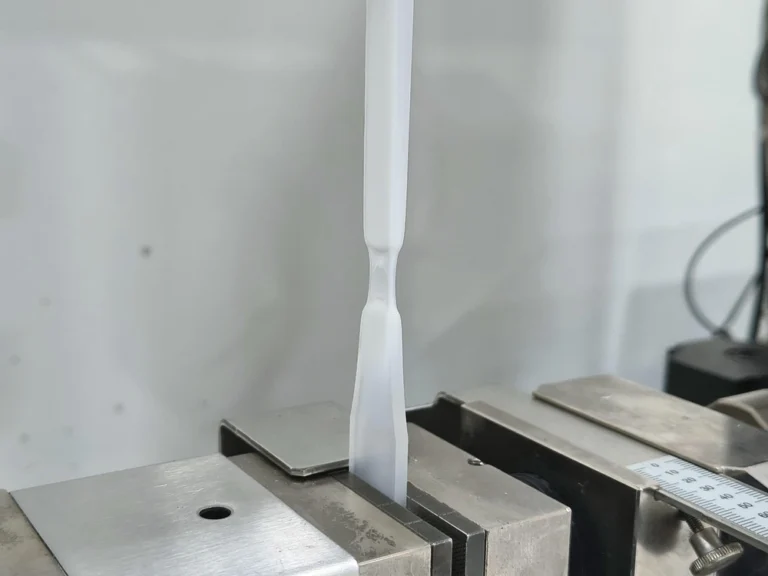
A fabricator may look at two aluminum profiles and see similar shapes and dimensions. Under load, however, they can behave very differently depending on their alloy, temper, and internal structure.
That difference makes tensile stress an important concept in aluminum fabrication. Tensile stress describes the internal stress created when a material is pulled. Combined with yield strength and ultimate tensile strength, it helps engineers understand how an aluminum profile may perform before it permanently deforms or fails.
For aluminum extrusion buyers, this is more than basic engineering theory. Strength affects decisions involving alloy selection, wall thickness, profile geometry, and the final application. This article explains tensile stress, aluminum strength, and how common 6000-series alloys relate to real extrusion projects.
What Is Tensile Stress?
Tensile stress is the internal stress produced when an external force pulls a material in opposite directions. Engineers calculate it by dividing the applied force by the cross-sectional area carrying that force.
The relationship is:
Tensile Stress = Force ÷ Cross-Sectional Area
The same pulling force creates more stress in a thin profile than in a thicker one because the force is distributed across less material.
For example, two aluminum bars may carry the same load. The bar with a smaller cross-sectional area experiences greater tensile stress.
This principle matters when selecting aluminum profiles for frames, rails, supports, and fabricated structures. However, tensile stress alone does not tell the full story. Engineers must also understand the material’s strength limits.
How Tensile Stress Relates to Aluminum Strength
Tensile stress describes the force acting within a material. Aluminum strength describes how much stress the material can resist.
Two measurements are particularly useful.
Yield strength: The point where aluminum begins to deform permanently. After this point, the profile may not fully return to its original shape.
Ultimate tensile strength: The maximum tensile stress the material can withstand before fracture.
In practical design, yield strength is often critical because a profile can become unsuitable for its intended function long before it breaks.
This is why two aluminum profiles with similar dimensions may not provide the same structural performance. Their alloy and temper can produce very different strength values.
Aluminum Strength in Common 6000-Series Alloys
Exalum Metal works with aluminum alloys commonly used for extrusion, including 6061, 6063, and 6005. Each serves different architectural and industrial requirements.
| Alloy & Temper | Approximate Yield Strength | Approximate Ultimate Tensile Strength | Typical Applications |
|---|---|---|---|
| 6063-T5 | ~110 MPa | ~150 MPa | Windows, doors, decorative profiles |
| 6063-T6 | ~170 MPa | ~200 MPa | Curtain walls, shop fronts, louvers |
| 6061-T6 | ~240–276 MPa | ~290–310 MPa | Structural profiles and heavy-duty frames |
| 6005A-T6 | ~215–225 MPa | ~260–270 MPa | Solar rails and industrial framing |
These figures are useful reference points, but actual properties can vary based on product dimensions, manufacturing requirements, and applicable standards.
6063 is widely used for architectural profiles because it extrudes cleanly and provides good surface quality.
6061 offers higher mechanical strength and can suit more demanding structural applications.
6005 provides a balance between strength and extrudability, making it useful for industrial and infrastructure-related profiles.
The correct choice depends on the application rather than strength alone.
T5 vs T6: Why Temper Changes Aluminum Strength
The temper of aluminum describes how the material has been processed to develop certain mechanical properties.
T5 and T6 are particularly relevant to aluminum extrusion.
A T5 temper generally develops through controlled cooling after extrusion followed by artificial aging. This process provides useful strength while supporting efficient extrusion production.
A T6 temper involves solution heat treatment followed by artificial aging. The process can produce higher mechanical strength by changing the material’s internal structure.
For buyers, the key point is straightforward: the same aluminum alloy can have different strength depending on its temper.
A 6063-T5 extrusion should therefore not automatically be considered equivalent to a 6063-T6 extrusion.
Why Aluminum Can Compete With Steel in Structural Applications
Aluminum does not always match steel in absolute strength. However, its lower density gives it an important advantage where weight matters.
| Material | Approximate Density | Typical Yield Strength | Strength-to-Weight Ratio |
|---|---|---|---|
| 6061-T6 Aluminum | 2.70 g/cm³ | ~240 MPa | ~89 |
| 6063-T6 Aluminum | 2.70 g/cm³ | ~170 MPa | ~63 |
| Structural Mild Steel | 7.85 g/cm³ | ~250 MPa | ~32 |
This strength-to-weight advantage helps explain aluminum’s use in transportation, architecture, solar infrastructure, and industrial equipment.
A properly designed aluminum structure can achieve sufficient mechanical performance while reducing overall weight.
However, aluminum is not always the best choice. Applications involving extreme impact, heavy abrasion, or exceptionally high loads may require steel or another material with greater absolute strength.
How Extrusion and Profile Design Affect Aluminum Stress
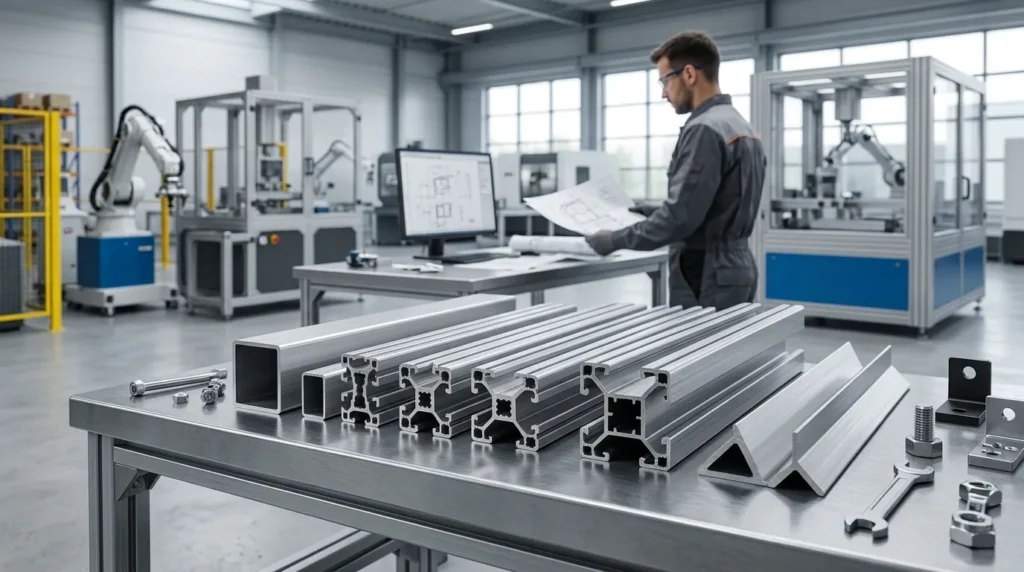
Aluminum strength depends on more than the alloy printed on a specification sheet.
During extrusion, heated aluminum passes through a shaped die to create a continuous profile. This process allows manufacturers to produce complex shapes with hollow chambers, reinforcing walls, and precisely positioned material.
Extruded aluminum also develops grain direction along the extrusion axis. As a result, mechanical properties can vary depending on the direction of the applied load.
Profile geometry matters as well. A well-designed Rectangular Hollow section can provide useful stiffness without requiring the weight of a solid profile.
When selecting an aluminum profile, buyers should consider:
- Cross-sectional area: More material generally reduces stress under the same tensile load.
- Wall thickness: Thicker walls can improve strength but also increase weight.
- Profile geometry: Hollow sections and internal ribs can improve stiffness efficiently.
- Load direction: Force acting along or across the extrusion direction may produce different behavior.
- Alloy and temper: Material selection must match the required mechanical performance.
- Connection design: Bolts, rivets, and joints can become critical points in a structure.
The goal is not simply to choose the strongest aluminum. It is to select the most suitable combination of material and geometry.
Aluminum Strength Requirements and Exalum Profiles
Different projects require different levels of mechanical performance. The table below connects common requirements with relevant aluminum applications.
| Application Requirement | Typical Alloy Direction | Relevant Exalum Product |
|---|---|---|
| Architectural framing and appearance | 6063-T5/T6 | Casement Windows |
| Structural connections and reinforcement | 6061-T6 | Equal Angle |
| Flat reinforcement and fabrication | 6061 or suitable 6000-series | Flat Bars |
| Industrial frameworks | 6005-series | Conveyor |
| Energy infrastructure | 6005-series | Solar Rail & Solar Panel |
| Architectural glazing systems | 6063 applications | Curtain Wall |
These examples provide general application guidance. Final material selection should consider actual loading, dimensions, fabrication methods, and engineering requirements.
Tensile Testing and Aluminum Quality Control
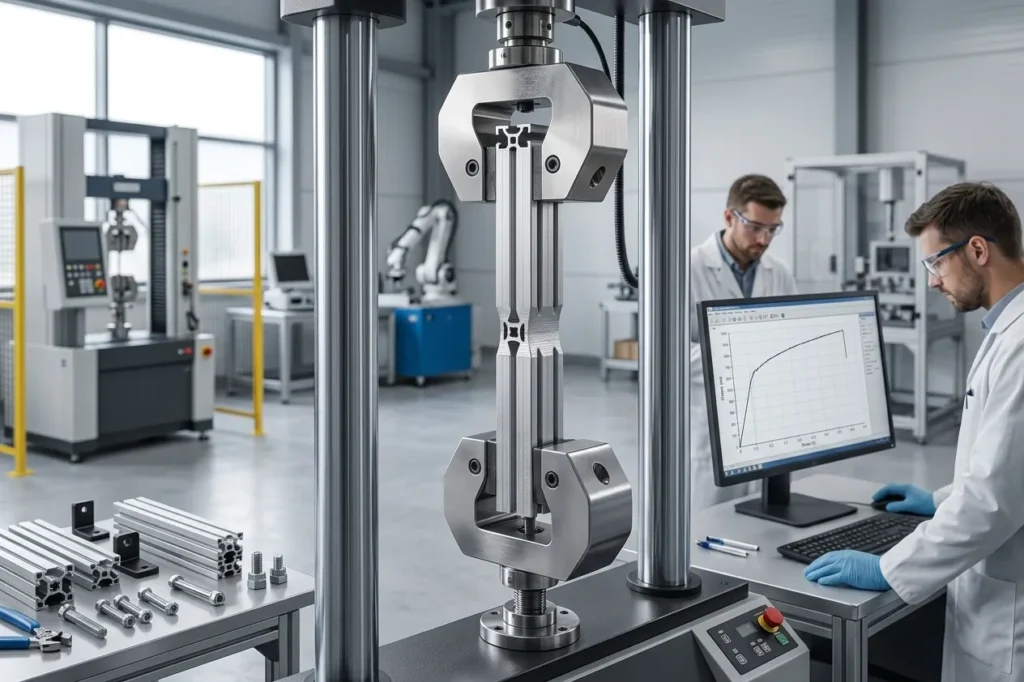
Manufacturers use tensile testing to measure how a material behaves under controlled pulling force.
During testing, a sample is pulled until it reaches specific deformation or failure points. The results can identify properties such as yield strength, ultimate tensile strength, and elongation.
Standards associated with aluminum extrusion include ASTM B221, which covers aluminum-alloy extruded bars, rods, profiles, and tubes. Tensile testing may also follow standards such as ASTM E8 or ISO 6892, depending on the applicable requirements. ASTM B221 specifies minimum tensile strength, yield strength, and elongation requirements that vary widely depending on the specific aluminum alloy and temper.
| Alloy | Main Strength | Typical Applications |
|---|---|---|
| 6063 | Excellent extrudability, surface finish, and corrosion resistance | Architectural profiles, windows, doors, curtain walls, decorative applications |
| 6005 | Higher strength with good extrudability | Structural profiles, ladders, solar mounting, transportation, industrial components |
| 6061 | High strength, good machinability and weldability | Structural and industrial profiles, frames, machinery components |
For large-volume orders, buyers should discuss mechanical property requirements before production. Alloy selection, dimensional tolerances, temper, and testing requirements can all affect the final specification. xalum Metal also provides tensile strength testing. If yield strength and tensile strength are critical to your requirements, we can support your project with both testing and aluminum extrusion as a one-stop solution.
Does Anodizing or Powder Coating Increase Aluminum Strength?
Surface finishing does not significantly increase the bulk tensile strength of an aluminum profile.
Mill finish: Suitable for applications where the profile will undergo further fabrication or where the surface remains concealed.
Anodizing: Creates a controlled oxide layer that improves surface durability and corrosion resistance.
Powder coating: Adds a protective and decorative surface layer while providing color options.
If a project requires greater structural strength, the solution usually starts with alloy selection, temper, wall thickness, and profile geometry rather than surface finishing.
Choosing the Right Aluminum Strength
Selecting aluminum based on one tensile strength number can create an inefficient design.
A stronger alloy may not offer the best combination of extrudability, cost, surface finish, and fabrication performance. On the other hand, a lower-strength architectural alloy may not suit a heavily loaded structural application.
Before placing an aluminum extrusion order, consider:
- Expected load: Identify whether the profile experiences tension, bending, compression, or vibration.
- Safety margin: The design should not operate directly at the material’s maximum strength.
- Profile dimensions: Confirm that wall thickness and geometry match the required load.
- Alloy and temper: Select the material based on the actual mechanical requirements.
- Environment: Consider corrosion, moisture, chemicals, and temperature.
- Fabrication requirements: Cutting, drilling, fastening, and welding may affect material selection.
For demanding structural applications, material data should support proper engineering calculations rather than replace them.
Aluminum Extrusion Solutions from Exalum Metal
Understanding tensile stress and aluminum strength can help businesses specify more suitable extrusion profiles before production begins. Exalum Metal provides aluminum extrusion solutions for architectural, industrial, transportation, and fabrication applications.
For project-specific requirements, Exalum Metal can support custom extrusion based on drawings, dimensions, alloy requirements, and estimated order volume. Available finishing options include mill finish, anodizing, and powder coating.
Bring your drawings, specifications, required alloy, or estimated volume to the Exalum Metal team to discuss the most suitable extrusion solution for your project.