
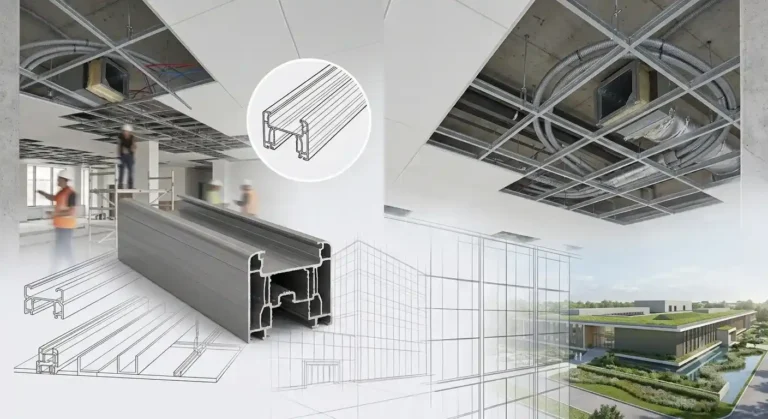
Look behind a drywall partition, above a suspended ceiling, or beneath an industrial wall cladding system, and you will often find the same aluminum profile doing the structural work: the hat channel.
This profile sits between the primary structure and the finished surface. Its outward flanges attach directly to the substrate, while its raised crown supports panels, ceilings, or cladding. As a result, it creates a consistent gap, improves alignment, and simplifies installation. This article explains what a hat channel is, how it works, where it performs best, and what to consider before selecting one.
What Is a Hat Channel?
A hat channel is an extruded aluminum profile with a cross-section that resembles an inverted top hat. It features a flat crown, two vertical webs, and two outward-facing flanges that provide secure mounting surfaces.
Unlike Equal Channel or Unequal Channel profiles, which have inward-facing legs, a hat channel creates a built-in standoff between the supporting structure and the finished surface. Consequently, installers can accommodate insulation, utilities, or ventilation without adding extra framing components.
Manufacturers produce hat channels by forcing a heated aluminum billet through a specially designed extrusion die. Most architectural applications use 6063 aluminum, while structural applications that demand greater strength often specify 6061 aluminum.
How Hat Channels Work in Buildings
The raised crown gives the profile its distinctive function. It separates two surfaces while the outward flanges create stable fixing points.
Common applications include:
- Subframing and standoff support: The crown keeps wall panels or cladding away from the primary structure, creating space for insulation, mechanical services, or thermal movement.
- Ceiling suspension: Hat channels span between hangers in suspended ceilings and provide continuous support for Diffusers, ceiling panels, and tiles.
- Partition backing: In Partition systems, installers secure hat channels to floors and ceilings before attaching wall boards, creating a rigid framing grid.
- Building services: The flanges fasten directly to the structure, while the crown supports HVAC ducts, conduit brackets, and other ceiling services.
Because the profile combines spacing and support in one component, it reduces installation time and minimizes the number of separate framing members.
Strengths and Limitations of Hat Channels
Understanding both the advantages and limitations of hat channels helps ensure the profile matches the intended application.
What Hat Channels Do Well
Hat channels provide two mounting faces within a single profile. Therefore, they simplify alignment and reduce the number of components required during installation.
In addition, aluminum construction offers several benefits:
- Lightweight yet durable
- Naturally corrosion resistant
- Compatible with anodized and powder-coated finishes
- Suitable for humid and coastal environments
These characteristics make aluminum hat channels an excellent choice for commercial interiors and architectural projects.
Where Hat Channels Have Limitations
Despite their versatility, hat channels are not ideal for every structural application.
Their open profile provides lower torsional stiffness than closed sections. Consequently, Rectangular Hollow profiles perform better when the structure experiences significant twisting or concentrated loads.
Furthermore, installation quality directly affects performance. Uneven fastener spacing or weak substrates can reduce load distribution and compromise the finished system.
Hat Channel, U-Channel, and C-Channel: Which One Should You Choose?
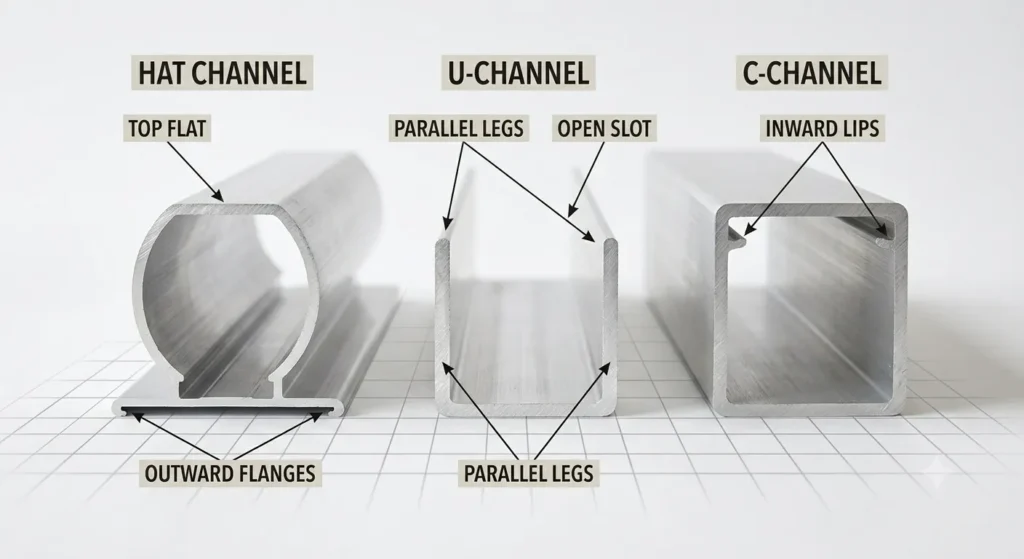
Although these three profiles share similarities, each serves a different purpose.
| Profile | Shape | Best For | Less Suitable For |
|---|---|---|---|
| Hat Channel | Raised crown with outward flanges | Standoff support, ceiling systems, subframing | High torsional or concentrated loads |
| U-Channel / Equal Channel | Open slot with inward legs | Guiding, edging, receiving components | Standoff applications |
| C-Channel | Legs with inward lips | Structural framing and load-bearing members | Decorative architectural finishes |
Choose a hat channel when you need to create a consistent gap while supporting another surface.
Choose a U-channel when another component must slide, fit, or sit inside the profile.
Choose a C-channel when the application demands greater spanning capability or structural strength.
Why Aluminum Hat Channels Work Well in Humid Climates
Aluminum naturally forms a protective oxide layer when exposed to air. As a result, it resists corrosion without requiring additional protective coatings.
This advantage becomes especially valuable in humid and coastal regions, where moisture and salt accelerate corrosion in conventional steel framing.
Across Southeast Asia, contractors frequently specify aluminum hat channels for partition systems and suspended ceilings because they maintain dimensional stability while requiring minimal maintenance.
Common Applications of Hat Channels
Commercial Ceilings and Partitions
Commercial buildings rely on hat channels to create framing grids for suspended ceilings and demountable partition systems. These profiles provide continuous fixing lines while keeping the overall structure lightweight.
Industrial Wall Cladding
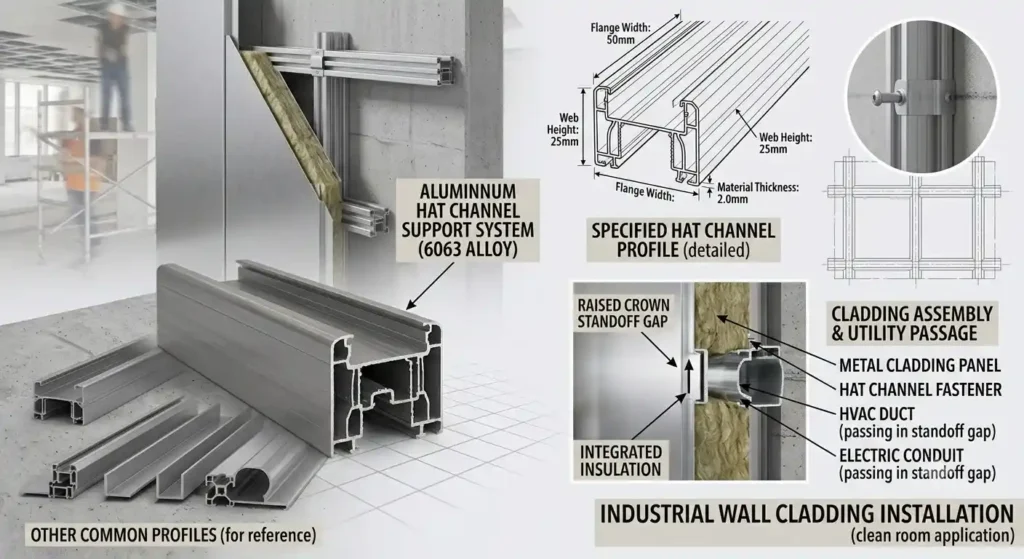
Industrial facilities and Clean Room environments use hat channels as secondary subframes behind wall panels. The standoff space accommodates insulation, utilities, and maintenance access while improving panel alignment.
Facade and Spandrel Systems
Hat channels also support Spandrel panels and facade cladding. In these systems, they transfer panel loads to the main structure while allowing controlled thermal movement.
What to Consider When Choosing a Hat Channel
Several specification details influence long-term performance.
Consider the following factors:
- Crown height: Match the standoff distance to insulation thickness, service requirements, or panel depth.
- Flange width: Wider flanges provide larger fixing surfaces, while narrower flanges suit confined installation spaces.
- Wall thickness: Thicker walls improve strength and reduce local buckling around fasteners.
- Alloy: Choose 6063-T5 for architectural and interior applications or 6061-T6 for higher structural demands.
- Surface finish: Select mill finish for concealed installations, anodizing for exterior durability, or powder coating for additional color options.
- Fastener spacing: Follow proper spacing guidelines because fixing intervals directly affect span capacity and overall system performance.
Carefully matching these specifications to the project helps ensure reliable performance throughout the service life of the installation.
Hat Channel Solutions from Exalum Metal
Exalum Metal manufactures aluminum hat channels in both standard and custom profiles for architectural, commercial, and industrial applications. We also provide complete finishing services, including mill finish, anodizing, and powder coating, while maintaining consistent dimensional tolerances across every production run.
Whether you require standard profiles or custom extrusion solutions, our team can help you determine the right specification for your project.
Get in touch with our team directly:
Email: [email protected] WhatsApp: +62 811 9429 970 Website: www.exalummetal.com