
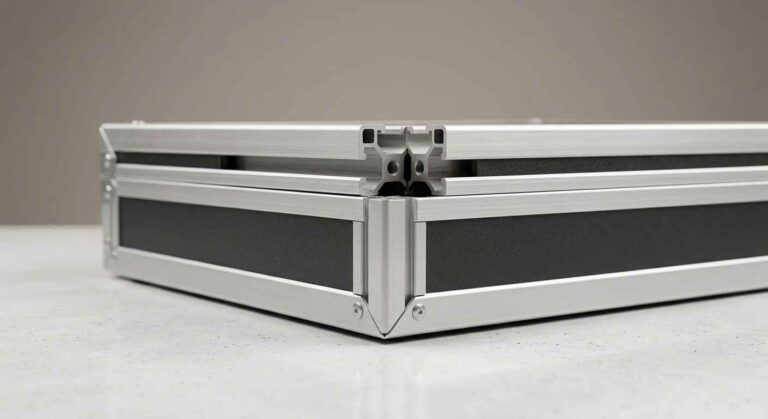
An aluminum hard case may look like a simple combination of panels, corners, and hardware. In practice, the aluminum profiles running along its edges and closure points play an important role in how the enclosure is assembled and how it performs during handling and transport.
Exalum Metal supplies precision-extruded aluminum hard case profiles for manufacturers building custom transport cases and specialized enclosures. Rather than producing finished cases, Exalum provides the framing and closure profiles that can become part of a complete case system.
What Makes an Aluminum Hard Case Different?
A typical hard case combines several components into one protective enclosure. Rigid panels form the main walls, aluminum profiles reinforce and connect the edges, hardware allows the case to open and close, and interior foam or compartments can help organize and protect the contents.
The aluminum profile is therefore one part of a larger system rather than the only source of strength. Its geometry can influence how panels are joined, how the edges are protected, and how the lid aligns with the base.
Depending on the application, a finished case may also include reinforced corners, hinges, locks, handles, wheels, foam inserts, and other hardware. The final level of protection depends on how all of these components work together.
Why Aluminum Profiles Matter in Case Construction
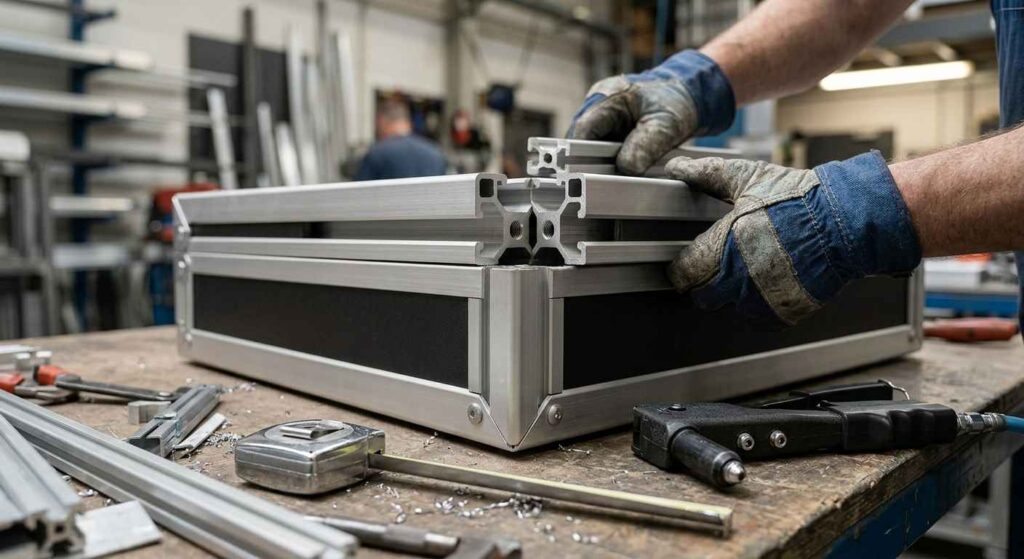
Aluminum profiles provide a practical balance between structural support and weight. This can be useful for transport cases that need reinforcement without adding unnecessary mass.
– Edge Protection and Panel Connection
Panels are particularly vulnerable along exposed edges. Aluminum framing can help cover and reinforce these areas while providing a defined connection between adjacent components.
Profile geometry also determines how the panel fits into the frame. For that reason, panel thickness and channel dimensions should be considered together during case design.
– Interlocking Closure Design
Many professional cases use male and female valance sections around the opening. These interlocking profiles help align the lid and base when the case is closed.
A properly designed connection can also reduce gaps around the opening. However, the final sealing performance depends on the complete case design, including tolerances, hardware, and any additional sealing materials.
– A Lightweight Structural Material
Aluminum is commonly used where designers want structural reinforcement without the weight associated with some heavier metals. This can make it suitable for transport cases that are moved regularly.
The appropriate profile still depends on the expected load and handling conditions. A lightweight profile is not automatically suitable for every heavy-duty enclosure.
Exalum Metal Hard Case Profile Options
Exalum Metal offers hard case and music box aluminum profiles designed for enclosure and framing applications. The two core sections below have different dimensions and weights, so selection should be based on the requirements of the complete project.
Both profiles have a 1.00 mm radius. Before selecting a section, manufacturers should confirm panel dimensions, the intended case configuration, expected handling conditions, and the equipment being transported.
| Profile Model | Wall Thickness | Weight | Radius | Potential Application |
| 78092 (List M) | 1.40 mm | 0.226 kg/m | 1.00 mm | Hard case framing and enclosure construction |
| 78093 (List L) | 1.75 mm | 0.185 kg/m | 1.00 mm | Project-specific hard case and enclosure designs |
Specifications follow the Exalum Hard Case & Music Box Aluminium Profiles catalog. The most suitable profile depends on the overall design and should not be selected based on wall thickness alone.
Surface finishing can also be considered according to the intended appearance and environment. Depending on project requirements, aluminum profiles may be supplied in mill finish, anodized, or powder-coated finishes.
Supporting Profiles for Specialized Enclosure Projects
Many case and enclosure builds pair the hard case sections with supporting profiles. The table below maps common options to their role, and each links to its product page for full specifications.
| Exalum Profile | Where It Helps |
| Equal Angle | Symmetrical corner and edge framing |
| Unequal Angle | Corners where the two legs differ |
| Flat Bars | Reinforcement strips and mounting bases |
| Rectangular Hollow | Larger enclosure framing |
| Square Hollow | Modular structural framing |
| Showcase | Presentation and display case edging |
| Furniture | Modular joinery for custom enclosures |
Choose supporting profiles by structural need, not by count; relevance to the design matters more than the number of parts.
Where Aluminum Hard Cases Are Used
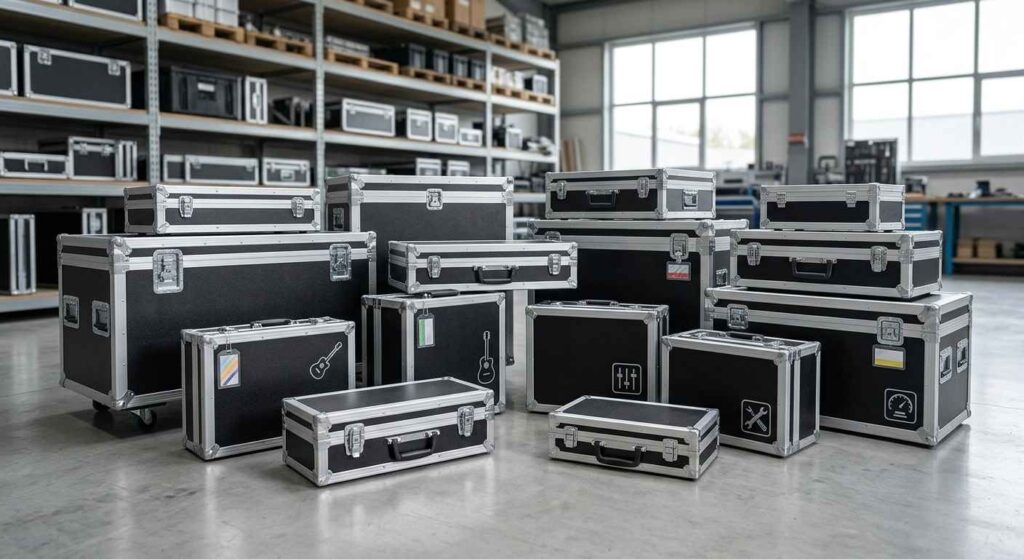
Custom hard cases are used when equipment requires repeated transport and a more structured enclosure than ordinary packaging can provide.
– Professional Audio and Stage Equipment
Flight and road cases can be used to transport speakers, lighting equipment, controllers, and other touring equipment. Reinforced framing helps protect panel edges that experience frequent handling.
– Musical Instruments and Specialized Equipment
Custom cases can be designed around the dimensions of instruments and related accessories. Internal foam or compartments can provide additional organization and separation between components.
– Industrial Tools and Instruments
Engineering tools, measuring instruments, and technical equipment may require cases that simplify storage and transport. The required level of protection depends on the equipment and its operating environment.
– Medical and Technical Equipment
Some technical equipment requires carefully designed internal layouts and transport protection. In these applications, the aluminum frame is only one part of a larger enclosure system that may also include specialized panels, foam, seals, and hardware.
– Presentation and Display Cases
Premium display cases may use aluminum profiles to create clean edges and structured panel connections. Showcase profiles may also be relevant for projects involving display-oriented aluminum framing.
What to Specify Before Ordering Aluminum Profiles
A detailed project brief makes it easier to determine whether a standard section or custom extrusion is appropriate. Before placing an order, consider the following factors:
- Case dimensions: Define the overall length, width, and height of the enclosure.
- Panel thickness: Confirm the material and dimensions of the panels that will connect with the profile.
- Equipment weight: Consider the load carried by the complete case and its contents.
- Handling conditions: Identify how frequently the case will be transported and the level of expected impact.
- Closure design: Specify whether the project requires an interlocking valance or another closure arrangement.
- Surface finish: Determine whether mill finish, anodizing, or powder coating suits the project.
- Order volume: Provide estimated quantities to support production and supply planning.
These details will establish whether an existing profile can meet the requirement or whether the project would benefit from a custom extrusion.
Build the Frame Around Your Project Requirements
A custom hard case begins with more than a choice of aluminum profile. Panel dimensions, equipment weight, closure geometry, hardware, and transport conditions should all be considered before finalizing the extrusion.
Exalum Metal can support project-specific aluminum profile requirements through custom extrusion dies and finishing options, including mill finish, anodizing, and powder coating. For volume projects, providing drawings, dimensions, panel specifications, and estimated quantities can help determine the most suitable approach.
Get in touch with our team directly through our contact inquiry or click the “Contact Us” button below.