
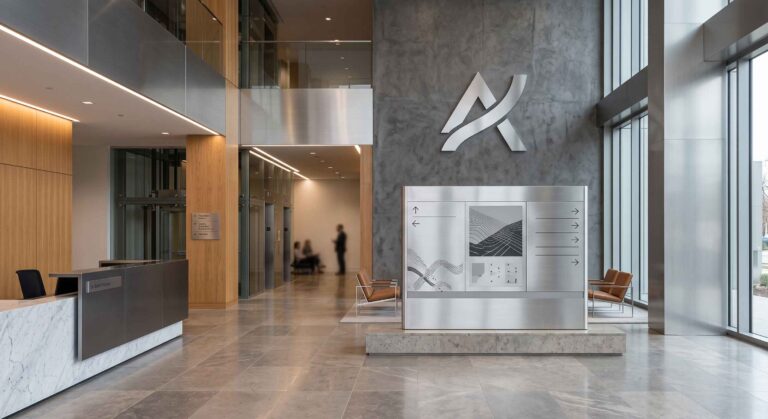
Have you ever read a sign in a hospital corridor, a corporate lobby, or a shopping mall without once thinking about the material behind it? More often than not, that material is aluminum.
Across modern commercial architecture, aluminum has overtaken acrylic, vinyl, and wood as the signage material of choice. It pairs a refined, contemporary look with the structural integrity that high-traffic buildings demand. Moreover, it survives daily cleaning, humidity, and constant handling far better than plastic.
This article explains why aluminum works so well for signs, how the main formats and finishes compare, where these signs perform best, and which extruded profiles actually hold a finished sign together.
What Exalum Metal supplies: the aluminum only. We extrude, source, cut, and finish custom sign panels, letters, frames, and profiles to your exact size, shape, and finish. Your own team or sign studio then designs and applies the printing, lettering, and branding. In short, we deliver the sign, and you add the message.
What Makes Aluminum the Right Material for Signs?
Aluminum sits at a useful intersection in material science, because it delivers the strength of metal without the weight or the corrosion problems that hold other metals back. First, it forms a natural oxide layer that resists corrosion, so a panel shrugs off repeated wipe-downs with sanitizers and cleaning agents. As a result, it suits hygienic settings such as hospitals and laboratories. Second, its high strength-to-weight ratio lightens both freestanding structures and wall-mounted panels, which makes installation safer and eases the load on the wall. Finally, aluminum stays flat. Unlike plastics, which warp under temperature shifts or distort across large faces, it holds crisp lines and rigidity over long spans.
Solid Aluminum vs. Aluminum Composite Panels
Before the artwork goes on, a project has to choose a format, because sign scale, handling frequency, and budget all point toward different options. The table below compares the two most common choices.
| Feature | Solid Aluminum | Composite Panel (ACM) |
| Composition | One solid aluminum alloy sheet | Polyethylene core between two thin aluminum skins |
| Strength and rigidity | High impact strength; resists dents and rough handling | Flat and rigid across large spans at low weight |
| Best indoor use | Tactile signs, cut-out letters, high-touch wayfinding | Large wall murals, reception backdrops, ceiling directories |
| Processing | Deep engraving, precision milling, edge polishing | Folding, v-grooving, lightweight large-format mounting |
Whichever face you choose, the frame and trim around it usually come from extruded profiles, which is where a specialist extruder like Exalum Metal fits in.
Finishes That Turn Metal into a Brand Surface
The finish decides how raw metal reads as a branded element, so it deserves as much attention as the shape. A brushed finish adds a soft satin grain that catches light without glare and hides fingerprints, which suits door signs and elevator plates. Powder coating, by contrast, cures a tough polymer layer in almost any RAL or Pantone color and outlasts liquid paint. Anodizing goes further still, since it thickens the oxide layer and locks color into the surface, leaving a finish that barely scratches and never fades. In addition, high-traffic signs often add a matte or anti-graffiti laminate over the printed artwork, a step the sign maker applies after the metal leaves our facility. Exalum finishes its own profiles and panels in mill, anodized, and powder-coated options to match any of these directions.
The Extruded Profiles Behind a Finished Sign
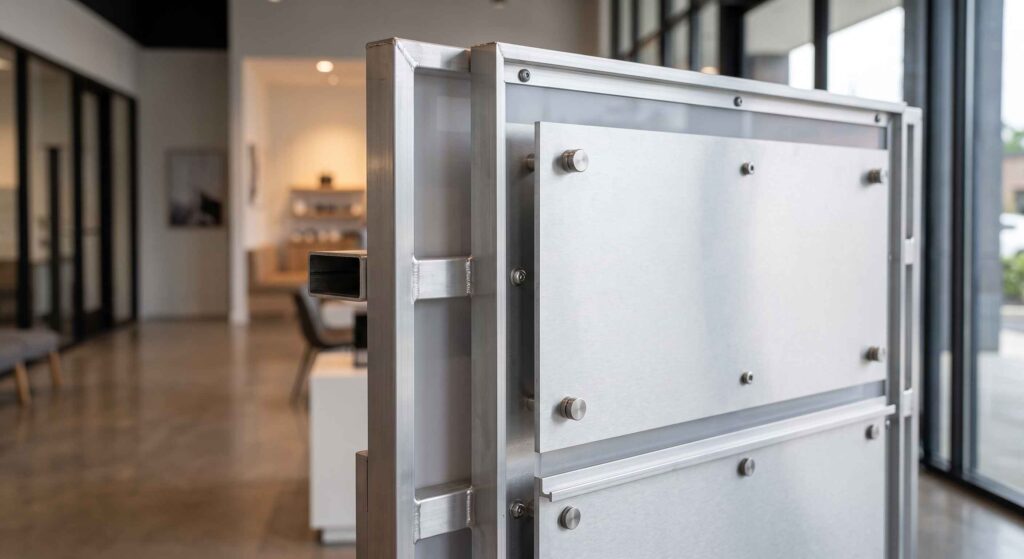
Look past the face of a sign and you find an extruded skeleton, and this is exactly where Exalum Metal’s catalog applies. For frames and freestanding bodies, Square Hollow and Rectangular Hollow sections give rigid, lightweight structure. To reinforce corners and join panels, Equal Angle and Unequal Angle profiles brace the assembly. For clean edges, an Equal Channel (U-channel) or Unequal Channel wraps a panel edge without visible fasteners. Meanwhile, Flat Bars serve as sign faces, backplates, letter stock, and mounting strips, while Round Bars and Pipes form standoffs, spacers, and posts. Finally, illuminated signs rely on Heatsink profiles to draw LED heat away and protect the electronics. In every case, Exalum supplies the bare, finished aluminum component, and your fabricator adds the graphics afterward.
| Sign Element | Exalum Profile |
| Frame or freestanding body | Square Hollow, Rectangular Hollow |
| Corner joints and reinforcement | Equal Angle, Unequal Angle |
| Panel edging and trim | Equal Channel (U-channel), Unequal Channel |
| Sign face, backplate, letters | Flat Bars |
| Standoffs, spacers, posts | Round Bars, Pipes |
| Illuminated lightbox housing | Heatsink |
Each element links to its Exalum product page above, and most signs combine several of these profiles in one assembly.
Where Aluminum Signs Perform Best
Because aluminum adapts so easily, the same custom sign metal serves almost every commercial sector. The examples below show where these signs earn their place, and which Exalum profiles sit behind them.
Corporate Reception and Brand Walls
A reception area shapes a visitor’s first impression, so the materials on show carry real weight. Cut-out aluminum logos, dimensional letters, and feature-wall panels signal stability and modern craftsmanship. Exalum supplies the aluminum blanks and Flat Bars for letters and backing plates, plus Square Hollow sections for freestanding logo frames. The brand design, colors, and finished lettering then come from the client’s own studio.
Wayfinding, Directories, and Room Identification
Large, multi-story buildings depend on clear, consistent wayfinding. Aluminum suits it because modular directory boards, suspended directionals, and room-number plaques stay light, rigid, and easy to update. Freestanding and hanging units use Rectangular Hollow frames with Pipes or Round Bars for posts and hangers, while channel trims hold swappable plates. Because the metal takes a durable finish, the client’s printed or engraved information stays legible for years.
Healthcare and Education Facilities
Hospitals, clinics, and campuses hold signage to strict hygiene and safety standards. Aluminum meets them because it withstands constant sanitizing with medical-grade cleaners without fading or corroding. Anodized and powder-coated panels shrug off chemical wipe-downs, and Equal Angle reinforcement keeps large boards flat over long service periods. Facilities receive the finished metal, then add their own room codes, symbols, and department graphics.
Retail and Storefront Displays
Retail rewards signage that looks sharp and updates quickly. Aluminum frames and edges give displays a clean, premium finish without visible fasteners. Here Showcase frames hold glass and back panels, Shop Front profiles tie signage into the storefront, and price-tag holders carry swappable pricing. Store teams then slot in their own printed cards and branding as promotions change.
Architectural Lightboxes and Backplates
Illuminated signage adds depth and stays visible after dark. Aluminum backplates and lightbox frames house LEDs while drawing their heat away, which protects the electronics and extends service life. Heatsink profiles handle the thermal load, and hollow sections form the box body. The sign builder then supplies and fits the acrylic faces, diffusers, and printed graphics.
What to Specify When Ordering Aluminum Signage
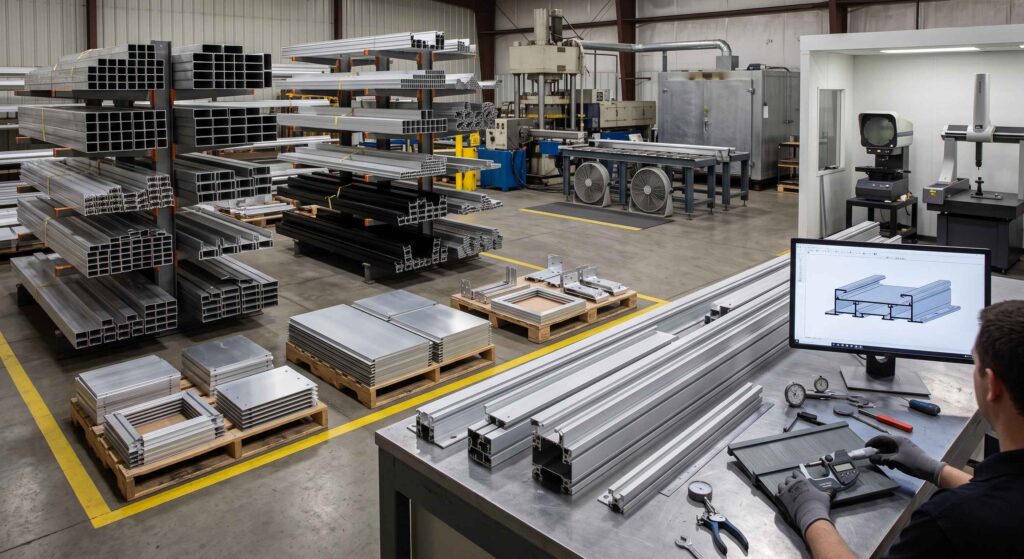
A clear specification keeps a signage order on budget and on time, so confirm these points up front. Note that each one describes the metal itself, since you prepare the artwork separately.
- Format and thickness: solid aluminum for tactile, high-touch signs, or composite panel for large flat faces.
- Profile type: hollow sections for frames, channels for edging, round bars for standoffs, and heatsink for lightboxes.
- Alloy grade: Exalum extrudes 6063 for surface quality on visible parts, 6061 for higher-strength structural work, and 6005 for stronger spans.
- Finish: mill for concealed parts, anodized for durable protection, and powder coating for the widest color range.
- Environment: indoor, or coastal and outdoor work that needs a thicker anodize or a sealed finish.
- Mounting and volume: standoffs, adhesive, or cleats, plus the order quantity and the delivery timeline.
Aluminum Signage Solutions from Exalum Metal
At Exalum Metal, we extrude, source, finish, and fabricate aluminum for construction, industrial, and commercial projects, including the sign material that professional signage depends on. We manufacture the metal itself, the custom panels, letters, frames, and profiles cut and finished to your drawing, so your design team can apply the branding and graphics separately. Our capabilities cover standard sections, custom extrusion, and finishing in mill, anodize, and powder coat, and we support volume orders with consistent dimensional quality and reliable production timelines.
Whether your project needs standard channels and hollow sections or a custom profile developed from a technical drawing, our team can help you specify the right aluminum. Get in touch with our team directly by clicking the “Contact Us” button below.