
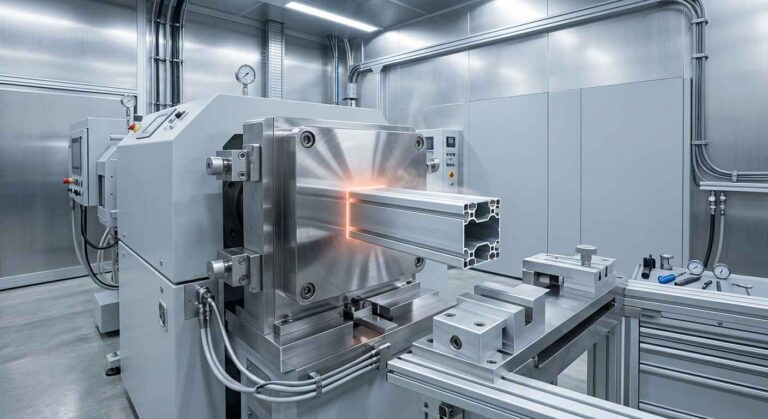
On an extrusion shop floor, a glowing aluminum billet slides into a press and leaves as a finished window track. It travels down the runout table in one continuous length. That speed hides how much gets decided. Dimensional accuracy, surface quality, and strength are all set on that line.
That matters when you place a large order. Aluminum extrusion pushes a softened aluminum billet through a shaped die, so the metal leaves carrying that exact cross-section, much like toothpaste through a nozzle. This guide walks the process from billet to finished profile, and shows how each stage shapes what you can order.
How a Solid Billet Becomes a Finished Profile
Every extruded profile starts as a billet. That billet is a solid cylindrical log of aluminum alloy, cast in a circular mold. Before pressing, it is heated to 400 to 500 degrees Celsius. It turns soft and plastic, yet stays below melting. A hydraulic ram then drives it against a preheated die, and the softened metal flows through the opening as a continuous shape.
The forces are large. Presses push at 100,000 to 125,000 psi, and the biggest reach 15,000 tons. As a result, the profile can emerge up to 50 to 70 meters long. A puller keeps it straight while fans or a water bath quench it. Each length is then stretched to remove twist, then sawn to shipping sizes, commonly 8 to 21 feet. Simple shapes like flat bars move through quickly, which holds their cost down.
The table lists the main stages and their settings.
| Stage | What Happens | Typical Setting |
| Billet preheat | Softens the log for flow | 400 to 500 C |
| Die preheat | Protects tooling, evens flow | 450 to 500 C |
| Ram pressure | Forces metal through the die | 100,000 to 125,000 psi |
| Quench | Locks in the structure | Water bath or air fans |
| Finish saw | Cuts to shipping length | 8 to 21 ft |
The Die Decides the Shape, Not the Press
Two profiles can run on the same press yet need different tooling. The die does the shaping, and dies fall into three classes.
Solid dies form shapes with no enclosed void. These include equal angle profiles, flat bars, and square bars. Their tooling is simplest, so they cost the least. Hollow dies form fully enclosed voids, like round and square tubing, and pipes rely on them. They use a mandrel with portholes, which raises cost and lead time.
Semi-hollow dies sit between the two. They form partial voids with narrow gaps, such as a deep unequal channel. That gap leaves a fragile tongue in the die, so it demands careful tooling. The table maps each die type to its best fit.
| Die Type | Best For | Less Suitable For |
| Solid die | Flat bars, angles, solid bars | Enclosed hollow shapes |
| Semi-hollow die | Channels, slotted rails | High-volume simple tubing |
| Hollow die | Round and square tubing | Lowest-cost simple bars |
Why Temper and Alloy Turn One Shape Into Different Products
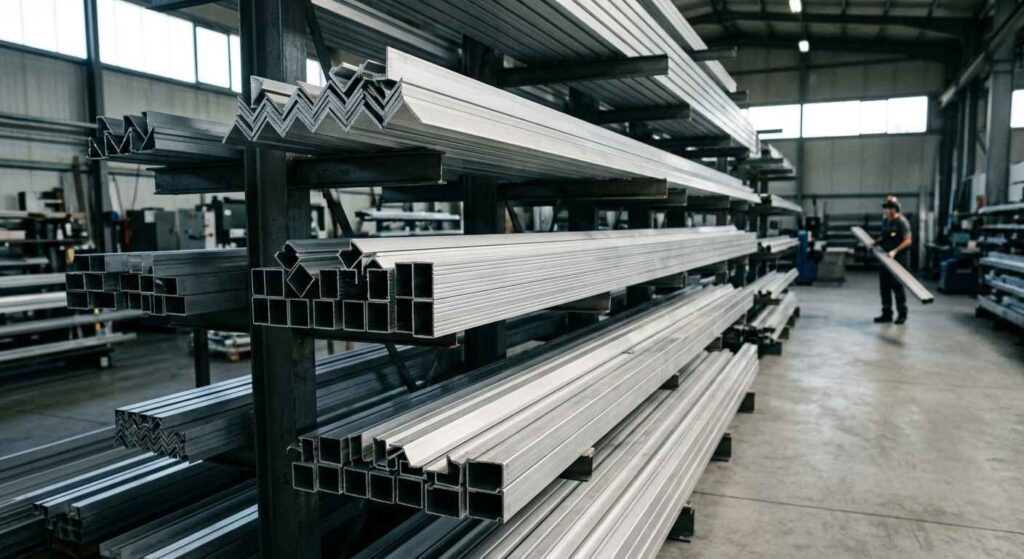
The cross-section is only half the story. Alloy and heat treatment decide how the profile performs. Alloy sets the base character. Temper, the aging after extrusion, sets final strength.
6063 flows easily and takes a smooth surface. That suits thin walls and visible work like curtain wall framing. 6061 trades some finish for higher strength and better machining, so it appears in structural framing and heatsink profiles.
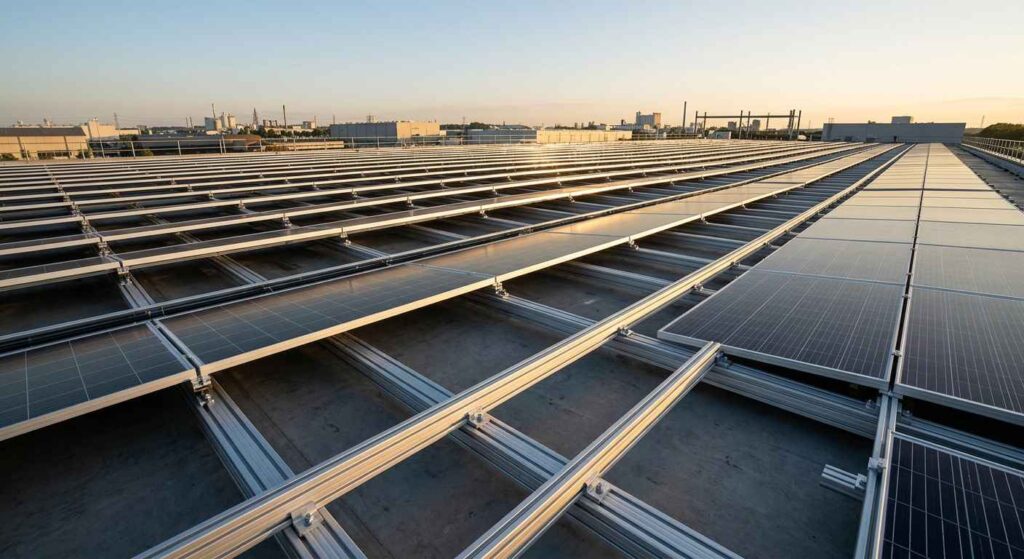
6005 balances the two. For that reason, it often frames solar rail and solar panel systems that face wind load outdoors.
Temper explains a striking gap. In the softer T4 state, 6061 reaches about 241 MPa in tensile strength. After aging to T6, the same profile reaches roughly 310 MPa. The table pairs each alloy with its typical use.
| Alloy | Strength and Finish | Common Use |
| 6063 | Smooth finish, thin walls | Architectural profiles, tubing |
| 6061 | Higher strength, machinable | Structural framing, heat sinks |
| 6005 | Balanced strength and finish | Solar rails, structural joinery |
Where Extrusion Is Not the Right Way to Make a Part
Extrusion excels at constant cross-sections. Even so, it is not the answer for every part. For very large flat plate or wide sheet, rolling is the right process, because a wide thin section distorts in a die.
Heavy structural frames tell a similar story. Some must carry loads beyond heat-treated 6061. Then a welded steel square hollow section or a forged part is often sounder, because forging aligns the grain. For simple bulk stock with no detail, casting can cost less per ton than a die. Naming these limits keeps the spec honest.
What to Confirm Before the Die Is Cut
A few decisions set cost and lead time before tooling is cut. Confirm them early, and quotes come back faster.
- Profile category: solid, semi-hollow, or a hollow rectangular hollow section, since this drives die cost most.
- Alloy and temper: 6063 for finish, 6061 for strength, 6005 for balance, paired with the temper that meets the load.
- Wall thickness: thicker walls resist bending but add weight and cost. Match them to the real load.
- Surface finish: mill, anodized, or powder coated, chosen up front because finish can shift final tolerances.
- Volume and cut length: run size and length set the price per meter and tooling payback.
From Drawing to Delivered Profile
Exalum Metal runs the full extrusion process across the 6061, 6063, and 6005 alloy series. That single-source path keeps tolerances consistent from billet to delivery.
Custom extrusion covers project-specific cross-sections when a standard profile does not fit. Mill finish, anodizing, and powder coating are handled in-house. Volume order support suits buyers running one profile across a full program.
If you are scoping a large order, bring your drawings, specifications, or estimated volume. The team can then confirm the right die class, alloy, and finish before production.
Get in touch with our team directly through our contact inquiry or click the “Contact Us” button below.