
Walk onto a poolside deck that has faced ten summers of sun and salt, and the surface underfoot tells you which material was chosen. Timber boards have cupped and greyed. Composite has faded and softened at the edges. Aluminum decking, by contrast, looks much as it did on the first day.
That gap in aging is why architects and developers keep specifying aluminum for outdoor decks. Aluminum decking is an extruded metal board system, usually interlocking planks laid over aluminum joists, built to shrug off rot, fire, and moisture. This guide covers how it behaves, how it compares with wood and composite, and what to specify before ordering.
The Science That Keeps Aluminum Decking Cool and Rust-Free
Two properties explain most of aluminum decking’s reputation: how it handles heat and water. Both come from the metal itself, not a coating.
Aluminum has high thermal conductivity, which means it moves heat quickly instead of storing it. A common worry is that a metal deck bakes bare feet, yet the opposite holds. The surface sheds heat fast, so in full sun it stays comparable to or cooler than dark composite. That same conductivity is why aluminum is the metal of choice for a heatsink.
Water is the other half of the story. Aluminum contains zero iron, so rust is structurally impossible. The metal does not rot, warp, split, or absorb moisture, which also rules out freeze-thaw cracking. It is also non-combustible, with a flame spread index of 0, which matters in wildfire zones and strict codes.
Aluminum, Wood, and Composite Decking Compared
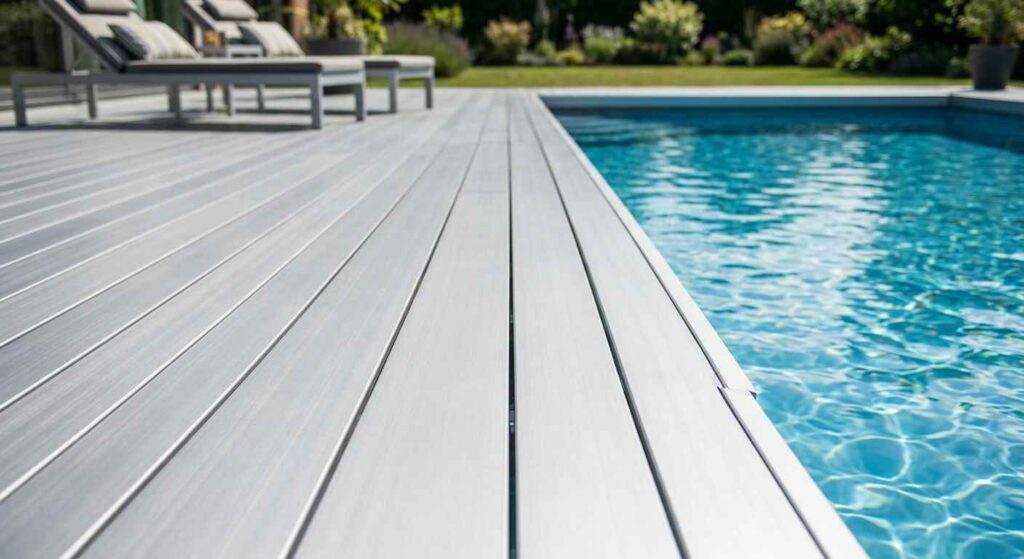
Set against wood and composite, aluminum decking trades a higher upfront price for a longer, quieter service life. The same holds for the rectangular hollow joists beneath, which replace wood framing that would eventually rot. The table below weighs all three on the factors that drive a decking decision.
| Feature | Aluminum | Wood (Pressure-Treated) | Composite |
|---|---|---|---|
| Lifespan | 30 to 50+ years | 10 to 15 years | 15 to 25 years |
| Maintenance | Soap and water rinse | Annual sealing and staining | Mold and fade treatment |
| Rot and insects | Immune | High risk | Moderate risk |
| Fire | Non-combustible | Flammable | Combustible |
| Heat | Sheds heat quickly | Holds moderate heat | Retains high heat |
| Weight | Light, high strength | Heavy | Very heavy |
| Cost | High upfront, low lifetime | Low upfront, high lifetime | Medium both |
The pattern stays consistent. Wood wins on upfront cost, composite sits in the middle, and aluminum leads on lifespan, fire safety, and maintenance.
Alloys, Tempers, and Finishes for Deck Profiles
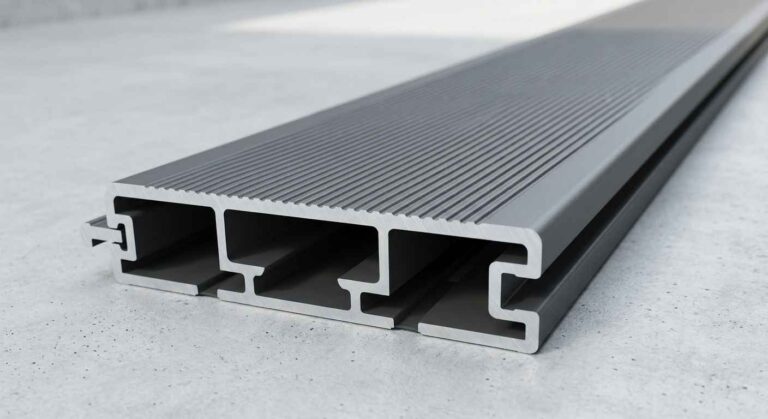
How a deck profile is extruded decides how much load it carries and how well it survives the weather. Softened aluminum is pushed through a shaped die, and hollow boards use a porthole die that forms enclosed channels in a single pass.
Alloy and temper then set the strength. Temper is the controlled heat treatment that hardens the metal after extrusion. For decking, square hollow posts and joists usually run in 6005-T6 or 6063-T66, both strong structural tempers. The visible boards and trims often use standard 6063 for its cleaner surface. Powder coating adds durable textured color, while anodizing thickens the oxide layer for salt-spray and UV resistance. The table pairs each alloy with where it fits.
| Alloy and Temper | Where It Fits | Strength or Finish |
|---|---|---|
| 6005-T6 | Joists and structural beams | High load |
| 6063-T66 | Substructure framing | Strong, clean surface |
| 6063 | Deck boards and edge trims | Smooth finish |
The Two Layers of an Aluminum Deck System
An aluminum deck is really two systems stacked together, and both can come from the same extruder. Sourcing them together keeps tolerances and finish consistent.
- Deck boards: interlocking or tongue-and-groove planks, often with integral drainage channels and ribbed, slip-resistant tops.
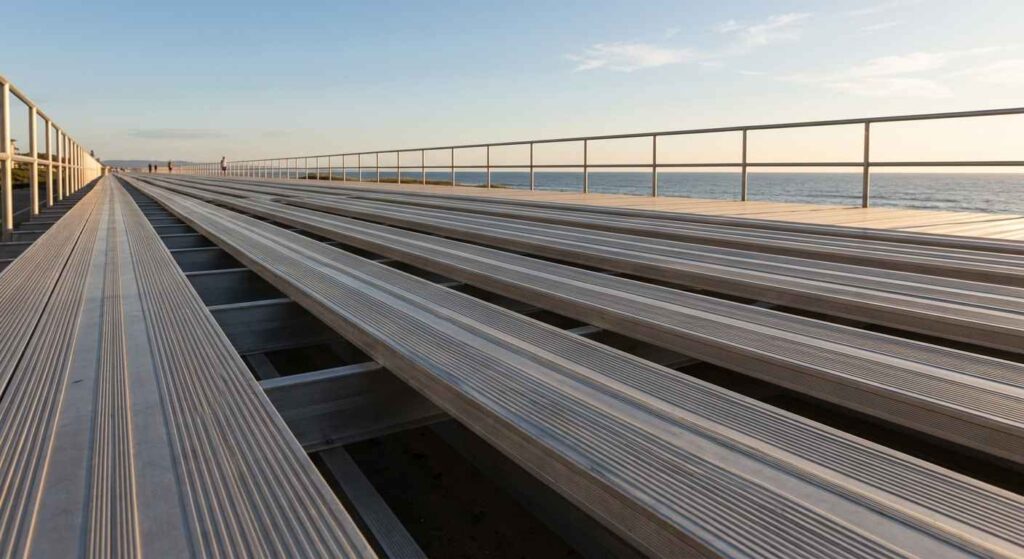
- Substructure joists: load-bearing framing members under the boards that replace rot-prone timber.
- Edge and fascia trim: an equal angle or fascia profile that finishes the perimeter and protects exposed board ends.
Hidden fastener tracks, usually a U-shaped equal channel, let clips grip the boards so no screws show on top.
Where Aluminum Decking Is Not the Obvious Choice
Aluminum decking is not the right call for every project. On a tight upfront budget, pressure-treated wood costs far less to install, even though it costs more to own over its life. For a low ground-level deck that will be replaced within a decade anyway, that math can favor timber.
Aesthetics matter too. Buyers who want the warmth and grain of real wood may prefer timber or wood-look composite, since aluminum reads cleaner and more industrial. Naming these cases keeps the comparison honest.
What to Specify Before Ordering Aluminum Decking
A few decisions shape cost, safety, and how easily the deck installs. Settle them before requesting a quote.
- Profile design: whether boards interlock or butt together, and whether joists are hollow box sections or channels.
- Surface texture: the rib or grip pattern that keeps the deck slip-resistant when wet around pools or docks.
- Load and span: the distance joists can bridge under foot and furniture load without flexing.
- Drainage: whether boards need integral channels to keep the space below dry.
- Finish and color: mill, anodized, or powder-coated, chosen for a coastal or inland environment.
- Matching accessories: whether you also need flat bars for starter strips, clips, and trim backing.
Turning a Deck Design Into Delivered Profiles
Exalum Metal extrudes the full aluminum deck system, from the visible boards to the joists, trims, and clips that complete it. Producing every layer in one facility keeps the finish and fit consistent across a large order.
Custom extrusion covers project-specific board widths, drainage channels, and joist spans, with mill finish, anodizing, and powder coating in-house. Volume order support suits developers rolling out the same deck across multiple sites.
If you are planning a commercial or coastal deck, bring your drawings, spans, or estimated volume, and the team can confirm the right profiles, alloys, and finish.
Get in touch with our team directly through our contact inquiry or click the “Contact Us” button below.