
A fabricator watches an aluminum component heat up during welding. The metal is nowhere near a furnace, yet the area around the weld can still lose some of its original strength. That is why the melting point of aluminum tells only part of the story.
Pure aluminum melts at about 660°C, or 1220°F. However, most architectural and industrial aluminum products are alloys rather than pure aluminum, so they do not always melt at one exact temperature.
For engineers and fabricators, understanding aluminum’s melting behavior helps with welding, extrusion, heat treatment, surface finishing, and material selection. This article explains the melting point of aluminum, how common 6000-series alloys behave under heat, and why temperature matters long before aluminum begins to melt.
What Is the Melting Point of Aluminum?
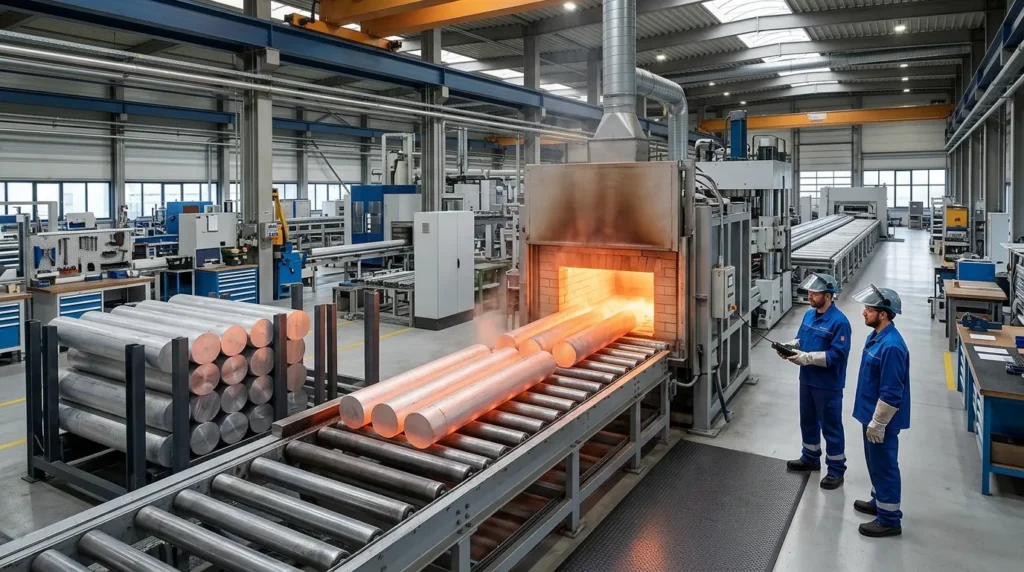
The melting point is the temperature at which a solid material changes into a liquid. For commercially pure aluminum, that temperature is approximately 660°C or 1220°F.
Aluminum alloys behave differently. Because they contain other elements, such as magnesium and silicon, they usually have a melting range rather than one precise melting point.
The lower end of the range is called the temperature where melting begins, while the upper end represents the point where the material becomes fully liquid.
Why Aluminum Alloys Have Different Melting Ranges
Alloying elements change the internal structure of aluminum. As a result, 6061, 6063, and 6005 do not behave exactly like pure aluminum when exposed to extreme heat.
This matters during manufacturing. Extrusion, welding, casting, and heat treatment all require careful temperature control to avoid unwanted melting or changes in mechanical properties.
Melting Temperatures of Common Aluminum Alloys
For most extrusion buyers, the most relevant alloys are not pure aluminum but engineered alloys selected for specific applications.
| Alloy | Approximate Melting Range | Approximate Range in Fahrenheit | Typical Exalum Application |
|---|---|---|---|
| 6063 | 615–655°C | 1139–1211°F | Windows, doors, architectural profiles |
| 6061 | 582–652°C | 1080–1205°F | Structural and industrial profiles |
| 6005 | 605–655°C | 1121–1211°F | Solar rails and structural systems |
| Pure aluminum | ~660°C | ~1220°F | Reference material |
These figures are approximate because exact composition can vary by specification. The alloy temper, however, affects mechanical strength more directly than the melting range.
Exalum Metal focuses its extrusion production on 6061, 6063, and 6005 aluminum alloys for industrial and architectural applications.
Aluminum Strength Changes Before It Melts
Melting temperature should not be confused with safe operating temperature. An aluminum profile can remain solid while losing a meaningful amount of its strength.
This is particularly important for load-bearing components, machinery, and structural frames.
Strength Loss at Elevated Temperatures
Heat can affect the microscopic structure responsible for an alloy’s strength. In heat-treated alloys, prolonged exposure to elevated temperatures can reduce the benefits of the original temper.
As a general engineering principle, the following temperatures deserve attention:
- Around 100°C or 212°F: Mechanical properties may begin to change, depending on the alloy and exposure time.
- Around 150°C or 302°F: Elevated-temperature performance becomes more relevant for continuously loaded components.
- Around 200°C or 392°F: Strength reduction can become significant, especially for heat-treated aluminum.
- Above these temperatures: Long-term structural performance requires more careful engineering analysis.
The exact reduction depends on alloy, temper, exposure duration, and loading conditions. Engineers should therefore use certified material data rather than relying on melting temperature alone.
Yield Strength Matters More Than Melting Point in Structural Design
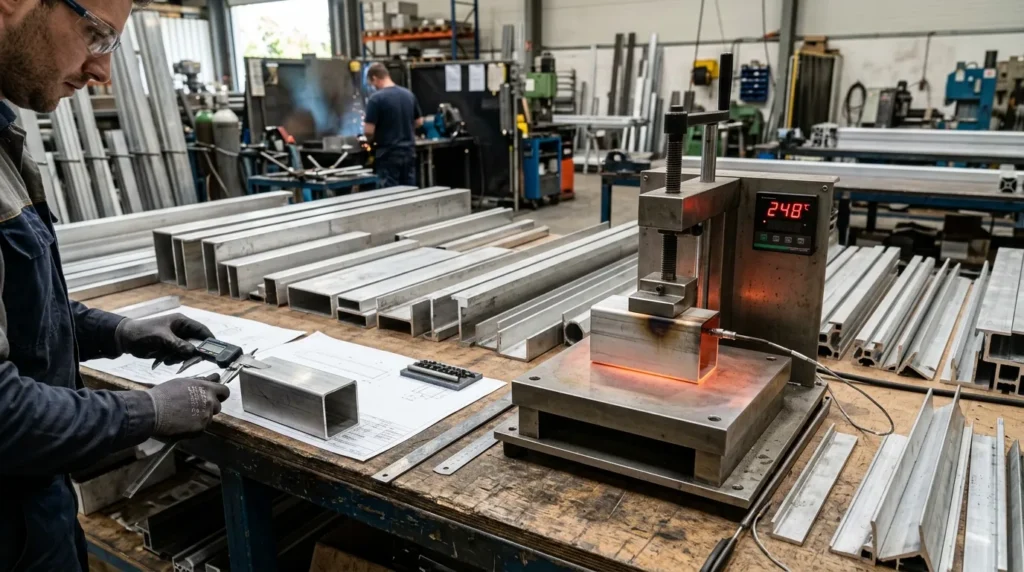
For a structural profile, permanent deformation often becomes the main concern before material failure.
Yield strength describes the stress level at which a material begins to deform permanently. Ultimate tensile strength describes the maximum stress reached before fracture.
For example, a long Rectangular Hollow section supporting a load may become unsuitable because of deflection or permanent bending long before heat approaches the alloy’s melting range.
How 6061, 6063, and 6005 Compare
The following table provides a practical comparison of Exalum Metal’s core alloy families. Actual mechanical properties depend on temper and product specification.
| Alloy | Typical Strength Level | Main Advantage | Best Suited For | Relevant Exalum Products |
|---|---|---|---|---|
| 6063 | Moderate | Excellent extrudability and finish | Architecture | Casement Windows, Doors, Louvers |
| 6061 | High | Strong structural performance | Industrial fabrication | Flat Bars, Pipes, structural profiles |
| 6005 | Medium to high | Strength and extrusion balance | Structural systems | Solar Rail, Conveyor |
6063 for Architectural Profiles
6063 is widely used for aluminum extrusion because it produces complex shapes with a smooth surface. It is well suited to visible architectural products where finishing quality matters.
This makes it a practical choice for applications such as Casement Windows, architectural frames, and Louvers.
6061 for Higher Structural Demands
6061 generally offers higher mechanical strength than 6063 in common heat-treated conditions. It also provides good corrosion resistance, machinability, and weldability.
For demanding industrial applications, the alloy may be considered for custom structural profiles, Flat Bars, and other fabricated components.
6005 for Structural Extrusion Applications
6005 provides a useful balance between strength and extrusion performance. It is commonly considered where a profile needs greater structural capability while still benefiting from extrusion.
Applications can include Solar Rail & Solar Panel systems and Conveyor components.
Why Aluminum Oxide Behaves Differently Under Heat
One reason aluminum can be challenging to weld is its natural oxide layer.
When exposed to air, aluminum quickly forms a thin layer of aluminum oxide, known chemically as Al₂O₃. This oxide protects the underlying metal against corrosion.
However, aluminum oxide has a much higher melting temperature than aluminum itself, approximately 2072°C or 3762°F.
During welding, this creates a practical challenge. The oxide layer can remain solid while the aluminum underneath approaches its melting range, which is why proper surface preparation and suitable welding procedures matter.
The oxide layer is also the basis of anodizing. Exalum Metal offers anodizing as part of its integrated manufacturing process, creating a controlled oxide layer that improves corrosion resistance and surface durability.
How Melting Temperature Affects Aluminum Extrusion
Aluminum extrusion does not involve fully melting the billet.
Instead, manufacturers heat aluminum to a temperature where it becomes soft and workable, then force it through a shaped die. The metal remains solid throughout the extrusion process.
This temperature control is critical. Excessive heat can affect surface quality and dimensional accuracy, while insufficient heat makes the material more difficult to extrude.
Exalum Metal manages multiple stages of production, including billet preparation, die manufacturing, extrusion, and finishing. This integrated process supports custom aluminum profiles with project-specific dimensions.
Melting Point vs. Welding Temperature
A common misconception is that aluminum must reach its exact melting point before welding becomes possible.
In reality, welding creates a localized molten pool. The temperature near the weld can vary significantly, while surrounding material experiences lower but still substantial heat.
This creates a heat-affected zone, often called the HAZ. The HAZ is the area next to a weld that does not melt but experiences enough heat to change its mechanical properties.
For heat-treated aluminum, this can reduce local strength. Therefore, the strongest alloy is not automatically the best welding choice.
If welding and fabrication are major requirements, alloy selection should consider:
- Alloy composition: Different alloys respond differently to welding heat.
- Temper: Heat-treated material may lose some local strength after welding.
- Service temperature: Continuous heat exposure can affect long-term performance.
- Profile geometry: Thick and thin sections distribute heat differently.
- Joint design: Poor joint design can concentrate stress around the HAZ.
When Aluminum Is Not the Best Choice
Aluminum is not the best material for every high-temperature application.
If a component must operate continuously at temperatures that significantly reduce aluminum’s mechanical properties, steel or another high-temperature material may be more appropriate.
Likewise, applications exposed to extremely high heat, such as furnace interiors, should not rely on standard architectural aluminum profiles simply because aluminum itself has a relatively high melting point.
Material selection should consider the complete operating environment, including temperature, load, corrosion, weight, and manufacturing requirements.
Choosing Aluminum Profiles for Heat and Structural Performance
The right profile involves more than choosing the alloy with the highest melting point.
| Project Requirement | Practical Consideration | Possible Exalum Profile Direction |
|---|---|---|
| Architectural appearance | Surface quality and finishing | 6063 architectural profiles |
| Higher structural loads | Strength and cross-section | 6061 structural profiles |
| Outdoor structural systems | Strength and corrosion resistance | 6005 profiles |
| Long spans | Stiffness and geometry | Square Hollow or rectangular sections |
| Heat dissipation | Surface area and thermal conductivity | Heatsink profiles |
Profile geometry can be just as important as alloy selection. A well-designed hollow profile may provide better stiffness than a heavier solid section while using less material.
For that reason, engineers should evaluate alloy, temper, wall thickness, cross-sectional geometry, operating temperature, and expected loads together.
Sourcing Aluminum Profiles With Confidence
The melting point of aluminum is a starting point for understanding the material, not the destination. What actually matters in fabrication is the alloy you choose, the temper it’s delivered in, and the manufacturer who controls the temperatures from billet to finished profile.
Exalum Metal has supplied aluminum extrusion to fabricators since 2009 from our vertically integrated facility in Indonesia. The advantage of vertical integration is straightforward: we control the temperatures, the alloy chemistry, and the finishing process under one roof, which means the material that leaves our facility behaves exactly the way the spec sheet says it should.
Whether you need standard profiles or custom cross-sections designed for your specific fabrication requirements, Exalum Metal has the capacity and expertise to deliver.
Ready to place an order or discuss your requirements? Get in touch with the Exalum Metal team directly by clicking the “Contact Us” button below.