
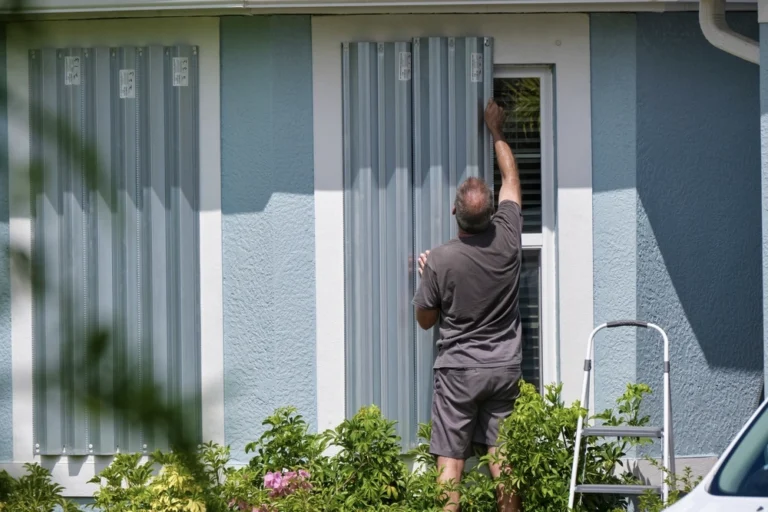
When a hurricane is bearing down and the wind is throwing debris at sixty miles an hour, the line between a damaged home and a destroyed one often comes down to the windows. A single breached window lets wind pressure inside, and that pressure can lift a roof and tear a house apart from the inside out. Hurricane shutters exist to keep that from happening, and aluminum has become the material that does the job best. It’s strong enough to stop flying debris, light enough to deploy quickly, and tough enough to survive year after year in the salt-laden coastal air where hurricanes strike.
For homeowners in storm regions, builders, and shutter fabricators, here’s how aluminum hurricane shutters protect a building, the main types available, and what goes into shutters that perform when it matters most.
What Hurricane Shutters Are Protecting Against
Understanding what shutters defend against explains why the material and build quality matter so much.
The first threat is wind-borne debris. Hurricane winds turn loose objects, roof tiles, branches, and gravel into projectiles, and an unprotected window shatters on impact. Once a window breaks, the building envelope is compromised.
The second threat is pressure. When wind enters through a broken window, it pressurizes the inside of the building. That internal pressure pushes up on the roof and out on the walls at the same time the external wind is pulling, and the combined forces can cause catastrophic structural failure. Keeping windows intact keeps that pressure out.
The third is the obvious one: rain and water intrusion through broken openings, which damages everything inside.
Hurricane shutters address all three by keeping the window opening sealed and protected through the storm. The shutter has to withstand both the impact of debris and the sustained pressure of hurricane-force wind, which is a genuinely demanding structural job.
Why Aluminum Is the Material That Does It
Hurricane shutters have been made from steel, plastic, and aluminum, and aluminum has become the dominant choice across most shutter types for reasons that fit the application perfectly.
It stops debris. Aluminum shutters, properly engineered, absorb and deflect the impact of wind-borne debris that would shatter glass, meeting the strict impact standards that hurricane-prone regions require.
It resists the coastal environment. Hurricanes happen where salt air, humidity, and rain are constant, and that environment destroys steel through rust. Aluminum’s natural corrosion resistance means shutters survive years of coastal exposure and still deploy smoothly when a storm comes.
It’s light enough to deploy. Shutters often have to be put up quickly as a storm approaches, sometimes by a single homeowner. Aluminum’s light weight makes manual deployment practical in a way heavy steel would not.
It lasts for decades. A shutter system is a long-term investment that may only be fully tested a handful of times. Aluminum’s durability means it’s ready every time, year after year, without rusting or seizing.
It can be finished to match a home. Anodized and powder-coated aluminum shutters come in colors and finishes that look intentional rather than industrial, which matters for shutters that are visible on a home year-round.
The Main Types of Aluminum Hurricane Shutters
Aluminum goes into several different shutter designs, each suited to different needs and budgets.
Accordion shutters fold open and closed horizontally like an accordion, permanently mounted beside the window and pulled across when needed. They deploy fast, lock securely, and are a popular choice for whole-home protection.
Roll-down shutters mount above the window in a housing and roll down on tracks, offering the most convenient deployment, often motorized, along with excellent protection and added security and insulation benefits year-round.
Bahama shutters mount above the window and prop outward, providing shade and a tropical look during normal weather while folding down to cover the window when a storm approaches.
Colonial shutters mount on either side of the window and close together over it, combining a classic decorative appearance with storm protection.
Storm panels are removable aluminum panels installed over windows only when a storm threatens, offering strong protection at a lower cost in exchange for the labor of putting them up and taking them down.
Each type uses extruded aluminum profiles for its slats, panels, tracks, and framing, engineered to meet the impact and pressure standards that storm regions enforce.
What Goes Into a Shutter That Actually Performs
A hurricane shutter is a life-safety product, so the difference between one that performs and one that fails is not cosmetic. A few things determine real-world performance.
The slat or panel profile has to be engineered for impact and pressure. The extruded aluminum slats need the right wall thickness, rib design, and alloy strength to resist both debris impact and sustained wind load without buckling or being torn from their mounts.
The alloy and temper have to deliver structural strength. Shutter components carry serious loads during a storm, so they need a structural aluminum alloy with the strength to hold up, not a soft architectural one.
The tracks and mounting have to be as strong as the shutter. A shutter is only as good as its weakest connection, so the tracks, hinges, and mounting hardware have to match the strength of the slats themselves.
The corrosion resistance has to last between storms. A shutter that corrodes in the coastal air during years of calm weather won’t deploy when the storm finally comes, so the material and finish have to survive the wait.
The dimensional consistency has to allow smooth operation. Shutters that bind, jam, or won’t lock are useless in an emergency, so the profiles have to be made to consistent dimensions that let the system operate reliably every time.
These come down to the engineering of the profile and the extrusion control behind it, which is why the material source matters as much as the shutter design.
How This Connects to Exalum
Hurricane shutters are built from exactly the kind of structural, corrosion-resistant extrusion that Exalum produces. The 20,000 m² vertically integrated facility in Indonesia controls alloy, extrusion, and finishing as one chain, delivering the strength, dimensional consistency, and durable finish that storm-rated shutters demand.
The profile range covers the components a shutter system is built from:
- Extruded slat and panel profiles for accordion, roll-down, and storm panel shutters
- Unequal Channel and Curtain Track for the tracks and guides that shutters run in
- Square Hollow and Rectangular Hollow for shutter framing and structural mounting
- Equal Angle and Unequal Angle for brackets, hinges, and mounting connections
- Flat Bars for mounting plates, locking bars, and reinforcement
- Round Bars for hinge pins, locks, and connection hardware
- Louvers profiles for the ventilated shutter and Bahama-style designs
For shutter manufacturers who need a specific impact-rated slat profile or a track matched to their system, custom extrusion can produce the exact cross-section the design requires, finished in-house with anodizing or powder coating that survives the coastal environment shutters live in.
Protection You Can Count On When It Counts
A hurricane shutter spends almost all its life doing nothing, and then on one day it has to do everything. That’s a demanding standard, and it’s why the material behind the shutter matters so much. Aluminum’s combination of impact strength, corrosion resistance, light weight, and durability is what lets a shutter wait through years of calm and still perform in the storm. The key is a properly engineered profile, the right alloy, strong mounting, and a manufacturer whose extrusion you can rely on.
Exalum Metal has supplied structural and architectural extrusions to fabricators and manufacturers since 2009, with the strength, consistency, and corrosion-resistant finishing that life-safety applications require.
Whether you need standard profiles or custom cross-sections designed for your specific shutter system, Exalum Metal has the capacity and expertise to deliver.
Ready to discuss your project or request material specifications? Get in touch with the Exalum Metal team directly:
Email: [email protected] WhatsApp: +62 811 9429 970 Website: www.exalummetal.com
When protection has to work the one time it’s needed, start with aluminum you can trust. Make Exalum Metal your standard.