
Every part you specify, fabricate, or install is making a quiet promise: it will hold up under the loads it’s going to see. Tensile strength is the number that tells you whether that promise is realistic. It’s one of the most cited material properties in engineering, and also one of the most misunderstood, because people use it to mean three different things and then wonder why their calculations don’t match reality.
If you spec metal for structural work, fabrication, or product design, getting tensile strength right is the difference between a part that lasts and a part that fails in the field. Here’s what the number actually means, how it gets measured, and how to use it without falling into the traps that catch a lot of buyers.
The Three Numbers People Call “Strength”
The first thing worth clearing up is that “strength” isn’t one number. When someone hands you a material spec, three different values are hiding under the word, and confusing them is where most mistakes start.
Ultimate tensile strength (UTS) is the maximum stress a material can take before it breaks. It’s the headline number, the one you see quoted first. For aluminum 6061-T6, it’s around 310 MPa (45,000 psi).
Yield strength is the stress at which the material stops springing back and starts permanently deforming. This is the number engineers actually design to, because a part that bends and stays bent has already failed for most practical purposes, even though it hasn’t snapped. For 6061-T6, yield strength is around 276 MPa (40,000 psi).
Breaking strength is the stress at the exact moment of fracture, which is often lower than UTS because the material necks down and thins before it finally lets go.
If you remember nothing else, remember this: design to yield strength, not ultimate. The gap between the two is your safety margin against permanent damage, and treating UTS as your working limit is how parts end up bent.
How Tensile Strength Is Actually Measured
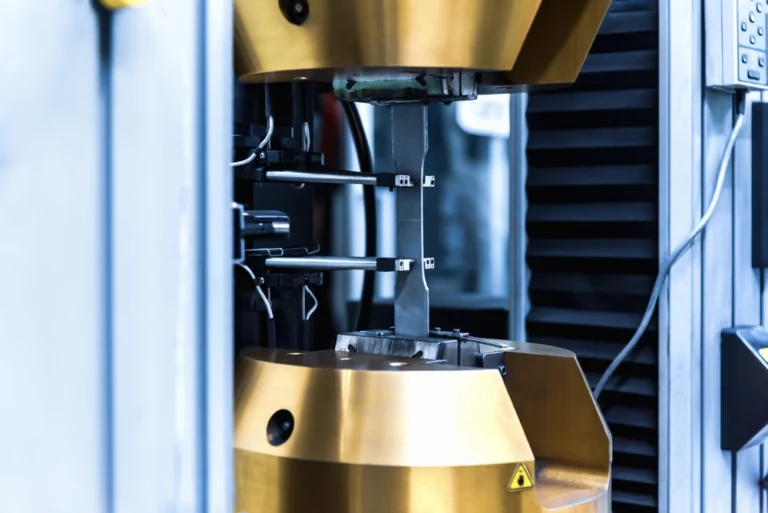
The number comes from a tensile test, which is about as direct as engineering gets. A standardized sample of the material, usually a dog-bone shape with a narrow middle section, gets clamped into a machine that pulls it apart at a controlled rate while measuring force and elongation.
As the pull increases, the machine records a stress-strain curve that tells the whole story of the material’s behavior:
The curve climbs in a straight line at first, the elastic region, where the material stretches but springs back if you release it. The slope of this line is the modulus of elasticity, a measure of stiffness.
At the yield point, the line bends. The material has started to deform permanently. This is where yield strength is read.
The curve keeps climbing to a peak, the ultimate tensile strength, then drops as the sample necks down and finally fractures.
Two other numbers come out of the same test. Elongation tells you how much the material stretched before breaking, which is a measure of ductility. And the area under the curve tells you toughness, the total energy the material absorbed before failing.
Standardized test methods like ASTM E8 (for metals) make sure the numbers are comparable between materials and suppliers. When a mill certificate quotes tensile strength, it’s quoting the result of this test.
Why the Same Metal Can Have Wildly Different Strength
Here’s where buyers get caught. Two extrusions can both be “aluminum” and have tensile strengths that differ by a factor of three. The metal’s chemistry and its heat treatment, not just the base element, determine strength.
Take aluminum as the example, since it’s where this comes up most in fabrication:
Pure aluminum (1100) has a tensile strength around 90 MPa. Soft, weak, but extremely formable.
Add magnesium and silicon and heat treat it to the T6 condition, and 6061-T6 jumps to around 310 MPa, more than three times stronger, while staying weldable and machinable.
Push into the aerospace alloys like 7075-T6, and tensile strength climbs to around 570 MPa, approaching the territory of structural steel, though at the cost of weldability and corrosion resistance.
The same logic applies to the temper, the heat treatment condition. 6061 in the soft T4 temper is noticeably weaker than the same alloy in T6. This is why “aluminum” on a spec sheet means almost nothing without the alloy and temper attached. “6061-T6” is a real specification. “Aluminum” is a wish.
Tensile Strength Across Common Materials
To put aluminum in context, here’s roughly where common materials land on ultimate tensile strength:
| Material | Approx. UTS (MPa) | Notes |
|---|---|---|
| Pure aluminum (1100) | 90 | Soft, highly formable |
| Aluminum 6063-T5 | 185 | Architectural extrusion standard |
| Aluminum 6061-T6 | 310 | Structural fabrication workhorse |
| Aluminum 7075-T6 | 570 | Aerospace, high strength |
| Mild steel (A36) | 400 to 550 | General structural steel |
| Stainless steel 304 | 515 to 750 | Corrosion-resistant structural |
| Titanium (Grade 5) | 900 to 1,000 | Aerospace, premium applications |
Notice that the best aluminum alloys overlap with structural steel on tensile strength, but at roughly one third of the weight. This strength-to-weight advantage is the entire reason aluminum dominates aerospace, transport, and any application where weight is a cost.
Where Tensile Strength Actually Matters in Real Projects
The number isn’t an academic curiosity. It drives real decisions:
Structural members carrying dead loads, live loads, and dynamic forces need enough yield strength to handle the worst-case load with a safety factor on top. Under-spec the strength and the member deforms or fails.
Fasteners and connections are often the weakest link in an assembly. The tensile strength of a bolt or a welded joint frequently determines the capacity of the whole structure.
Pressure applications like pipes, vessels, and hydraulic components rely on tensile strength to resist the hoop stress that internal pressure creates.
Lifting and rigging equipment is designed with large safety factors against tensile strength because failure is catastrophic.
Transport and automotive components balance tensile strength against weight, which is exactly the trade-off aluminum alloys are engineered to optimize.
In each of these, the engineer isn’t just picking the strongest material. They’re picking the material whose strength, weight, cost, corrosion resistance, and fabrication behavior best fit the application. Tensile strength is one input into that decision, not the whole answer.
The Mistake That Costs Projects Money
The most expensive tensile strength mistake isn’t picking a weak material. It’s assuming the material you ordered actually has the strength its spec claims.
Tensile strength depends on the alloy chemistry being correct and the heat treatment being done properly. An extrusion that’s slightly off on its alloy composition, or that wasn’t aged correctly during heat treatment, can fall short of its rated strength even though it’s labeled correctly. The part looks identical. It fails differently.
This is why mill certificates and material traceability matter. When a structural design assumes 6061-T6 at 310 MPa, that assumption is only valid if the material genuinely meets the spec. A supplier who controls alloy chemistry from the billet stage and verifies temper through proper heat treatment delivers material whose actual strength matches the certificate. A supplier who cuts corners delivers material that tests fine on paper and disappoints under load.
How This Connects to Exalum’s Extrusions
At Exalum, tensile strength isn’t a marketing number on a datasheet. It’s controlled at every stage of production. Our 20,000 m² vertically integrated facility in Indonesia handles alloy preparation, extrusion, and heat treatment under one roof, which means the temper that determines strength is verified rather than assumed.
Most of our structural and architectural profiles are produced in two alloy families that cover the vast majority of fabrication needs. The 6063 alloy, typically in T5 temper, serves architectural work where corrosion resistance, finish quality, and moderate strength matter most. The 6061 alloy in T6 temper handles structural applications where higher yield and tensile strength carry real loads.
That control shows up across the product range:
- Square Hollow and Rectangular Hollow where tensile and yield strength determine load capacity in structural framing and conveyor chassis
- Equal Angle, Unequal Angle, and Unequal Channel for brackets and bracing where strength under load is the whole point
- Flat Bars and Round Bars for machined components and structural connections
- Tubing Pipes for railings, frames, and pressure applications where wall strength matters
- Heat Sinks where the alloy balances strength with the thermal conductivity the application needs
- Curtain Wall, Casement Windows, and Doors where structural integrity meets architectural finish
When a structural design depends on the material genuinely meeting its rated strength, the supplier behind the extrusion becomes part of the engineering, not just the procurement.
Specifying Strength With Confidence
Tensile strength, used well, is a powerful tool for matching material to application. Used carelessly, by confusing ultimate with yield, or by trusting a spec without traceability, it becomes a source of expensive surprises. The professionals who get it right design to yield strength, specify alloy and temper precisely, and source from manufacturers who can prove the material meets the number.
Exalum Metal has supplied extruded aluminum to fabricators, engineers, and OEMs since 2009, with the vertical integration that keeps alloy chemistry and temper consistent so the strength on the certificate is the strength in the part.
Whether you need standard profiles or custom cross-sections designed for your specific structural requirements, Exalum Metal has the capacity and expertise to deliver.
Ready to discuss your project or request material specifications? Get in touch with the Exalum Metal team directly:
Email: [email protected] WhatsApp: +62 811 9429 970 Website: www.exalummetal.com When your design depends on the material holding, specify aluminum you can verify. Make Exalum Metal your standard.