
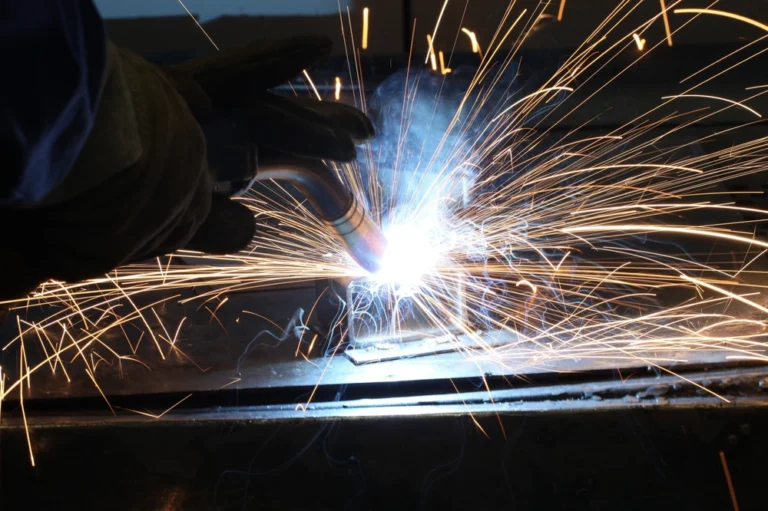
If you’ve ever tried to weld aluminum and watched it slump, crack along the joint, or refuse to bond cleanly no matter how clean your prep was, you’ve already learned something most catalogs don’t tell you: aluminum welding is not a single skill. Different alloys behave like different metals when you put a torch to them. Some weld beautifully with basic equipment and standard technique. Others crack the moment they cool, no matter how skilled the welder. And a few simply shouldn’t be welded at all, full stop.
For fabricators, structural welders, and procurement teams sourcing aluminum for welded assemblies, this article walks through which alloys actually weld well, which ones cause trouble, and how to match the alloy to the job before the welding rod ever comes out of the package.
Why Aluminum Is Harder to Weld Than Steel
Three things make aluminum welding fundamentally different from welding mild steel:
The melting point gives no warning. Steel glows red, orange, then white as it heats. Aluminum stays the same silver-gray right up until it suddenly turns to liquid. There’s no visual cue telling you the metal is about to drop out from under your weld pool.
The oxide layer melts at 2,037°C, but the metal underneath melts at 660°C. That’s why aluminum welding requires either AC TIG (which breaks up the oxide) or proper chemical cleaning before MIG welding. Skip the oxide management and the weld won’t bond.
Heat conducts away from the joint fast. Aluminum has thermal conductivity nearly four times higher than steel, so heat dissipates as quickly as you put it in. This is why aluminum welding usually needs higher amperage and preheating on thicker sections.
These quirks don’t make aluminum impossible to weld. They just mean you can’t apply steel welding habits to aluminum and expect good results.
How Aluminum Alloy Numbering Tells You About Weldability
Aluminum alloys are organized by series, with the first digit indicating the principal alloying element. Knowing the series tells you almost immediately whether the alloy welds well:
- 1xxx series (pure aluminum): Welds excellently
- 2xxx series (copper alloys): Mostly NOT recommended for welding
- 3xxx series (manganese alloys): Welds well
- 4xxx series (silicon alloys): Welds well, often used as filler metal
- 5xxx series (magnesium alloys): Welds excellently
- 6xxx series (magnesium-silicon alloys): Welds well with right technique
- 7xxx series (zinc alloys): Generally poor weldability (some exceptions)
- 8xxx series (other elements): Varies by specific alloy
This is the first filter every fabricator should run before even thinking about welding procedure. If the alloy starts with 2 or 7, you’ve already got a problem.
The Aluminum Alloys That Weld Beautifully
These are the alloys most fabrication shops actually work with for welded structural and architectural assemblies:
5052 (Al-Mg) is one of the best welding aluminum alloys available. Excellent corrosion resistance, no heat-treatment complications, and welds cleanly with both TIG and MIG using 5356 or 5183 filler. Standard for marine work, fuel tanks, and pressure vessels.
5083 and 5086 are higher-strength magnesium alloys with the same outstanding weldability as 5052. Used in marine hulls, military vehicles, and cryogenic tanks.
6061 is the workhorse structural aluminum, and it welds well with 4043 or 5356 filler. The catch is that welding reduces strength in the heat-affected zone by around 40 percent compared to the original T6 temper. Designers need to account for this with thicker sections at joints or post-weld heat treatment.
6063 welds cleanly with similar fillers, though it’s chosen less often for welded structural work because of the same HAZ strength loss. Where 6063 shines is in architectural assemblies that are mechanically joined rather than welded.
6005 and 6005A are extrusion alloys with excellent weldability and slightly higher strength than 6063. Popular for transportation and structural framing applications.
3003 and 3004 are common in cookware, heat exchangers, and roofing applications. They weld easily with 4043 or 4047 filler.
1100 and 1350 are pure aluminum grades used in electrical, chemical, and food handling applications. They weld effortlessly because there’s no alloying element to complicate the process.
The Aluminum Alloys to Avoid Welding
Some alloys are engineered for strength at the cost of weldability. Putting heat into them is asking for cracks:
2024 and 2014 (Al-Cu) are aerospace alloys that develop microcracks during welding because of the wide solidification range and copper-induced hot cracking. They can be friction stir welded or mechanically fastened, but conventional welding is off the table for structural work.
7075 (Al-Zn) is the classic high-strength aerospace aluminum used in aircraft structures, climbing hardware, and high-stress machined parts. It’s almost completely unweldable by conventional methods due to stress corrosion cracking risk.
7050 and similar 7xxx alloys have the same weldability problem as 7075. If your design needs welding, you cannot use these alloys.
High-copper alloys generally are problematic. Copper widens the solidification range, increases hot cracking, and reduces corrosion resistance in the heat-affected zone.
For these alloys, the right call is to redesign with bolted or riveted joints, or specify a more weldable alloy and accept the lower strength. There’s no welding technique that fixes fundamental alloy chemistry.
Choosing the Right Filler Metal
Filler metal matters as much as the base alloy. The two most common choices for fabrication work:
4043 (5% silicon) is the default filler for 6xxx series alloys. It lowers the melting range of the weld pool, reduces cracking risk, and produces clean welds with good appearance. The trade-off is slightly lower strength than 5356.
5356 (5% magnesium) is the higher-strength choice for 5xxx and 6xxx alloys. Color-matches 5xxx series base metal after anodizing (4043 turns dark gray under anodizing, which is ugly on visible work). Use 5356 anywhere appearance or maximum strength matter.
4047 (12% silicon) is used where extra fluidity helps fill gaps, common in thinner aluminum sheet work.
5183 is similar to 5356 but with slightly higher magnesium content for the highest-strength joints on 5xxx alloys.
The general rule: 4043 for general 6061 and 6063 work, 5356 for visible welds that will be anodized, and 5xxx fillers for marine and pressure applications.
TIG vs MIG for Aluminum Welding
Both processes work, with different strengths:
TIG (GTAW) with AC current is the gold standard for aluminum. The AC waveform breaks up the oxide layer automatically, and the precision control produces beautiful welds on thin material. Slower than MIG but cleaner.
MIG (GMAW) with spray transfer is faster and better suited to thicker material and production environments. Requires more attention to wire feeding (aluminum wire is soft and tangles easily) and proper shielding gas (100% argon for most work, argon-helium mixes for thicker plate).
Both processes need clean material. A wire brush dedicated to aluminum and a stainless steel brush for oxide removal are non-negotiable.
Why the Alloy You Order Matters Before Welding Ever Starts
Most aluminum welding problems trace back to alloy mismatch, not welder skill. A welder who’s been told the material is 6061 and gets handed unmarked 2024 will produce a beautiful-looking weld that cracks the first time it’s loaded.
This is where the supplier behind your aluminum matters more than most fabricators realize. Profiles delivered without clear alloy marking, mixed alloys in a single delivery, or vague specifications all create the conditions for failed welds, rejected jobs, and warranty claims.
At Exalum, every extruded profile we produce is alloy-controlled from the billet stage through finishing, with documentation that matches the spec sheet. Most of our structural and architectural profiles are 6063-T5 or 6061-T6, both of which are weld-friendly with standard fabrication techniques and the right filler.
Exalum Products That Weld Cleanly Into Fabrication Assemblies
The product range that comes out of our 20,000 m² vertically integrated facility in Indonesia is designed for the fabrication workflows that include welding:
- Square Hollow and Rectangular Hollow for welded structural framing
- Tubing Pipes for railings, frames, and fluid handling assemblies
- Equal Angle and Unequal Angle for brackets, cross-bracing, and corner reinforcement
- Unequal Channel for edge stiffening and welded channel mounting
- Flat Bars for mounting plates and welded brackets
- Round Bars for welded shaft and pivot assemblies
- Heat Sinks that integrate into welded electronic enclosures
- Curtain Wall profiles for facade assemblies (most are mechanically joined, but secondary welding is common)
- Ladder and Handle components for industrial fabrication
Every one of these comes in alloys and tempers chosen for compatibility with the fabrication methods our customers actually use, including welding.
Sourcing Weldable Aluminum With Confidence
Getting aluminum welding right starts long before the torch comes out. The alloy has to be right, the temper has to be documented, and the supplier has to stand behind both.
Exalum Metal has supplied aluminum extrusion to fabricators since 2009, with the vertical integration that keeps alloy chemistry, extrusion quality, and finishing consistent across every shipment. When the spec sheet says 6063-T5, that’s what shows up at your shop.
Whether you need standard profiles or custom cross-sections designed for your specific fabrication requirements, Exalum Metal has the capacity and expertise to deliver.
Ready to place an order or discuss your requirements? Get in touch with the Exalum Metal team directly:
Email: [email protected] WhatsApp: +62 811 9429 970 Website: www.exalummetal.com
Your next fabrication project deserves material you can count on. Make aluminum profiles from Exalum Metal your standard.