
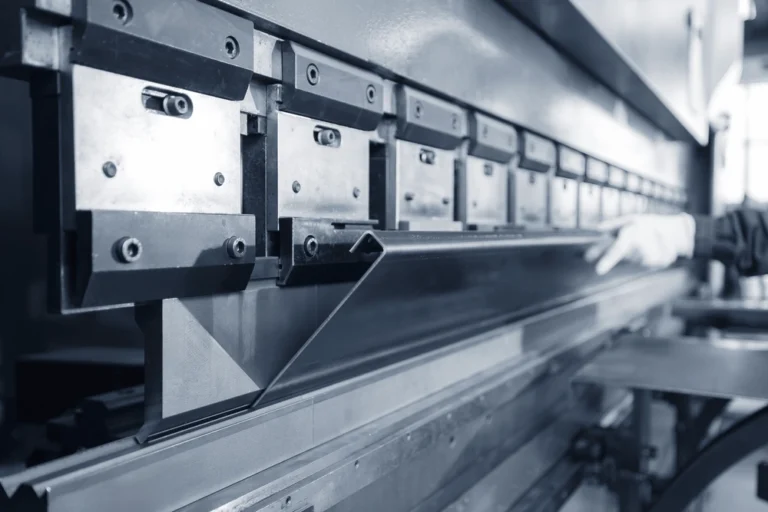
If you’ve ever pulled a bent aluminum profile out of a press brake and seen a crack running along the outside of the curve, you’ve already learned the lesson the hard way. Aluminum bending isn’t like steel bending. The same techniques that produce a clean 90-degree corner in mild steel can shatter a “bend-friendly” aluminum alloy if you’ve spec’d it wrong. And here’s the part that catches a lot of fabricators off guard: even the right alloy can be the wrong temper for the job.
For shops doing architectural bending, structural fabrication, custom railings, or any work where aluminum has to take a curve, this article walks through which alloys bend cleanly, which ones to avoid, and the temper choice that quietly determines whether your bending project succeeds or fails.
Why Some Aluminum Alloys Bend Cleanly and Others Don’t
Three properties determine whether an aluminum alloy will bend well or crack:
Elongation is the measure of how much a metal can stretch before it tears. Higher elongation means more bend-friendly material. Aluminum alloys with elongation above 15 percent bend cleanly. Below 10 percent, you’re fighting the metal.
Strain hardening behavior describes how the alloy reacts to deformation. Some alloys harden quickly under bending stress, which makes them prone to cracking on tight radii. Others spread the deformation evenly across the bend.
Heat treatment condition (temper) changes the alloy’s behavior dramatically. The same alloy in a soft temper bends beautifully, while in a hardened temper it cracks on contact. This is the single most overlooked factor in failed bending jobs.
Bending performance is the combination of these three factors, plus the bend radius, the tooling, and the technique. Get the alloy and temper right, and you’ve solved most of the problem before you even touch the press brake.
The Aluminum Alloys That Bend Beautifully
These are the alloys fabricators actually use when bending is part of the workflow:
3003 is one of the most bendable aluminum alloys available. High elongation, low yield strength, and excellent formability. Standard for sheet metal work, ductwork, cookware, and anything that needs tight bends with no cracking. The aluminum equivalent of “you can bend this with a hammer if you have to.”
5052 is the go-to bending alloy for structural and marine work. Good strength, excellent corrosion resistance, and reliable bending behavior even on tighter radii. Used heavily in fuel tanks, marine fittings, and architectural sheet work.
5083 and 5086 are higher-strength magnesium alloys with the same bend-friendly behavior as 5052. Used where the bent part also needs to carry significant load.
1100 is commercially pure aluminum, with extreme bendability but low strength. Used for decorative work, signage, and applications where bending complexity matters more than mechanical performance.
6063 bends well in softer tempers and is the most common architectural extrusion alloy. The catch is that the temper matters enormously. 6063-T4 bends beautifully, 6063-T5 bends acceptably with the right radius, and 6063-T6 is risky on tight bends without annealing first.
6061 can be bent, but with more care than 6063. 6061-T4 is the bending-friendly temper. 6061-T6, the most common structural temper, requires generous bend radii and often benefits from heat treatment after bending to restore strength.
The Aluminum Alloys to Avoid Bending
Some alloys are engineered for strength at the cost of formability. Trying to bend them is asking for cracks:
2024 is an aerospace alloy with high strength but low elongation. It cracks easily under bending and should be formed with specialized techniques (stretch forming, hot bending) rather than press brake work.
7075 is the classic high-strength aerospace aluminum used in aircraft structures and high-stress machined parts. Very limited bending capability. If your design needs bending, you should not be using 7075.
6061-T6 on tight bends is technically not unbendable, but it’s so prone to cracking on radii below 3 to 4 times the material thickness that most fabricators treat it as a no-go for tight work. Either bend in T4 condition and heat treat after, or design with generous radii.
For these alloys, the right call is to redesign with welded or bolted joints, or specify a more bendable alloy and accept the lower strength.
Why Temper Is the Decision That Actually Matters
Here’s the thing about aluminum bending that most fabrication catalogs gloss over: the alloy alone tells you only half the story. The temper finishes the rest.
The major tempers and their bending behavior:
- O (annealed) is the softest condition. Maximum bendability, lowest strength. Used when the part will be bent first and heat-treated to final strength after.
- T1 and T4 are partially heat-treated tempers with good bending characteristics. The standard choice when bending is needed but some mechanical strength is required.
- T5 is cooled from the press and artificially aged. Higher strength than T4 but still bendable with the right radius. The most common temper for architectural extrusion.
- T6 is fully heat-treated to peak strength. Best mechanical properties but the most challenging for bending. Reserve for structural work where bending happens at generous radii or doesn’t happen at all.
The general rule: bend in soft temper, heat treat after. If that’s not practical, design with bend radii that match the temper you’re working with.
Minimum Bend Radius: The Number That Decides the Job
The minimum bend radius is the tightest curve you can produce in a given material without cracking. It’s specified as a multiple of the material thickness (for example, “2T” means the radius is twice the material thickness).
Approximate minimum bend radii for common aluminum alloys at 90-degree bends:
| Alloy / Temper | Minimum Bend Radius |
|---|---|
| 3003-H14 | 1T |
| 5052-O | 0T (sharp bend possible) |
| 5052-H32 | 1T to 1.5T |
| 6063-T4 | 1T |
| 6063-T5 | 2T |
| 6063-T6 | 3T to 4T |
| 6061-T4 | 1.5T to 2T |
| 6061-T6 | 4T to 6T |
These are approximate values that depend on bend angle, tooling, lubrication, and bending technique. Always run a sample bend on the actual material before committing to a production run.
Bending Extruded Profiles vs Bending Sheet
Sheet aluminum bends predictably because it has uniform thickness and the bending forces are easy to control. Bending an extruded profile (a square hollow, a channel, an angle) is harder because the cross-section has thin and thick areas that respond to bending forces differently.
Three rules for bending extruded aluminum:
Use the right tooling. Rotary draw bending with mandrels, ring rolling, and stretch forming all work better than press brake bending for extrusions. The mandrel inside a hollow profile prevents wall collapse.
Watch for wall distortion. Hollow profiles tend to flatten on the bend (the outside wall stretches, the inside wall compresses, and the cross-section deforms). Internal mandrels or filler materials prevent this.
Match radius to profile geometry. Tight bends on extrusions create more cross-section distortion than tight bends on sheet. A 50mm square hollow bent on a 100mm radius will have visible distortion. A 300mm radius produces a cleaner bend.
Why the Manufacturer Behind the Aluminum Matters for Bending
Most bending failures trace back to one of three problems: wrong alloy, wrong temper, or inconsistent material chemistry across batches. The first two are design decisions. The third is a supplier issue, and it’s the one most fabricators don’t see coming.
A batch of 6063 that’s slightly off-spec on magnesium or silicon content can bend cleanly on Monday and crack on Tuesday using the same setup. Inconsistent grain structure from poor extrusion control can produce profiles that bend differently along their length.
This is why working with a vertically integrated extrusion manufacturer matters. When billet preparation, alloy chemistry, extrusion temperature, and post-extrusion heat treatment are all controlled under one roof, the material that arrives at your shop bends the way the spec sheet says it should.
Exalum Products Suited to Bending Applications
The product range from our 20,000 m² vertically integrated facility in Indonesia includes profiles that work well in bending applications when paired with the right alloy and temper:
- Tubing Pipes in 6063 for railings, furniture frames, and curved architectural details
- Decorative Tubing Pipes for retail displays, signage frames, and decorative bent assemblies
- Square Hollow and Rectangular Hollow for bent structural frames and machine guards
- Flat Bars for bent mounting brackets, decorative trim, and curved spacers
- Round Bars for bent shafts, handles, and curved structural components
- Curtain Track for curved interior installations
- Handle components for bent architectural and furniture hardware
- Showcase profiles for retail display work that often includes bent elements
For any of these applications, specifying the alloy and temper that match your bending requirements is the first step. We can supply 6063-T4 for tighter bends, 6063-T5 for moderate bends with better strength, and 6061-T6 for structural work where bending happens at generous radii.
Sourcing Bendable Aluminum With Confidence
Aluminum bending succeeds or fails on three decisions: the alloy, the temper, and the supplier. Get all three right and the bending itself is the easy part. Get any one of them wrong and you’ll spend more time troubleshooting than fabricating.
Exalum Metal has supplied aluminum extrusion to fabricators since 2009, with vertical integration that keeps alloy chemistry and temper consistent across every shipment. When you spec 6063-T4 for bending work, that’s exactly what arrives at your shop, with documentation that backs up the spec.
Whether you need standard profiles or custom cross-sections designed for your specific fabrication requirements, Exalum Metal has the capacity and expertise to deliver.
Ready to place an order or discuss your requirements? Get in touch with the Exalum Metal team directly:
Email: [email protected] WhatsApp: +62 811 9429 970 Website: www.exalummetal.com. Your next fabrication project deserves material you can count on. Make aluminum profiles from Exalum Metal your standard.