
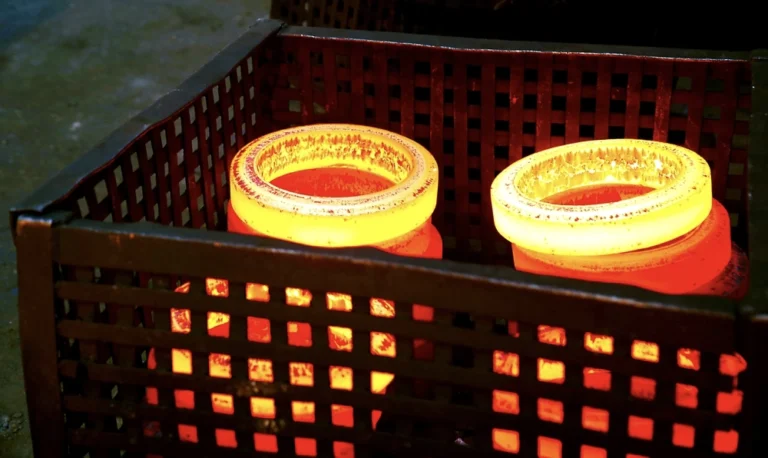
Annealing is a heat treatment used to soften aluminum and improve its suitability for further forming. The required treatment depends on the alloy, starting temper and final properties needed. The annealed condition is identified by the letter O.
Before specifying annealing, identify the material and the work it must undergo. The appropriate process should support both the forming operation and the finished component’s requirements.
What Annealing Does to Aluminum
Aluminum hardens when you work it. Every bend, draw, roll, and hammer blow distorts the grain structure inside the metal, and that distortion makes it stronger but also more brittle. Metallurgists call this work hardening or strain hardening. Push it far enough and the metal becomes too hard to form without cracking.
Annealing reverses that. By heating the aluminum to a specific temperature and holding it there, the distorted grain structure reorganizes itself into new, strain-free grains. The metal comes out softer, more ductile, and ready to be worked again. In the world of tempers, fully annealed aluminum carries the “O” designation, the softest condition the alloy can be in.
The trade-off is real and worth understanding. Annealing buys you formability at the cost of strength. A fully annealed part is significantly weaker than the same part in a hardened temper, which is why annealing is usually a step in the middle of a process rather than the final condition for a structural part.
The Three Stages Happening Inside the Metal
When aluminum is annealed, three distinct things happen as the temperature rises, and knowing them explains why the process works the way it does.
Recovery comes first, at lower temperatures. Internal stresses relax and the metal softens slightly, but the grain structure hasn’t changed much yet. This stage alone is sometimes used as a stress-relief treatment.
Recrystallization is the main event. At the annealing temperature, brand-new grains form to replace the distorted ones created by work hardening. This is where the real softening happens and where the metal regains its formability.
Grain growth comes last, if the metal is held too hot for too long. The new grains start merging into larger ones, and oversized grains can actually hurt the surface finish and mechanical behavior of the final part. This is why annealing isn’t just “heat it up.” Temperature and time both have to be controlled.
How Aluminum Is Actually Annealed
The process sounds simple, and the principle is, but the details determine whether it works.
The aluminum is heated to its annealing temperature, which for most common alloys sits between 300 and 410°C (570 to 770°F) depending on the alloy. It’s held at that temperature long enough for recrystallization to complete, typically anywhere from thirty minutes to a few hours depending on section thickness.
Then comes the part that catches people out: the cooling. Unlike steel, which often needs slow furnace cooling to anneal, the cooling rate for aluminum depends on the alloy family.
Non-heat-treatable alloys like the 1xxx, 3xxx, and 5xxx series can be cooled in air at almost any rate after annealing and stay soft. These are the alloys used where formability matters more than ultimate strength.
Heat-treatable alloys like the 6xxx and 7xxx series are trickier. To keep them in the soft annealed state, they need to be cooled slowly, often no faster than about 28°C per hour down to around 260°C. Cool them too fast and you accidentally start a hardening process instead of keeping them soft.
That cooling-rate distinction is the single most common annealing mistake, and it’s why heat-treatable alloys need more careful control than the simpler formable grades.
Standard Annealing Temperature & Cooling Reference Chart
To achieve consistent mechanical properties, precise control over temperature ranges, soak times, and cooling rates is necessary:
| Alloy Family | Example Alloys | Annealing Temperature | Soak Time | Cooling Method / Rate |
| 1xxx (Pure Aluminum) | 1100, 1050 | 340°C – 400°C (650°F – 750°F) | 1 to 2 hours | Air cooling |
| 3xxx (Mn Alloys) | 3003, 3105 | 340°C – 410°C (650°F – 770°F) | 1 to 2 hours | Air cooling |
| 5xxx (Mg Alloys) | 5052, 5083 | 345°C – 380°C (650°F – 715°F) | 1 to 2 hours | Air cooling |
| 6xxx (Mg-Si Alloys) | 6061, 6063 | 415°C (780°F) | 2 to 3 hours | Controlled furnace cooling (28°C/hr down to 260°C) |
| 7xxx (Zn Alloys) | 7075 | 410°C – 430°C (770°F – 800°F) | 2 to 4 hours | Controlled furnace cooling (15°C/hr down to 230°C) |
Why You’d Anneal Aluminum in the First Place
Annealing earns its place in several real situations:
Forming complex shapes is the big one. Deep draws, tight bends, and intricate forming operations need soft, ductile metal. Annealing before forming prevents the cracking that hardened aluminum produces.
Restoring formability mid-process happens when a part has already been worked hard and needs more forming. An intermediate anneal resets the metal so it can take the next operation without failing.
Improving machinability matters for some operations, where softer metal cuts more cleanly and reduces tool wear.
Relieving internal stress helps with dimensional stability, particularly on parts that will be machined heavily, where locked-in stresses would otherwise cause warping as material is removed.
In each case, annealing is a tool for getting the metal into the right condition for the next step, not usually the final state of a finished structural part.
Understanding Temper Designations (H-Series & O-Temper)
Understanding how annealing interacts with standard industrial tempers is essential for specifying material correctly:
O Temper (Fully Annealed): The softest condition available, providing maximum ductility for severe forming, bending, and deep drawing operations.
H1x Series (Strain Hardened Only): Applies to non-heat-treatable alloys that achieve strength strictly via cold work (e.g., H12 quarter-hard, H14 half-hard, H18 full-hard).
H2x Series (Strain Hardened and Partially Annealed): Products are cold-worked beyond target specs and then brought down to intermediate strength levels via partial annealing (e.g., H22, H24, H26, H28).
H3x Series (Strain Hardened and Stabilized): Applied specifically to aluminum-magnesium alloys (5xxx series) that age-soften naturally at room temperature. Low-temperature thermal treatment stabilizes mechanical properties and prevents post-fabrication property shifts.
Where Annealing Fits Against Other Heat Treatments
Annealing is one of several heat treatments aluminum can undergo, and it helps to know how it relates to the others.
Annealing softens the metal to its most workable state. Solution heat treatment, by contrast, is the first step in hardening, where the alloying elements are dissolved into the aluminum at high temperature. Aging, whether natural or artificial, is what follows solution treatment to build strength back up, producing tempers like T4 and T6.
So a heat-treatable alloy might go through a full cycle: annealed and formed into shape, then solution treated and aged to reach its final structural strength. The annealing makes the forming possible. The later treatments make the part strong enough to use. They’re complementary steps, not competing ones.
Annealing and Temper Selection
These two processes serve different purposes. The former softens the material, while appropriate hardening treatments can increase strength in heat-treatable alloys.
Compare the alloy and temper together when planning the manufacturing sequence. Read our aluminum hardening guide for an explanation of O, T4, T5 and T6 conditions.
Shop-Floor Troubleshooting & Practical Application Examples
Real-World Industrial Applications
Fluid & Hydraulic Tubing: Aluminum tubing used for automotive fluid lines or structural frames undergoes work hardening during initial drawing or extrusion. Full annealing ensures the tubing deforms safely during localized impact rather than snapping or cracking.
Architectural Bending & Framing: Intricate window frames, curtain tracks, and curved structural profiles often require localized or post-extrusion annealing to complete sharp radius bends without tearing.
Shop-Floor Defect Prevention
Preventing “Orange Peel” Surface Defects: Over-annealing (excessive hold time or temperature above 430°C) causes secondary grain growth. This coarse grain structure creates a rough, bumpy surface known as “orange peel” during subsequent bending operations.
Avoiding Edge Cracking: Under-annealing (insufficient temperature or premature cooling) leaves residual dislocations in the material. When formed, the metal reaches its failure point quickly, resulting in micro-cracks along sharp bend radii.
The Extrusion Connection Most Buyers Miss
Here’s where annealing quietly touches almost every aluminum profile, even the ones nobody anneals after delivery.
Extrusion itself is a forming process done with heat. When a billet is pushed through a die, the temperature and the deformation both affect the grain structure and the properties of the finished profile. Controlling those conditions, the billet preheat, the extrusion speed, the cooling at the press, the subsequent heat treatment, is what determines whether a profile comes out at its rated temper or falls short.
A profile delivered in T5 or T6 has been through a carefully controlled thermal cycle. A profile that needs to be bent or formed after delivery might be specified in a softer temper, or annealed before forming, precisely because the buyer understands the formability trade-off. The point is that temper and thermal history aren’t afterthoughts. They’re designed into the profile from the billet onward.
This is why the manufacturer behind the aluminum matters so much for any project involving forming. A profile whose thermal history was poorly controlled behaves unpredictably when you try to bend it, anneal it, or machine it.
How This Shows Up at Exalum
At Exalum, the thermal control that governs temper and formability is built into the production process. The 20,000 m² vertically integrated facility in Indonesia handles billet preparation, extrusion, and heat treatment as a continuous chain, which is what allows profiles to leave in the temper they were specified in, with the predictable forming behavior that follows.
For projects that involve bending or forming after delivery, this control is what matters most. A profile specified in a formable temper bends the way it’s supposed to. A profile specified in a harder structural temper holds its strength under load. The range across the catalog reflects both needs:
- Tubing Pipes and Decorative Tubing Pipes for railing and furniture work that often involves bending, where formable tempers prevent cracking
- Flat Bars and Round Bars for components that get machined or formed after delivery
- Square Hollow and Rectangular Hollow for structural framing where harder tempers carry the load
- Equal Angle, Unequal Angle, and Unequal Channel for brackets and bracing
- Curtain Track and Handle profiles for architectural and furniture applications where formability matters
- Heat Sinks where the alloy and temper balance forming behavior against thermal performance
When a project’s success depends on how the metal behaves under forming, the temper and thermal history of the profile become part of the design conversation, not just a line on the purchase order.
Getting Formable Aluminum Right
Annealing is a precise tool, not a rough one. Done correctly, it turns hardened, crack-prone aluminum back into metal that forms cleanly. Done carelessly, by overheating, by holding too long, or by cooling a heat-treatable alloy too fast, it produces metal with the wrong properties for the job. The professionals who form aluminum well understand the alloy they’re working with, control the thermal cycle, and source profiles whose temper and history they can trust.
Exalum Metal has supplied extruded aluminum to fabricators, formers, and manufacturers since 2009, with the vertical thermal control that keeps temper consistent and forming behavior predictable across every shipment.
Whether you need standard profiles or custom cross-sections designed for your specific forming requirements, Exalum Metal has the capacity and expertise to deliver.
Planning to Bend or Form an Aluminium Profile?
Share your drawing, intended forming operation, required final properties and quantity. Exalum Metal can discuss the material and manufacturing requirements with you. Communicate with our team by clicking the “Contact US” button below.