
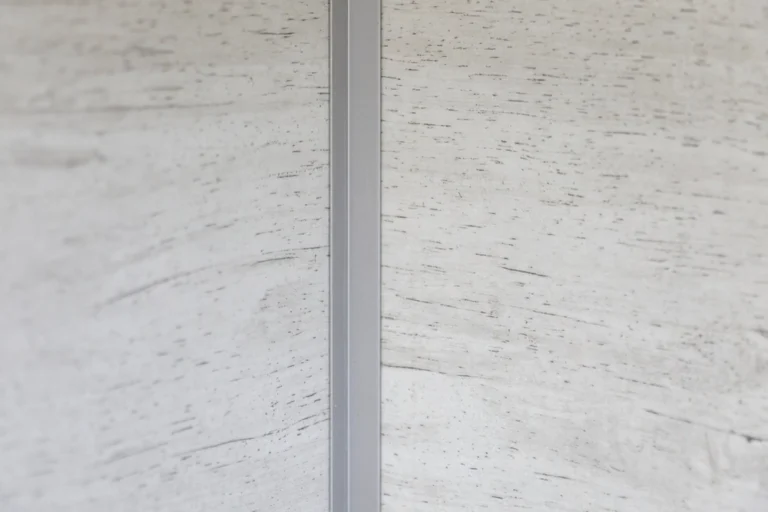
Walk through any well-finished commercial space, modern kitchen, or hospital interior and you’ll notice that the corners look intentional. The edges of tile, drywall, paneling, and cabinetry meet cleanly, without ragged exposed substrate or chipped paint at the wear points. That clean look almost always comes down to one product: aluminum corner trim. It’s the kind of detail that nobody compliments specifically, but everyone notices when it’s missing or installed badly.
For fabricators, interior contractors, tile installers, and procurement teams sourcing trim for commercial or residential projects, this article walks through what aluminum corner trim is, the different profile types and their uses, and how to spec the right trim for the job.
What Is Aluminum Corner Trim?
Aluminum corner trim is an extruded aluminum profile designed to cover, protect, or finish the edge or corner where two surfaces meet. The shape varies depending on the application, but the function is consistent: protect the substrate from impact damage, create a clean visual line at the transition, and provide a finish that lasts longer than the surfaces it’s protecting.
Corner trim is one of the highest-volume aluminum extrusion categories globally because it shows up in almost every type of construction and fabrication work. From tile installations and drywall edges to cabinetry, paneling, and exterior cladding, the demand is constant and the design variations are nearly endless.
The Main Types of Aluminum Corner Trim
Corner trim isn’t a single product. It’s a family of profiles, each optimized for specific applications:
Equal angle corner trim is the simplest configuration, with two equal-length legs meeting at a 90-degree angle. Used to wrap external corners on walls, columns, paneling, and millwork. The most versatile corner trim and the largest single category by volume.
Unequal angle corner trim has one leg longer than the other, used where one side of the corner needs more coverage than the other. Common for paneling installations where one face is visible and the other is hidden behind structure.
Square edge trim is a J-shaped or L-shaped profile that caps the exposed edge of tile, panel, or laminate without wrapping around a corner. The standard for finishing the top edge of tile wainscoting, backsplashes, and decorative wall panels.
Round edge trim (bullnose trim) has a rounded outer profile that creates a soft, finished edge on tile or panel installations. Common in bathrooms, kitchens, and any setting where sharp corners would be undesirable.
Stair nosing trim is a specialized corner trim with anti-slip surface features, designed to finish the front edge of stair treads while providing slip resistance and edge protection.
Drywall corner bead is a perforated or solid aluminum profile that reinforces drywall corners during finishing. The aluminum substrate resists denting and impact damage far better than paper-faced corner bead.
Transition strips finish the edge where one flooring material meets another, particularly between tile and carpet, tile and wood, or different tile types. Aluminum transition strips combine durability with clean architectural lines.
Tile edge trim specifically finishes the cut edge of ceramic, porcelain, or stone tile. Available in straight edge, round edge, and decorative profiles in a wide range of colors and finishes.
Cabinet and millwork corner trim protects the corners of cabinets, counters, and built-in furniture from impact damage while contributing to the visual finish.
Cladding corner trim finishes the corners of metal, composite, and stone cladding systems on building exteriors, providing weather sealing and visual continuity.
Why Aluminum Beats Plastic and Vinyl for Corner Trim
Corner trim has historically come in three material options: plastic, vinyl, and aluminum. Plastic and vinyl still have their place at the budget end of the market, but aluminum has steadily taken over premium and commercial installations for clear reasons:
Impact resistance. Aluminum corner trim absorbs impact and bounces back without cracking, denting permanently, or splitting. Plastic and vinyl chip and crack under the same impacts, exposing the substrate underneath.
Long-term color stability. Anodized or powder-coated aluminum holds its color for decades without fading, even in direct sunlight. Plastic and vinyl yellow, fade, and chalk over time.
Heat resistance. Aluminum handles temperature swings without warping or distortion. Plastic and vinyl can sag, warp, or pull away from substrates in hot conditions.
Fire performance. Aluminum is non-combustible. Plastic and vinyl burn and contribute to fire spread, which is increasingly a compliance issue in commercial construction post-Grenfell and similar regulatory changes.
Finish consistency. Aluminum trim with anodized or powder-coated finishes matches in color across long production runs and across separate orders. Plastic and vinyl finish quality varies by batch and degrades over time.
For commercial, hospitality, healthcare, and any installation where the trim has to look intentional for years, aluminum is the default specification.
How to Specify Aluminum Corner Trim
Five details separate corner trim that performs well from corner trim that disappoints:
Profile type and dimensions. Match the trim profile to the substrate and the corner geometry. Wrap distance, leg thickness, and edge radius all matter for fit. A trim profile that’s slightly oversized leaves gaps. Undersized profiles don’t seat properly against the substrate.
Alloy and temper. 6063-T5 is the standard for architectural corner trim. It extrudes into thin-walled, intricate profiles cleanly, finishes beautifully, and provides adequate strength for trim applications. For heavier-duty applications like stair nosing or impact-prone commercial corners, 6061-T6 adds durability.
Wall thickness. Lightweight trim (1.0 to 1.5mm) works for residential and low-traffic commercial installations. Medium-duty trim (1.5 to 2.0mm) handles commercial corners and impact-prone areas. Heavy-duty trim (2.0mm or thicker) is specified for stair nosing, exterior cladding corners, and high-impact zones.
Finish. Mill finish for hidden installations. Clear anodizing for natural aluminum appearance. Color anodizing in bronze or black for darker architectural schemes. Powder coating in any RAL color for color-matched installations. The finish choice determines both appearance and long-term durability.
Length and installation method. Standard lengths are 2.5m, 3m, or 6m. Cut-to-length services reduce waste. Installation methods include adhesive bonding, mechanical fastening, and integrated mounting features on the trim profile itself.
A specification with all five elements gives the manufacturer exactly what they need to produce trim that fits cleanly and performs over the long term.
Where Aluminum Corner Trim Shows Up in Real Projects
The applications cover almost every category of finish work:
- Bathroom and kitchen tile installations
- Commercial wall paneling and decorative finishes
- Exterior cladding and rainscreen systems
- Office partition systems and modular wall construction
- Cabinet and millwork edge protection
- Stair treads and step nosing in commercial buildings
- Hospital and clinical wall protection
- Retail fixture and display construction
- Hotel and hospitality interior finishes
- Educational and institutional corridor protection
- Industrial facility wall protection and equipment edges
- Door and window trim where the frame meets the wall
Each of these applications has its own ideal trim profile, finish, and installation approach, which is why corner trim is one of the most varied product categories in aluminum extrusion.
What to Look For in an Aluminum Corner Trim Supplier
Corner trim is a deceptively simple product where small manufacturing details determine the result. Three things matter most:
Dimensional consistency. Trim that varies in leg length, angle accuracy, or wall thickness produces visible gaps, misalignment, and rework on site. Working with a manufacturer who controls extrusion tolerance tightly delivers trim that installs cleanly from the first piece to the last.
Surface finish quality. Corner trim is almost always visible, which means die lines, mill marks, and surface defects become problems rather than acceptable variations. A manufacturer who protects surface quality from extrusion through finishing produces trim that looks intentional.
Finish color matching across batches. When a project orders trim across multiple deliveries, color variation between batches creates visible mismatches at corners and transitions. Manufacturers with controlled anodizing and powder coating processes maintain color consistency across orders.
These three capabilities separate trim suppliers worth working with from the ones who’ll produce trim that looks fine in isolation but fails when installed together.
Exalum Products for Corner Trim and Edge Finishing
The product range from our 20,000 m² vertically integrated facility in Indonesia includes the profile categories that cover most corner trim applications:
- Equal Angle profiles in multiple sizes for external corner wrapping on walls, columns, paneling, and millwork
- Unequal Angle profiles for asymmetric corner applications and panel edge finishing
- Unequal Channel profiles for edge capture, J-bead style trim, and panel termination
- Flat Bars for custom trim applications, mounting backers, and edge protection
- Curtain Wall trim profiles for facade corner finishing and panel termination
- Spandrel profiles for panel infill edge work
- Door Jamb for door opening trim and corner finishing
- Shop Front profiles for retail facade corner work
- Tubing Pipes and Decorative Tubing Pipes for radius corner work and tubular edge protection
- Showcase profiles for retail fixture and display corner trim
Beyond standard profiles, custom corner trim extrusions to specific project dimensions cover the unique requirements that off-the-shelf catalog products don’t fit. Die design, alloy selection, extrusion, and in-house anodizing or powder coating happen inside our facility, which makes custom trim projects practical rather than just possible.
Finishing Options for Corner Trim
Finish choice is where corner trim either succeeds or fails visually. Four options cover most applications:
Clear anodizing is the architectural standard, providing scratch resistance and a clean silver-gray appearance that integrates with most interior schemes.
Color anodizing in bronze, black, gold, or champagne tones is specified for darker architectural environments and contemporary design schemes.
Powder coating in any RAL color matches branded environments, color-coordinated commercial fit-outs, and specific design palettes.
Brushed and polished mill finishes offer the industrial-modern aluminum aesthetic that’s become popular in contemporary interior design.
In-house finishing means the trim arrives with the specified finish quality intact, which protects the visual investment that custom trim represents.
Sourcing Aluminum Corner Trim With Confidence
The right corner trim installation looks effortless. The wrong corner trim becomes the thing everyone notices when they walk into the room, for all the wrong reasons. The difference comes down to extrusion quality, dimensional consistency, and finishing discipline at the manufacturer.
Exalum Metal has supplied aluminum corner trim, edge profiles, and architectural trim to fabricators, interior contractors, and construction integrators since 2009. The vertical integration that keeps alloy chemistry, dimensional tolerance, and surface finish consistent across batches is what produces trim that installs cleanly and looks the same in year 20 as it did on opening day.
Whether you need standard profiles or custom cross-sections designed for your specific project requirements, Exalum Metal has the capacity and expertise to deliver.
Ready to discuss your corner trim project or request finish samples? Get in touch with the Exalum Metal team directly:
Email: [email protected] WhatsApp: +62 811 9429 970 Website: www.exalummetal.com
Your next finishing project deserves trim you can count on. Make aluminum corner trim from Exalum Metal your standard.