If you’re sourcing custom metal parts internationally in 2026, Indonesia keeps coming up in the conversation. The combination of established manufacturing capacity, competitive pricing, and the February 2026 US-Indonesia Agreement on Reciprocal Trade has put Indonesian factories firmly on the radar of procurement teams who used to default to other origins. The question that follows is usually the same: which factory is actually capable of delivering what you need, on time, with the documentation and quality your customers expect?
This article walks through what separates a serious Indonesian custom metal parts factory from a trading company with a website, what to look for in a manufacturing partner, and how to evaluate whether a factory can actually deliver on the specifications you send them.
Why Indonesia Has Become a Serious Sourcing Destination
Indonesia’s manufacturing sector has grown into one of the largest in Southeast Asia, with deep capability in aluminum, steel, and copper fabrication. Three forces have moved the country up the consideration list for international buyers:
Trade infrastructure. The Agreement on Reciprocal Trade signed between Indonesia and the United States in February 2026 established a structured trade relationship with predictable tariff treatment. For US buyers in particular, this has made Indonesian sourcing more strategically attractive than uncertain origins.
Manufacturing depth. Indonesia has decades of established industrial manufacturing capacity, particularly in aluminum extrusion, steel fabrication, and component production. This isn’t a country that just started exporting metal parts. The infrastructure has been built out over generations.
Workforce and cost structure. Indonesia combines a skilled industrial workforce with cost levels that allow custom manufacturing without the markups that come from higher-cost regions. The combination is what makes total landed cost competitive even after international freight.
For procurement teams diversifying away from origins with higher tariff exposure or geopolitical risk, Indonesia has become a serious answer rather than a fallback option.
What Separates a Real Factory From a Trading Company
The hardest part of sourcing custom metal parts from Indonesia (or anywhere) is figuring out whether you’re talking to an actual manufacturer or to a broker reselling someone else’s work. Both have websites. Both quote prices. The difference shows up later, in delivery delays, quality inconsistency, and the inability to honor specifications when something goes wrong.
Five signals separate a real custom metal parts factory from a trading layer:
They own the physical facility. A factory has an address you can visit, photographs of the production floor that match the address, and a verifiable operating history. Trading companies have offices and websites.
They control raw material. A real manufacturer can document where the metal comes from, what alloy it is, and how chemistry is verified. Traders typically can’t answer these questions clearly because they don’t actually produce the material.
They have process equipment. Extrusion presses, casting equipment, machining centers, finishing lines, and quality control labs are visible, photographable, and operated by trained staff. If a “factory” can’t show you the equipment, they probably don’t have it.
They issue documentation. Mill certificates, material test reports, dimensional inspection reports, and finishing certifications are produced internally and signed by named quality engineers. Documentation copied from suppliers or unsigned is a major red flag.
They handle technical questions directly. When you ask about alloy temper behavior, tolerance capability, or finishing options, the answers come from engineers, not from sales reps reading scripts. Real manufacturers know their own process limits.
These signals matter because every problem in international sourcing eventually traces back to one of them.
What Custom Metal Parts Actually Means in Practice
“Custom metal parts” covers a wide range of work, and the right factory depends on what you actually need. The major categories that Indonesian factories produce:
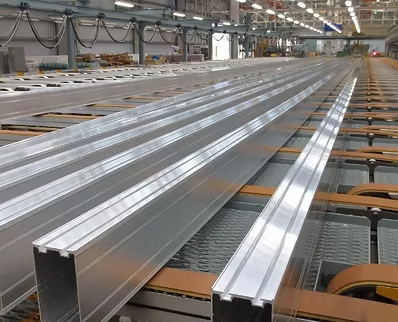
Custom aluminum extrusions are the largest volume of custom metal work coming out of Indonesia. This means designing a unique cross-section, having a steel die machined to produce that shape, and running production lengths through an extrusion press. Used for architectural profiles, industrial framing, heat sinks, transport components, and OEM applications.
Custom machined parts start with bar stock or billet and are machined to finished dimensions using CNC milling, turning, and grinding equipment. Higher tolerance than extrusion, but also higher cost.
Custom fabricated assemblies combine extruded, machined, and stamped components into welded or bolted assemblies. This is where conveyor frames, machine guards, equipment skids, and structural sub-assemblies come from.
Custom castings produce complex three-dimensional shapes through sand casting, die casting, or investment casting. The right choice when geometry can’t be achieved through extrusion.
Custom sheet metal work produces bent, formed, and welded sheet metal components for enclosures, panels, and ductwork.
For most international buyers, custom extrusion and the fabricated assemblies built from it represent the highest value category, because Indonesia’s extrusion capacity is among the most developed in the region.
How to Evaluate a Custom Metal Parts Factory in Indonesia
Beyond the basic real-factory checks, six specific capabilities tell you whether a manufacturer can handle serious custom work:
Die-making capability. A factory that designs and produces its own extrusion dies catches problems earlier, iterates faster on design revisions, and supports the kind of custom geometry that off-the-shelf profiles can’t match. Factories that outsource die-making add weeks to every project and have less control over the result.
Alloy chemistry control. Real custom work requires the ability to produce specific alloys to specific tempers. Factories that can verify chemistry through internal spectrometer analysis, rather than relying on supplier certificates, deliver more consistent material.
Dimensional tolerance capability. Standard extrusion tolerance is generally adequate for most fabrication work, but tight-tolerance custom parts require press equipment, die maintenance discipline, and post-extrusion straightening and machining capability that not all factories have.
Finishing range. In-house anodizing and powder coating eliminate transit damage risk and shorten lead times. Factories that outsource finishing lose control over the final surface quality and add weeks to delivery.
Custom packaging and logistics. Custom parts often need custom packaging to survive international transit. Factories experienced with export shipping understand crating, labeling, and customs documentation requirements that domestic-focused manufacturers don’t.
Communication discipline. A factory that responds to technical questions in days rather than weeks, in clear English, with answers from engineers, dramatically reduces the friction of international sourcing.
These six capabilities, combined with the real-factory signals above, separate the manufacturers worth working with from the ones who’ll consume your time and budget without delivering.
What Custom Manufacturing Looks Like at Exalum Metal
Exalum Metal Indo is an aluminum extrusion manufacturer based in Indonesia, operating a 20,000 m² vertically integrated facility since 2009. The vertical integration model means every step from billet preparation through extrusion, heat treatment, and in-house finishing is controlled under one roof, which is what allows us to support genuinely custom work rather than just resale of standard profiles.
The product range that comes out of our facility covers the major categories where extrusion is the right manufacturing process:
- Square Hollow and Rectangular Hollow for structural framing, machine bases, conveyor chassis, and welded assemblies
- Tubing Pipes and Decorative Tubing Pipes for railing systems, furniture, architectural details, and fluid transport
- Equal Angle, Unequal Angle, and Unequal Channel for brackets, cross-bracing, and structural connections
- Flat Bars and Round Bars for mounting plates, machined components, and precision spacers
- Heat Sinks exploiting aluminum’s high thermal conductivity for electronics, motors, and power systems
- Curtain Wall, Casement Windows, Doors, Sliding Doors, Door Jamb, and Windows Wall for architectural facade and fenestration work
- Louvers, Partition, Diffusers, and Spandrel for ventilated and modular construction systems
- Showcase, Handle, and Curtain Track for retail, residential, and interior applications
- Ladder, Rolling Doors, Shop Front, and Conveyor profiles for industrial and commercial installations
- Furniture and Automotive profiles for OEM and specialty fabrication
Beyond this range, we produce custom extrusions to client specifications, designing dies for unique cross-sections required by specific projects. The die-making, alloy control, extrusion, and finishing capabilities all sit inside our facility, which is what allows us to deliver custom work on realistic timelines.
Custom Manufacturing Lead Times and What to Expect
International custom metal parts work runs on longer timelines than domestic sourcing, and managing expectations is part of running a successful project. Typical lead times for custom aluminum extrusion from Indonesia:
- Die design and machining: 3 to 5 weeks
- First production trial: 1 to 2 weeks after die completion
- Production run: 2 to 4 weeks depending on volume
- Finishing (anodizing or powder coating): 1 to 2 weeks
- Packaging and ocean freight: 4 to 6 weeks to most international destinations
Total project timeline from approved drawing to delivered parts is typically 12 to 20 weeks. Faster is possible on simpler projects, slower on complex custom dies or large-volume production. Planning custom projects 4 to 6 months ahead of need date is the right cadence for predictable delivery.
Sourcing Custom Metal Parts From Indonesia With Confidence
The right Indonesian custom metal parts factory turns international sourcing from a procurement headache into a stable, predictable supply relationship. The wrong one wastes months and budget without delivering. The difference is usually the manufacturer’s vertical control, documentation discipline, and willingness to communicate technically.
Exalum Metal Indo has supplied custom and standard aluminum extrusion to international fabricators, OEMs, and construction contractors since 2009. The combination of vertical integration, in-house die-making, controlled alloy chemistry, and on-site finishing is what allows us to support serious custom work with realistic lead times and consistent quality.
Whether you need standard profiles or custom cross-sections designed for your specific fabrication requirements, Exalum Metal has the capacity and expertise to deliver.
Ready to discuss your custom project or request a quote on specific specifications? Get in touch with the Exalum Metal team directly:
Email: [email protected] WhatsApp: +62 811 9429 970 Website: www.exalummetal.com
Your next fabrication project deserves a manufacturing partner you can count on. Make Exalum Metal your sourcing standard for custom aluminum from Indonesia.