If you’ve ever looked up at the ceiling in a hospital, hotel, or open-plan office and noticed the slim aluminum track that carries curtains, room dividers, or modular partitions, you’ve seen L track doing its job invisibly. The same profile, in slightly different configurations, runs sliding doors, supports cubicle systems, and creates the modular flexibility that modern interiors depend on. It’s one of those products where most buyers don’t know what they’re looking at, but the spec details quietly decide whether the installation works smoothly for years or jams within months.
For fabricators, interior contractors, and procurement teams sourcing L track for commercial or residential applications, this article walks through what L track is, what it’s used for, and how to spec it so the system actually performs.
What Is L Track?
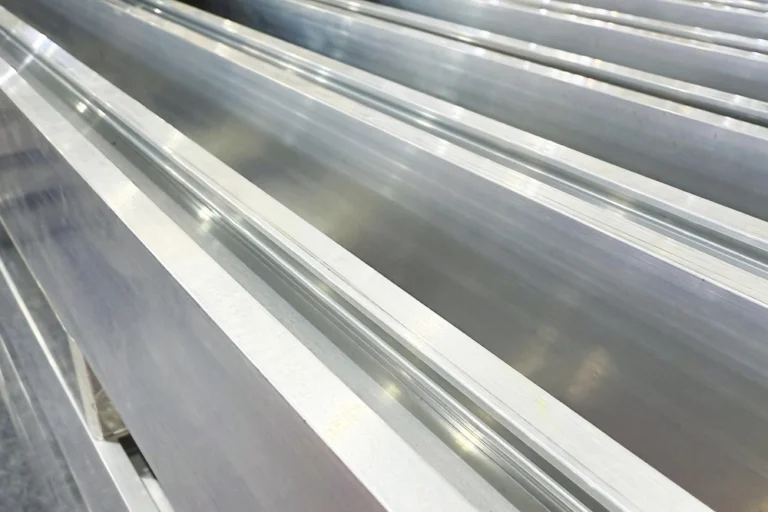
L track is an extruded aluminum profile shaped like the letter L when viewed in cross-section. The vertical leg fastens to a ceiling, wall, or structural member, while the horizontal leg forms a running surface that captures a slider, roller, hook, or carrier. The interlocking geometry between the L track and its carriers is what allows curtains, panels, doors, and partitions to slide smoothly along the track.
In practice, L track is rarely as simple as a plain L shape. Most production L track profiles include integrated features like inner channels that guide ball bearings, retention lips that prevent carriers from dropping out, and mounting flanges that simplify installation. The basic L is the foundation, but the engineering happens in the details.
How L Track Is Different From Other Track Profiles
Three track configurations compete for the same applications, and the differences matter:
L track has a single horizontal running surface with a vertical mounting flange. Used where the track is mounted to a flat surface (ceiling or wall) and only needs to support sliding motion in one direction.
U track has two parallel walls forming a U-shaped slot that captures the carrier from both sides. More secure than L track but harder to install and load with carriers.
C track has inward-returning flanges that lock carriers more firmly than L track while still allowing easy loading from the end of the track.
For most curtain, partition, and sliding door applications, L track strikes the best balance between installation ease, carrier capacity, and aesthetic clean lines. U and C track are reserved for heavier loads or higher-security applications.
The Major Applications for Aluminum L Track
L track shows up across a wide range of interior fabrication work:
Curtain track systems in hospitals, hotels, residential homes, and commercial buildings. Hospital curtain tracks alone are one of the largest single applications for L track globally, supporting privacy curtains and infection-control divisions across millions of patient rooms.
Modular partition and cubicle systems in offices, call centers, training facilities, and event venues. L track lets the partitions be reconfigured without rebuilding the room.
Sliding door systems for closets, wardrobes, room dividers, and storage. Top-hung sliding doors typically run on L track or its close relatives.
Stage and theater curtain systems where heavy stage curtains, scrims, and backdrops need smooth movement and reliable load support.
Retail display systems including movable mannequins, fixture rails, and product display tracks.
Architectural shading systems for sun blinds, light filtering panels, and seasonal screens.
Industrial curtain walls for warehouse partitioning, cold storage rooms, dust containment, and workspace separation.
Modular wall systems in trade show booths, conference centers, and adaptive interior environments.
Each application has its own load profile, carrier type, finish requirement, and installation context, which is why L track is rarely a single off-the-shelf product but rather a family of profiles optimized for specific use cases.
How to Specify L Track Properly
Five details separate L track that performs well from L track that disappoints:
Alloy and temper. 6063-T5 is the standard for architectural L track. It extrudes cleanly into the precise inner channel geometry needed for smooth carrier movement, finishes well under anodizing, and provides adequate strength for typical loads. For heavier applications like stage curtains or industrial partitions, 6063-T6 or 6005A-T5 add load capacity.
Load capacity. L track is rated by weight per linear meter, and the rating depends on the wall thickness, carrier type, and mounting interval. Light curtain tracks handle 10 to 25 kg per meter. Medium-duty partition tracks handle 50 to 100 kg per meter. Heavy stage and industrial tracks handle 200 kg or more per meter.
Inner channel dimensions. The running surface inside the track has to match the carrier system you’re using. Mismatched dimensions cause jams, premature wear, and noisy operation. Specify either a brand-specific track designed for a known carrier system, or a custom track with documented inner channel dimensions.
Surface finish. Mill finish is acceptable for hidden installations. Clear anodizing is the standard for visible interior work, providing scratch resistance and a clean architectural appearance. Powder coating in matching ceiling or wall colors helps the track disappear visually.
Mounting method. Ceiling-mounted with surface fasteners, recessed into a drop ceiling, suspended from threaded rods, or wall-mounted with brackets. The L track profile should match the mounting context. Some tracks include integrated mounting slots that simplify installation.
These five elements turn a generic “L track” spec into something the manufacturer can actually produce correctly.
What to Look For in a Quality L Track Supplier
L track is a deceptively simple product where small manufacturing details have outsized consequences. Three things matter most:
Inner channel consistency. The running surface inside the track has to be dimensionally precise across the entire length. Variation of even half a millimeter causes carriers to bind, jump, or skip. Suppliers with poor extrusion control deliver tracks that work in some sections and fail in others.
Straightness. A track that arrives bowed or twisted will not run carriers smoothly. Good extrusion practice and proper stretching after extrusion produce tracks that lie flat and run true.
Surface finish quality. Visible interior tracks need finish quality that matches the architectural intent of the space. Mill marks, die lines, and pickup defects all become more visible after anodizing, not less. Working with a manufacturer who controls surface quality from extrusion through finishing produces tracks that look intentional rather than industrial.
Suppliers who can deliver all three consistently are the ones worth long-term relationships.
Exalum Products for L Track and Track System Applications
The product range from our 20,000 m² vertically integrated facility in Indonesia includes the profile categories relevant to L track and track-based fabrication work:
- Curtain Track as a dedicated product category covering L track, U track, and related profiles for curtain, drape, and partition installations
- Sliding Doors profiles including the tracks and channels that support top-hung and bottom-running sliding door systems
- Partition profiles for modular partition and cubicle systems where L track integrates with vertical wall framing
- Unequal Channel profiles for custom track applications where the L geometry needs to be adapted to specific carrier systems or mounting requirements
- Equal Angle and Unequal Angle for bracket connections, mounting hardware, and corner connections in track systems
- Tubing Pipes for vertical supports, suspension rods, and structural framing of track installations
- Flat Bars for mounting plates, splice connectors, and adjustment hardware
- Decorative Tubing Pipes for visible track installations where aesthetic appeal matters as much as function
- Showcase profiles for retail display tracks and movable fixture systems
- Door Jamb and Windows Wall for door framing systems that integrate with sliding track installations
Beyond standard L track profiles, custom extrusions to designer or system-specific dimensions cover the unique track requirements that off-the-shelf catalog products can’t meet. Die design, alloy chemistry, extrusion, and in-house anodizing or powder coating all happen inside our facility, which keeps custom track projects moving on realistic timelines.
Finishing Options for L Track
Visible L track installations almost always specify a finish, and the choice affects both appearance and durability:
Clear anodizing is the standard finish for interior architectural L track. The natural aluminum appearance integrates with most interior color schemes, and the hard anodic layer protects the running surface from wear caused by carriers passing thousands of times.
Color anodizing in bronze, black, or champagne tones is specified when the track needs to match dark architectural elements or contemporary interior design schemes.
Powder coating in any RAL color is the choice when the track needs to color-match ceiling tiles, wall paint, or specific brand color schemes. Powder coated finishes also provide thicker protective layers for high-traffic installations.
Mill finish is acceptable when the track is hidden inside ceiling cavities or behind cornices.
In-house finishing means the L track arrives with the specified finish quality intact, without the transit damage that often occurs when extrusion and finishing are split between separate suppliers.
Sourcing L Track With Confidence
The right L track installation looks like it isn’t there. Carriers run silently, partitions move smoothly, and the system works for years without maintenance. The wrong L track produces installations that bind, squeak, jump, and frustrate users until someone replaces the whole system. The difference comes down to extrusion quality, dimensional consistency, and finishing discipline.
Exalum Metal has supplied aluminum L track, curtain track, sliding door track, and related profiles to fabricators, interior contractors, and architectural integrators since 2009. The vertical integration that keeps alloy chemistry, extrusion tolerance, and surface finish consistent across batches is what produces tracks that work the way they’re supposed to.
Whether you need standard profiles or custom cross-sections designed for your specific track system requirements, Exalum Metal has the capacity and expertise to deliver.
Ready to discuss your L track requirements or request profile samples? Get in touch with the Exalum Metal team directly:
Email: [email protected] WhatsApp: +62 811 9429 970 Website: www.exalummetal.com
Your next track installation deserves material you can count on. Make aluminum L track from Exalum Metal your standard.