
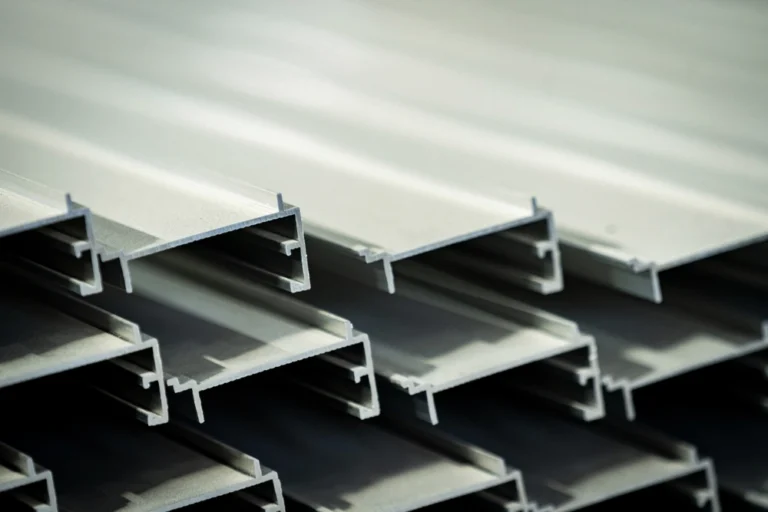
If you walked into any fabrication shop and pulled the most-used profile off the rack, odds are it would be aluminum angle. It braces, it frames, it trims, it reinforces, it mounts. The simple L-shaped cross-section turns out to solve more problems than almost any other extrusion, which is why it shows up in everything from machine frames to picture frames. The challenge isn’t finding a use for it. It’s choosing the right version, because angle comes in more variations than most buyers realize.
For fabricators, builders, and anyone specifying angle for a project, here’s how to pick the right profile, the right alloy, and the right size for the job in front of you.
What Aluminum Angle Actually Is
Aluminum angle is an extruded profile with two legs meeting at a 90-degree corner, forming an L when you look at the end. That corner is what makes it useful. The right angle resists bending in two directions at once, which is why angle is the go-to profile anywhere two surfaces meet, anywhere an edge needs reinforcing, and anywhere a bracket has to hold something at a right angle.
Because it’s extruded rather than bent from sheet, aluminum angle has a consistent cross-section, sharp or radiused inside corners depending on the die, and uniform wall thickness along its full length. That consistency is what separates extruded angle from formed sheet angle, and it matters anywhere the part has to fit precisely or carry a predictable load.
Equal Angle Versus Unequal Angle
The first real decision is whether you need equal or unequal legs, and the two serve genuinely different purposes.
Equal angle has two legs of the same length, like 25mm by 25mm or 50mm by 50mm. It’s the symmetrical workhorse, used wherever the load or the geometry is balanced between the two faces. Corner trim, square framing, general bracketry, and most bracing applications use equal angle because there’s no reason to favor one leg over the other.
Unequal angle has one leg longer than the other, like 50mm by 25mm. The longer leg gives more surface for fastening or more depth for stiffness in one direction, while the shorter leg keeps the profile compact in the other. This matters when one face needs to mount to a wide surface while the other just needs to cap an edge, or when the load is heavier in one direction than the other. Shelf supports, asymmetric brackets, and panel edge framing often call for unequal angle.
Picking the wrong one usually shows up as either wasted material, when an equal angle’s second leg is bigger than the job needs, or a poor fit, when an unequal angle’s geometry doesn’t match the surfaces it has to join.
Why Aluminum Angle Instead of Steel
Steel angle is stronger per unit cost, so the reasons to choose aluminum come from everywhere else.
Weight is the obvious one. Aluminum angle weighs roughly a third of steel, which makes it easier to handle, cheaper to ship, and lighter on whatever structure it’s attached to. For overhead work, portable assemblies, and transport applications, that weight saving is decisive.
Corrosion resistance is the other major driver. Aluminum forms a protective oxide layer that keeps working even at cut edges, so it survives outdoor, humid, marine, and chemical environments where steel angle would rust and need painting. There’s no galvanizing to scratch through and no touch-up paint to apply at every cut.
Workability rounds it out. Aluminum angle cuts, drills, taps, and machines cleanly with standard tools, and it takes anodizing and powder coating beautifully for applications where appearance matters. For visible architectural work, that finish quality is often the deciding factor.
Choosing the Right Alloy and Temper
Two alloy families cover the vast majority of aluminum angle in use, and the choice between them comes down to what the angle has to do.
The 6063 alloy, usually in T5 temper, is the architectural and general-purpose choice. It extrudes cleanly into precise profiles, finishes smoothly under anodizing, and carries enough strength for trim, light framing, and most non-structural work. When the angle will be visible or anodized, this is usually the right call.
The 6061 alloy in T6 temper is the structural choice. It carries significantly more load, handles welding better, and stands up to the stresses of real structural framing, machine bases, and load-bearing brackets. When the angle has to hold weight or take stress, 6061-T6 is the safer specification.
Specifying the alloy and temper matters as much as specifying the size, because the same dimensions in a different alloy behave very differently under load.
How Angle Is Sized and Specified
A complete angle specification comes down to a few numbers:
Leg lengths define the overall size, given as the length of each leg. For equal angle that’s a single dimension repeated; for unequal angle it’s two different numbers.
Wall thickness sets the strength and weight. Thicker walls carry more load and resist bending, but add weight and cost. The thickness should match the load, not default to the heaviest option.
Length is usually supplied in standard mill lengths, commonly around 6 metres, with cut-to-length services available to reduce waste and shop labor.
Finish ranges from mill finish for hidden or industrial work, through clear and color anodizing for visible architectural applications, to powder coating where specific colors are needed.
The combination of those four, plus the alloy and temper, fully describes the angle a project needs.
Where Aluminum Angle Earns Its Place
The applications are almost too broad to list, but they cluster into a few categories:
Structural framing uses angle for machine frames, equipment supports, mezzanine bracing, and the countless right-angle connections that hold structures together.
Trim and edge protection uses angle to cap and protect the exposed edges of panels, counters, steps, and millwork.
Bracketry and mounting relies on angle to attach components, hang equipment, and create the connection points that assemblies depend on.
Architectural work uses anodized angle for corner detailing, frame edges, and the clean visible lines that finish a building or interior.
Reinforcement adds angle to strengthen panels, stiffen long spans, and add rigidity wherever a flat surface needs backbone.
Marine and outdoor construction specifies aluminum angle wherever corrosion would defeat steel, from boat fittings to coastal railings.
Each of these draws on the same simple geometry, just sized and finished for the demands of the specific job.
The Quality That Separates Good Angle From Bad
Angle looks like the simplest profile there is, which is exactly why poor quality slips through unnoticed until it causes a problem. Three things separate angle worth buying from angle that frustrates:
A true 90-degree corner is not guaranteed. Angle that’s extruded or handled poorly can come out slightly open or closed at the corner, which throws off every joint and bracket made from it. Consistent angular accuracy across the full length is the first mark of quality.
Straightness matters along the length. An angle that bows or twists won’t lie flat or fasten cleanly, and the error compounds across a long run.
Consistent wall thickness and alloy chemistry determine whether the angle meets its rated strength. Variation in either one produces angle that tests fine on a short sample but underperforms when it’s loaded in service.
These come down to the extrusion control at the manufacturer, which is why the source of the angle matters as much as the spec written on the order.
How This Connects to Exalum
Equal and unequal angle are core profiles in the Exalum range, produced on the same vertically integrated process that governs every profile leaving the facility. The 20,000 m² plant in Indonesia handles alloy preparation, extrusion, and heat treatment as one continuous chain, which keeps the corner accurate, the lengths straight, and the temper reliable, the three things angle depends on most.
The angle profiles sit within a broader catalog that covers most fabrication needs:
- Equal Angle for balanced bracing, corner trim, and symmetrical framing
- Unequal Angle for asymmetric brackets, shelf supports, and edge framing where one leg does more work
- Unequal Channel for edge capture and channel-mounting alongside angle work
- Square Hollow and Rectangular Hollow for closed-section structural framing
- Flat Bars and Round Bars for plates, spacers, and machined connections
- Tubing Pipes for railings and tubular framing that combines with angle bracketry
- Curtain Wall, Doors, and Casement Windows for architectural work where angle handles the corner and edge detailing
For projects that need a specific leg ratio, wall thickness, or finish that standard sections don’t cover, angle can be extruded to custom dimensions rather than forcing a design to fit stock sizes.
Specifying Angle With Confidence
Aluminum angle rewards getting the basics right. Match equal or unequal to the geometry, pick the alloy to the load, size the wall thickness to the demand, and source from a manufacturer whose corners are true and whose temper is honest. Do that, and the most versatile profile in the shop does exactly what you need it to, in framing, in trim, in brackets, and in reinforcement, for the full life of the project.
Exalum Metal has supplied angle and structural extrusions to fabricators, builders, and manufacturers since 2009, with the dimensional accuracy and temper consistency that precise fabrication requires.
Whether you need standard profiles or custom cross-sections designed for your specific requirements, Exalum Metal has the capacity and expertise to deliver.
Ready to discuss your project or request material specifications? Get in touch with the Exalum Metal team directly:
Email: [email protected] WhatsApp: +62 811 9429 970 Website: www.exalummetal.com. When the corner has to be true and the metal has to hold, start with angle you can trust. Make Exalum Metal your standard.